Share your photos by tagging us and using the hashtag #BigGreenEgg.
Want to see how the EGG is made? Click to Watch
I honestly don’t know where to post this.
Comments
-
Yesterday's blurb from HCR gives a history of what happened in the US immediately following the Civil War, and ties it into today. Fascinating and kinda scary (again).
On the evening of April 14, 1865, President Abraham Lincoln and First Lady Mary Todd Lincoln went to Ford’s Theater in Washington, D.C., to see a production of the comedy Our American Cousin. The Lincolns had spent the afternoon taking a carriage ride together and discussing the future, including the travel they hoped for, to Europe and to California to see the Pacific Ocean.
One of the last men to speak with the president before he left for the theater said it seemed the cares of the previous four years were melting away. The Confederacy was all but defeated, and the nation seemed to be on its way to a prosperous, inclusive new future.
The very heavens seemed to reflect the dawn of a new era. Poet Walt Whitman noted that after months of fog and clouds, the weather had cleared. “The western star, Venus, in the earlier hours of evening, has never been so large, so clear,” he wrote. “It seems as if it told something as if it held rapport indulgent with humanity, with us Americans.”
When the Lincolns and their guests arrived at the theater at about 8:30, the people in the audience leaped to their feet to applaud and the actors stopped the production while the orchestra played “Hail to the Chief.” About a half-hour later, the president felt chilly and put on his overcoat but was clearly relaxed and enjoying the play. Shortly after 10:00 the Lincolns were holding hands, and Mrs. Lincoln worried their public affection would scandalize the young Clara Harris, daughter of New York senator Ira Harris, who shared their box with her fiance, Major Henry Rathbone. Mrs. Lincoln whispered to her husband that she wondered what Clara would think of them holding hands, and Lincoln answered: “She won’t think anything about it.”
They would be the last words he ever spoke. On the stage, the play had just reached its best joke, and as the audience roared with laughter, actor John Wilkes Booth entered the presidential box and shot Lincoln in the head, then slashed Rathbone’s arm as the officer tried to stop him from getting away. He jumped to the stage, breaking his leg, and shouted the state motto of Virginia, “Sic Semper Tyrannis,” thus always to tyrants.
As Booth escaped, news spread that Secretary of State William Henry Seward had also been attacked, and in the days to follow, the euphoria of the last days of the war gave way to grief. The windows in Washington, D.C., were hung with black garlands. And then the rain came back. In New York City, Whitman wrote in his diary: “Lincoln’s death—black, black, black—as you look toward the sky—long broad black like great serpents slowly undulating in every direction—New York is distinguished for its countless gay flags—every house seems to have a flag staff—on all these the colors were at half mast.”
At first, Americans wanted revenge against the men who had slain their president. After a two-week investigation in which they questioned hundreds of people, investigators identified ten people they believed responsible for Lincoln’s death. Booth himself had been killed on April 26 as officers tried to take him into custody. Another conspirator had fled the country. The other eight stood trial for seven weeks before a military commission in May and June 1865. Four were sentenced to death by hanging; four were imprisoned.
But while Americans mourned Lincoln, the new president, Andrew Johnson, restored the political power of Confederates. On May 28, he issued a blanket pardon for most former Confederates except certain leaders and wealthy southern planters. Those he said could apply to him directly for a presidential pardon, which he promised would be “liberally extended.” They were. By December 1865 he had pardoned all but about 1,500 former Confederate leaders.
At the same time, Johnson either looked the other way or cheered as southern state legislatures passed Black Codes, laws that worked to push Black Americans back into subservience. Congress had adjourned in March 1865, the day of Lincoln’s second inauguration, and Johnson refused to call it back into emergency session after Lincoln’s death. When it convened in December, Johnson told the congressmen that Reconstruction was over. Northern congressmen simply had to seat newly elected southern congressmen—some of whom had led the Confederacy less than a year before—to end the unpleasantness of the war years.
Congress fought back, trying to protect the principles for which Lincoln had died, but with no accountability for a war that had left 620,000 Americans dead and cost more than $5 billion, the ideas of the Confederacy never became odious. Former Confederates still talked to newspapermen, gave speeches, ran for office, and garnered support.
By the 1870s, after the establishment of the Department of Justice meant that discrimination based on race could result in federal charges, former Confederates switched their rhetoric from race to economics. Because most Black men were impoverished, their votes for roads and schools and hospitals translated into tax levies on white men with property. Former Confederates argued that Black voting was just a redistribution of wealth from white taxpayers to Black Americans, a form of socialism.
That rhetoric appealed to northern Americans who worried about immigrants voting in cities. Increasingly, they listened as former Confederates began to argue that their fight had not been to spread human enslavement—despite their many declarations saying exactly that—but to preserve individualism from a grasping federal government.
By the 1890s, towns not only across the South but also in the North and West were putting up statues of Confederate soldiers as symbols of true America.
In the 1930s, with the southern economy dependent on New Deal programs from the federal government, Confederate iconography fell out of sight, but it sprang back to popularity after President Harry S. Truman, a Democrat, ordered the integration of the U.S. military in 1948. That year, the Democratic Party split in two as half of the party followed Truman and half refused. Southern racists under then–South Carolina governor Strom Thurmond—who had fathered the child of his family’s teenaged Black housekeeper in 1925—formed the segregationist States Rights Democratic Party, called “Dixiecrat” in a play on the South’s nickname, and took the Confederate battle flag as their party flag.
The ruling of a unanimous Supreme Court that racial segregation in the public schools was unconstitutional in the May 1954 Brown v. Board of Education of Topeka, Kansas, decision resurrected Confederate ideology more widely. In Georgia the Ku Klux Klan had reformed near Stone Mountain outside of Atlanta in the early twentieth century, and the United Daughters of the Confederacy set out to create a giant carving of Confederate leaders on the side of the mountain. The plan had been abandoned by 1928 as interest in the project waned, but it was reborn after Brown v. Board. Vice President Spiro Agnew dedicated the monument, which features Confederate leaders Jefferson Davis, Robert E. Lee, and Stonewall Jackson, in May 1970.
The idea that those embracing the iconography of the Confederacy were simply defending individual liberty against an overreaching government became an article of faith among the radical right, especially as the Republican Party complained that the taxes necessary to run a modern government that included everyone were promoting socialism.
Former Army gunner Timothy McVeigh wrote to a newspaper in 1992, saying: “Taxes are a joke. More taxes are always the answer to government mismanagement…. Is a Civil War Imminent? Do we have to shed blood to reform the current system? I hope it doesn’t come to that. But it might.”. Three years later, McVeigh set off a bomb at the Alfred P. Murrah Federal Building in Oklahoma City, Oklahoma, killing 168 people, including nineteen children younger than six, and wounding more than 800 others. When captured, he was wearing a T-shirt with a picture of Abraham Lincoln and the words “Sic Semper Tyrannis.”
In 2009, Elmer Stewart Rhodes, a lawyer and former paratrooper who had been a staffer for Representative Ron Paul (R-TX), started a right-wing gang called the “Oath Keepers.” Claiming to take their inspiration from the patriots who stood against the British regulars on Lexington Green in 1775, they pledged to stand against what they considered a tyrannical government.
In 2021, Rhodes and the Oath Keepers, along with the right-wing Proud Boys, were part of the planning and execution of the January 6 attack on the U.S. Capitol when they tried to stop the counting of the electoral votes that would make Democrat Joe Biden president. Biden had won both the electoral vote and the popular vote by more than 7 million votes, but the insurrectionists wanted their own leader, President Donald Trump, to stay in office. One of the rioters accomplished what the southern troops during the Civil War had never been able to: he carried the Confederate flag into the United States Capitol.
In November 2022 a federal jury convicted Rhodes of seditious conspiracy for using force and violence to try to stop the process of the democratic election of a president. Juries found at least a dozen other Oath Keepers guilty of seditious conspiracy or other serious crimes.
As soon as he retook office in 2025, Trump issued a sweeping pardon to the participants in the January 6 attack who had been convicted of crimes, including the crimes of using a deadly weapon and causing serious bodily injury to an officer, removing accountability for their attempt to overturn the nation’s democratic process and releasing them back into the streets. At the time, he commuted the sentence of fourteen of the leading Oath Keepers and Proud Boys, ending prison sentences that had been as long as 22 years.
Because he did not pardon those leaders, but commuted their sentences, their cases continued to work their way through the appeals court. Yesterday the Department of Justice moved to wipe out the seditious conspiracy convictions altogether. “The United States has determined in its prosecutorial discretion that dismissal of this criminal case is in the interests of justice,” Assistant U.S. Attorney Daniel Lenerz of the U.S. Attorney’s Office in Washington, D.C., wrote.
Exactly 161 years before, on the night of April 14, 1865, bystanders at Ford’s Theater had carried the grievously wounded Lincoln to a boardinghouse across the street, where members of his Cabinet crowded around his bed. At 7:22 on the morning of April 15, 1865, President Abraham Lincoln breathed his last. His secretary of war, Edwin Stanton, stood heartbroken by the bedside of the man who had tried to preserve American democracy and said, “Now he belongs to the ages.”
When he tried to put his own loss, and that of the nation, to poetry, Walt Whitman thought back to the heady days of Spring 1865 when the heavens themselves seemed to promise a glorious democratic future, and their contrast to what came after.
“When lilacs last in the dooryard bloom’d,” he wrote, “And the great star early droop’d in the western sky in the night,
“I mourn’d, and yet shall mourn with ever-returning spring.”
Counting to ten only makes it Premeditated.
Ogden, UT, USA
-
A shout-out to WH Correspondent for PBS Newshour, Ms. Liz Landers. She was attending the WHCD Saturday night, was told by the authorities that trump had been whisked to the WH, and was going to be giving a presser "in 30 minutes". Landers wanted to cover it, the streets throughout DC were locked down, so she rented a scooter:
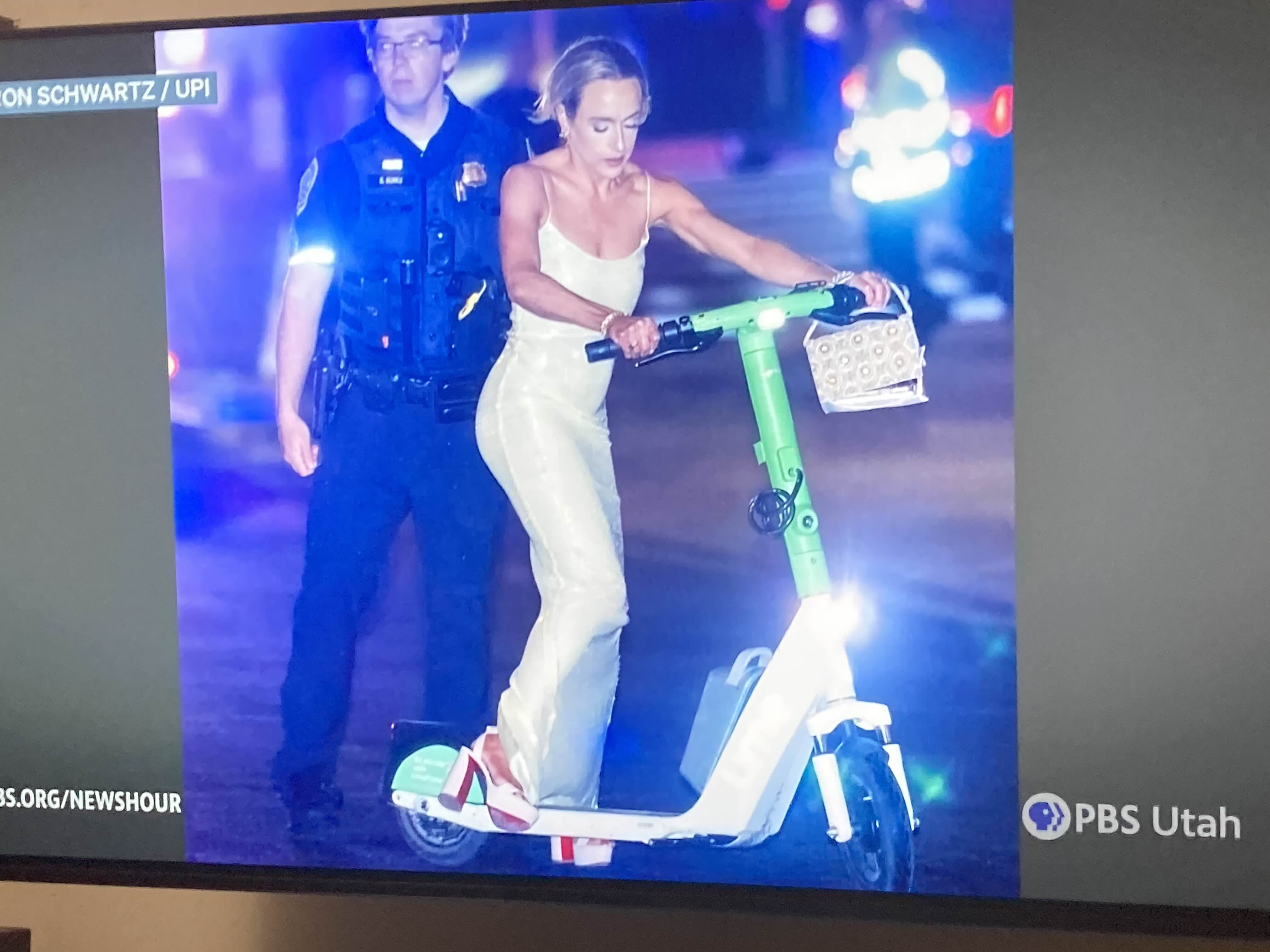
...and apparently the sidewalks were not blocked off. She was able to get to her apartment (in heels!), grab her WH press credentials, and make it to the WH before the presser began. Kudos to her, and that'll be a nice pic in her resumé portfolio.
EDIT: Oh, and Apple: it'd be great for you to add the ability to grab a screenshot from your AppleTV box, to upload to our iCloud thingie; just an idea.
Counting to ten only makes it Premeditated.
Ogden, UT, USA
-
Ukraine's $2K drones are wiping out Iran's Shahad $50K drones, and both UAE and the US are very interested:
 https://youtu.be/CVcy3sbF6ng?si=6yZENtGuFvpBP0Or
Here and there throughout my AF career I've been involved with DARPA, the Defense Advanced Research, ahh, something-something. They awarded small- to medium-sized research grants to advanced/future weaponry, for "tomorrow's wars" rather than the present. Just as I was retiring six years ago there were rumblings about laser systems being used to shoot down drones; this was an excellent idea for ground- and ship-based weapon systems, as:
1) their heavy power supply weight could be supported on the ground and on ships (aircraft, not so much)
2) good range, and with the right electronics, excellent response time,
3) rapid target acquisition/kill times (using automated radars and aiming) as the "laser shot" doesn't need much time to take out a tiny target, and it sounded like a good way to take out a "swarm" of drones efficiently (ie, a rapid "pew-pew-pew!").
I would be curious to see what the status quo is right now; I haven't seen much of anything on the daily Early Bird.
EDIT: Heh, I asked Siri what "DARPA" stood for and she replied:"To listen to Apple Music, you'll have to agree to the Terms and Conditions agreement"
Counting to ten only makes it Premeditated.
Ogden, UT, USA
-
From Robert Reich, yesterday:
Stephen Colbert’s last show is this Thursday evening.CBS refused to renew his contract, and you know exactly why: He mocked and criticized Trump.CBS says it’s ending “The Late Show” because the show was costing CBS some $40 million a year. That’s utter bullsh*t. Colbert allowed CBS to charge higher fees to local affiliates, because it attracted millions of viewers to those affiliates’ 11 p.m. news programs in anticipation of “The Late Show” airing right after. The show was also a promotional gold mine for CBS, whose series stars were often interviewed by Colbert. No wonder CBS was “feverish” to lock Colbert into a new contract only three years ago.What really happened couldn’t be clearer. Führer Trump was furious at Colbert’s mocking and publicly called for CBS to cancel him (or “put him to sleep NOW” as Trump wrote in one social media post). At the same time, CBS’s parent company, Paramount, was on the verge of a lucrative merger deal that Trump could interfere with.Paramount had already sucked up to Trump by offering him $16 million to settle a lawsuit he brought against CBS News’s “60 Minutes,” although he had almost no chance of prevailing in court.In a monologue, Colbert called the settlement a “big fat bribe,” which it was. Days later he got word he’d been canceled. About a week after that, the deal was approved.***Before Colbert started at CBS, he hosted Comedy Central’s “The Colbert Report,” where he played a right-wing, blowhard, curmudgeonly TV host.I was often a guest, presumably because I was a good foil for the blowhard Colbert was acting. (I’ve also been a guest on his “The Late Show.”)The first time I came to do “The Colbert Report,” I was nervous. I didn’t know how to respond to someone who’d be acting as a conservative **** but wasn’t one in real life.I was sitting alone in the greenroom when Colbert popped in. He introduced himself, sat down, and then, smiling, said, “Just wanted to warn you that I play a real jerk out there.”“Oh, I know,” I said. “I’ve watched the show.”“Good. Don’t argue with me. Just play along,” he counseled.“I’ll try not to argue,” I said. “But I go on so many of these combative shows that I may automatically start arguing.”Colbert laughed. “That’s fine. Just let me do the heavy lifting. I’ll be so obnoxious that viewers will see the wisdom in your argument!”“Sounds good,” I said, still nervous.“Just have fun!” Colbert advised, before vanishing to his set.Colbert was anything but a right-wing jerk. In fact, as I’ve come to know him over the years, he’s remarkably self-effacing and wicked smart. He’s progressive in his politics, of course, but never dogmatic. Even when he skewers Trump on his “The Late Show,” he does it with gentle humor and no trace of anger or bitterness.I’ve done many thousands of interviews over my adult life. Some interviewers, like the late Bill Moyers, have been so thoughtful and well-prepared that I’ve barely had to think; I just fall into a natural conversation with them. Others are so stilted or slick that they hardly listen to what I say, and the interview has the tortuous feel of gears grinding from one topic to another.Colbert is like Moyers in being well-prepared and listening intently. But he adds a rapid-fire wit that can make a serious point while putting an audience in stitches.When Colbert interviewed me last August about my latest book, CBS had just announced that his contract wouldn’t be renewed and that by late May the show would be off the air for good.A stagehand met me at the side door to the old Ed Sullivan Theater. As he led me to the greenroom, I asked him how everyone there was taking the news.“Not well,” he said. After a pause he said, “We’re like a family here.”Some time later, Stephen came by the greenroom. I asked him how he was doing. “Oh, I’m fine,” he said. “I’ll find something else to do. But there are about a hundred people here who will be out of jobs, and frankly I’m worried about them.”They are like a family — Stephen Colbert, his executive producer, the segment producers and directors, showrunners, writers, cameramen, gaffers, grips, lighters, stagehands, custodians, musicians. Stephen has treated them like a family. His respect and concern for them is unusual in the business but consistent with the courtesy and kindness I discovered the first time I met him.In sharp contrast is the way CBS and Paramount’s new owners, Larry and David Ellison, have treated Colbert and all those who have made “The Late Show” such an important part of our entertainment and political firmament.Behind the Ellisons lurks Trump, who treats everyone like **** except strongmen he can’t control such as Vladimir Putin and Xi Jinping.After this Thursday’s show, the Ed Sullivan Theater will go dark, and we’ll lose one of the nation’s funniest and most courageous, truthful, and gentlemanly critics of Trump and his lawless regime. Our society and democracy will be the worse for it.Farewell, and thank you, Stephen.Counting to ten only makes it Premeditated.
Ogden, UT, USA
-
.i don’t think I’ve ever watched the late show👀fukahwee maineyou can lead a fish to water but you can not make him drink it
-
Counting to ten only makes it Premeditated.
Ogden, UT, USA
-
Counting to ten only makes it Premeditated.
Ogden, UT, USA
-
Cheers to Lindsey Graham for being the one Republican who found out where Mitch McConnell was and actually went there.
"I've made a note never to piss you two off." - Stike
"The truth is, these are not very bright guys, and things got out of hand." - Deep Throat


Categories
- All Categories
- 184.1K EggHead Forum
- 15.8K Forum List
- 460 EGGtoberfest
- 1.9K Forum Feedback
- 10.4K Off Topic
- 2.2K EGG Table Forum
- 1 Rules & Disclaimer
- 9K Cookbook
- 13 Valentines Day
- 93 Holiday Recipes
- 224 Appetizers
- 520 Baking
- 2.5K Beef
- 88 Desserts
- 167 Lamb
- 2.4K Pork
- 1.5K Poultry
- 33 Salads and Dressings
- 324 Sauces, Rubs, Marinades
- 548 Seafood
- 175 Sides
- 122 Soups, Stews, Chilis
- 44 Vegetarian
- 102 Vegetables
- 313 Health
- 292 Weight Loss Forum