Share your photos by tagging us and using the hashtag #BigGreenEgg.
Want to see how the EGG is made? Click to Watch
Lump Trivia ... Crusin' at 250

Here's a graph of the data with a best fit line for the nerds:

If we round off some of the numbers from the best fit line, then we can conclude that it takes approximately 2/3 of a pound of lump to warm up the egg to 250 degrees and then shut it down. Once it's warmed up and is percolating along, it's burning approximately 1/3 of a pound of lump per hour.
If we assume that half the warm-up-cool-down lump is used to warm up the egg (1/3) pound, and there is 1-1/3 pounds left when the fire goes out (previous thread), we have 8-1/3 pounds left from a 10 pound (to the bottom of the notches) fill. That equates to a 25 hour cook at 250 degrees. Fill to the top of the fire ring and the cook time will drop to about 10 hours. Fill to the top of the KAB and the cook time will drop to about 4 hours!
One observation: Although the data suggests that you can cook for 25 hours on a 10 pound fill, you will be lucky to achieve that without an intervention at about the 15 hour point ... wiggle stick and leveling of the lump would be helpful.
Washington, IL > Queen Creek, AZ ... Two large eggs and an adopted Mini Max
Comments
-
When you are weighing used lump, how do you distinguish between ash (unusable), fines (which still have burn potential), and partially burned lump (which may have potential to produce heat that isn't consistent with its weight, depending on how burned it is) ?
NOLA -
@buzd504 ... I tried to take the data in a "this is how I cook" manner. Thus, I used the KAB to shake out the ash and any lump that would fall through the basket. I also used a KAB to weed out the fines and small pieces when loading the egg out of a fresh bag of lump. I would argue that the amount of energy in any fines or small burnt pieces is a small variable.
There are other variables affecting the consumption of BTUs more than fines. How much protein is on the grill? I had one rack of ribs for the 6 hr test and one pork butt for the 17 hr test. Had I cooked a half dozen of each, then the lump per hour value would have been higher and overshadowed the BTUs lost through the KAB.
Thanks for the question ...
Washington, IL > Queen Creek, AZ ... Two large eggs and an adopted Mini Max
-
This screams for 1 more test around 12hrs. Regardless, I love this kind of stuff. Good work!
Btw...did you start with the approx the same amount of lump each time?North Pittsburgh, PA
1 LGE -
@chadpsualum ... the one hour cook was nominally 6 pounds, but the other two were nominally 10 pound cooks. They're nominal fills 'cuz I had to account for the smoke wood that was used. Converted the weight of smoke wood to BTUs and then converted the BTUs back to an equivalent amount of Rockwood lump. Turns out that adjusting the fill numbers didn't change the final numbers from the curve that much.
Washington, IL > Queen Creek, AZ ... Two large eggs and an adopted Mini Max
-
theres also the factor of direct verse inderect, i did an overnight butt cook raised grid direct once and it burned very little lump. maybe 2/3 less
fukahwee maineyou can lead a fish to water but you can not make him drink it -
always wondered how much more gets burned with a controller verse just doing it manually
fukahwee maineyou can lead a fish to water but you can not make him drink it -
@fishlessman ... forgot to mention that variable. I used an AR rig with the oval stone, oval drip pan, and one grill.
Why do you think direct vs indirect affects lump usage?
Washington, IL > Queen Creek, AZ ... Two large eggs and an adopted Mini Max
-
Heat retention of the platesetter?Jeepster47 said:@fishlessman ... forgot to mention that variable. I used an AR rig with the oval stone, oval drip pan, and one grill.
Why do you think direct vs indirect affects lump usage?North Pittsburgh, PA
1 LGE -
Got to laugh about that question. I though I had all the variables in hand before taking the first data point. Turned out that lump in an egg is a true Pandora's box. Every time I had one variable accounted for a couple more popped up to consider.fishlessman said:always wondered how much more gets burned with a controller verse just doing it manually
Your question is a good one ... that I don't know the answer to. If you set up the controller like @stlcharcoal does - where the controller comes on only once in awhile - then the answer is probably they are the same. If you set it up like I do - fan running around 20~30% of the time - then more air cool air is forced into the egg, is heated up to temp, and then vented to the outside. That would suggest that lump usage with the controller is higher ... but, how much?
Washington, IL > Queen Creek, AZ ... Two large eggs and an adopted Mini Max
-
Okay, but that's an extremely small about of BTUs to heat it up ... and once at temp, it should not require extra BTUs to keep it at temp. Yes/no?chadpsualum said:
Heat retention of the platesetter?Jeepster47 said:@fishlessman ... forgot to mention that variable. I used an AR rig with the oval stone, oval drip pan, and one grill.
Why do you think direct vs indirect affects lump usage?
Washington, IL > Queen Creek, AZ ... Two large eggs and an adopted Mini Max
-
it either does something to the heat flow or its reflecting the heat down into the pit, i did a large cook once with an oversized stone in the large once, had a dome of around 200 and looking down there was a 1000 degree inferno under the stone. ive also had some neat effects using a round bottom deflector where i could get the dome hotter than the stone, actually had a blue flame hovering in the dome over the stone, broiler effect. direct verse inderect, the direct wins out large, but you need to start with very little lump and raise the grid as high as possible. heres a visualJeepster47 said:@fishlessman ... forgot to mention that variable. I used an AR rig with the oval stone, oval drip pan, and one grill.
Why do you think direct vs indirect affects lump usage?
http://eggheadforum.com/discussion/507801/cooking-a-butt-direct
fukahwee maineyou can lead a fish to water but you can not make him drink it -
I was just thinking of insulating effects...Jeepster47 said:
Okay, but that's an extremely small about of BTUs to heat it up ... and once at temp, it should not require extra BTUs to keep it at temp. Yes/no?chadpsualum said:
Heat retention of the platesetter?Jeepster47 said:@fishlessman ... forgot to mention that variable. I used an AR rig with the oval stone, oval drip pan, and one grill.
Why do you think direct vs indirect affects lump usage?North Pittsburgh, PA
1 LGE -
@fishlessman ... hard to argue with facts, isn't it! So, there's another escapee from Pandora's box.
Washington, IL > Queen Creek, AZ ... Two large eggs and an adopted Mini Max
-
Fishlessman's experience seems to support your position.chadpsualum said:I was just thinking of insulating effects...
Washington, IL > Queen Creek, AZ ... Two large eggs and an adopted Mini Max
-
Fishlessman's experience seems to support your position.chadpsualum said:I was just thinking of insulating effects...
Washington, IL > Queen Creek, AZ ... Two large eggs and an adopted Mini Max
-
Maybe not any difference. When the fan is not running, is less air escaping from the egg because the egg is shut down more than it would be when running on solely on natural draft? When using the FB 200 at low temps, my DW holes are closed to a point that would risk the fire going out absent the blower. At high blower percents, I do see the smoke being forced out, but less when running around 20% - 30%.Jeepster47 said:
Got to laugh about that question. I though I had all the variables in hand before taking the first data point. Turned out that lump in an egg is a true Pandora's box. Every time I had one variable accounted for a couple more popped up to consider.fishlessman said:always wondered how much more gets burned with a controller verse just doing it manually
Your question is a good one ... that I don't know the answer to. If you set up the controller like @stlcharcoal does - where the controller comes on only once in awhile - then the answer is probably they are the same. If you set it up like I do - fan running around 20~30% of the time - then more air cool air is forced into the egg, is heated up to temp, and then vented to the outside. That would suggest that lump usage with the controller is higher ... but, how much?
Cooking on an XL and Medium in Bethesda, MD. -
my thoughts would be the controller forces a larger fire feeding and snuffing were my low and slow would start with and maintain a smaller fire. kinda like the guy that steps on the gas only to have to stop t the next light verse the guy that feathers the pedal and times the next light not having to stopRagtop99 said:
Maybe not any difference. When the fan is not running, is less air escaping from the egg because the egg is shut down more than it would be when running on solely on natural draft? When using the FB 200 at low temps, my DW holes are closed to a point that would risk the fire going out absent the blower. At high blower percents, I do see the smoke being forced out, but less when running around 20% - 30%.Jeepster47 said:
Got to laugh about that question. I though I had all the variables in hand before taking the first data point. Turned out that lump in an egg is a true Pandora's box. Every time I had one variable accounted for a couple more popped up to consider.fishlessman said:always wondered how much more gets burned with a controller verse just doing it manually
Your question is a good one ... that I don't know the answer to. If you set up the controller like @stlcharcoal does - where the controller comes on only once in awhile - then the answer is probably they are the same. If you set it up like I do - fan running around 20~30% of the time - then more air cool air is forced into the egg, is heated up to temp, and then vented to the outside. That would suggest that lump usage with the controller is higher ... but, how much?
fukahwee maineyou can lead a fish to water but you can not make him drink it -
What if a big gust of wind came up (in manual) and forced his foot on the gas causing him to accelerate higher than he wanted? Since there was no magic break he could use he'd have to come down naturally.fishlessman said:
my thoughts would be the controller forces a larger fire feeding and snuffing were my low and slow would start with and maintain a smaller fire. kinda like the guy that steps on the gas only to have to stop t the next light verse the guy that feathers the pedal and times the next light not having to stopRagtop99 said:
Maybe not any difference. When the fan is not running, is less air escaping from the egg because the egg is shut down more than it would be when running on solely on natural draft? When using the FB 200 at low temps, my DW holes are closed to a point that would risk the fire going out absent the blower. At high blower percents, I do see the smoke being forced out, but less when running around 20% - 30%.Jeepster47 said:
Got to laugh about that question. I though I had all the variables in hand before taking the first data point. Turned out that lump in an egg is a true Pandora's box. Every time I had one variable accounted for a couple more popped up to consider.fishlessman said:always wondered how much more gets burned with a controller verse just doing it manually
Your question is a good one ... that I don't know the answer to. If you set up the controller like @stlcharcoal does - where the controller comes on only once in awhile - then the answer is probably they are the same. If you set it up like I do - fan running around 20~30% of the time - then more air cool air is forced into the egg, is heated up to temp, and then vented to the outside. That would suggest that lump usage with the controller is higher ... but, how much?
I see a large, multivariable DOE coming on here. I think BGE should sponsor this research...North Pittsburgh, PA
1 LGE -
@fishlessman I get the car analogy, but most of the energy difference in that example goes to driver #1 converting his momentum to heat by applying the brakes. There some rotational losses due to differing acceleration rates and maybe peak rpms, but after sitting through heated debates on the use of drivetrain loss percentages to convert rear wheel HP to engine HP, I don't want to go down that path.

Cooking on an XL and Medium in Bethesda, MD. -
 LBGE 2013 & MM 2014Die Hard HUSKER & BRONCO FANFlying Low & Slow in "Da Burg" FL
 -
Nice work jeepster. My last long cook was roughly 24 hours at 200-250 and it consumed one load of lump, almost to the top of the ring.
Maybe the most useful information from your experiments will be how long can I cook at a given temperature with X lbs of lump.
Now to test other egg sizes...Chicago, IL - Large and Small BGE - Weber Gasser and Kettle -
Nice info. It should help give people an idea of how much lump they need for a cook.
Aledo, Texas
Large BGE
KJ Jr.
Exodus 12:9 KJV
Eat not of it raw, nor sodden at all with water, but roast with fire; his head with his legs, and with the purtenance thereof. -
Once again a great set of data upon which to reasonably understand and apply to your BGE cooks. Your collection of BGE performance data should be compiled and offered as a side-bar file on the main site. Thanks for running and documenting this data. Always a learning eggsperience here.Louisville; Rolling smoke in the neighbourhood. Life is too short for light/lite beer! Seems I'm livin in a transitional period. CHEETO (aka Agent Orange) makes Nixon look like a saint.
-
Scientific method (more or less). You are my hero, man!!!
______________________________________________I love lamp.. -
@nolaegghead ... you, probably more than most, have a feel for the variables that were glossed over. One could run lump tests for life, but the final conclusion would be the same ... "lump in the bag doesn't help your cook ..."nolaegghead said:Scientific method (more or less). You are my hero, man!!!
Washington, IL > Queen Creek, AZ ... Two large eggs and an adopted Mini Max
-
You should probably change your curve fit so that it starts at (0, 0) (because no burn time uses no lump)
-
@bloodocean ... the x-axis represents the burn time AT 250 degrees. With that approach the intercept at the y-axis represents the amount of lump used to warm the egg up to 250 degrees and shut it down.
Another way to look at it is to imagine that you start the egg and get it up to 250 degrees. At the instant it reaches 250 degrees you change your mind and shut it down. You will have burned 2/3 of a pound of lump ... which is what the y-axis intercept represents.
Washington, IL > Queen Creek, AZ ... Two large eggs and an adopted Mini Max
-
This is great stuff. Thanks for doing it and posting.
XXL BGE, Karebecue, Klose BYC, Chargiller Akorn Kamado, Weber Smokey Mountain, Grand Turbo gasser, Weber Smoky Joe, and the wheelbarrow that my grandfather used to cook steaks from his cattle
San Antonio, TX
-
...so add a y-intercept. More data points are really needed, but this is perfect for a second degree polynomial. What we have now is the classic slope.bloodocean said:You should probably change your curve fit so that it starts at (0, 0) (because no burn time uses no lump)
______________________________________________I love lamp.. -
The cool down portion is more amendable to being described by a polynomial equation ... although a sixth order equation was necessary for the greatest accuracy.
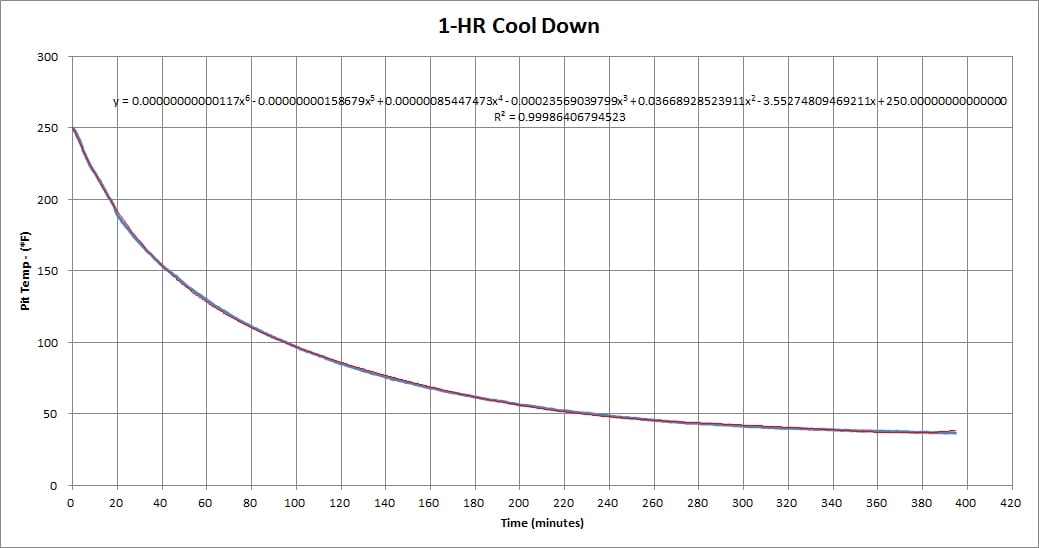
This data was plotted to see if the "when the fire went out" point would identify itself.
Washington, IL > Queen Creek, AZ ... Two large eggs and an adopted Mini Max




Categories
- All Categories
- 184K EggHead Forum
- 16.1K Forum List
- 461 EGGtoberfest
- 1.9K Forum Feedback
- 10.5K Off Topic
- 2.4K EGG Table Forum
- 1 Rules & Disclaimer
- 9.2K Cookbook
- 15 Valentines Day
- 118 Holiday Recipes
- 348 Appetizers
- 521 Baking
- 2.5K Beef
- 90 Desserts
- 167 Lamb
- 2.4K Pork
- 1.5K Poultry
- 33 Salads and Dressings
- 322 Sauces, Rubs, Marinades
- 548 Seafood
- 175 Sides
- 122 Soups, Stews, Chilis
- 40 Vegetarian
- 103 Vegetables
- 315 Health
- 293 Weight Loss Forum