Share your photos by tagging us and using the hashtag #BigGreenEgg.
Want to see how the EGG is made? Click to Watch
Temp Management Advice Please????

But I bought an XL after Christmas and have now tried 2 low and slows. A brisket a week ago and 3 butts this past weekend. While both cooks turned out great, they both wore me out trying to maintain a steady temp. I was shooting for 250. I wasn't real particular, as long as it would settle somewhere around there. Neither cook would settle. Just when I thought I finally had it, temps would start to creep one way or the other. A few degrees, no problem, but these were 20-30 degree swings and still going. I would go out to the egg (it's 40 feet out back in a shed, thank God for my maverick), and make a small, very small adjustment. Ok, it's leveled out. Do something else for a while. Check the egg and it's moved 30 or 40 degrees the other way and still changing. Constantly, from 2 pm Sat to 7 am Sunday. No let-up. Makes me want to abandon low and slow and go turbo all the way.
I don't yet want to go the controller route. Plenty of you do low and slow and succeed without the added gadgets. What am I doing wrong? I used to always light in multiple areas around the lump, but with these low and slows I have been using my mapp torch to light one softball size area dead in the center, or slightly forwards of center. Leave it a few minutes, then add plate setter, drip pan, and grid, and close the lid so that everything but the meat is in there coming up to temp. I will admit that on both cooks, my egg got over temp and I had to shut it down and get the temp into the desired range. But I let it set there, got the vents regulated and had a steady temp before adding the meat. All would be well for an hour or two, and then the temp swings would start. It even dropped to almost 200 once, barely any fire remaining. I had to fully open top and bottom, get the lump going again, and reset the vents when temp was once again correct. Held steady for an hour or so and then it would start creeping again.
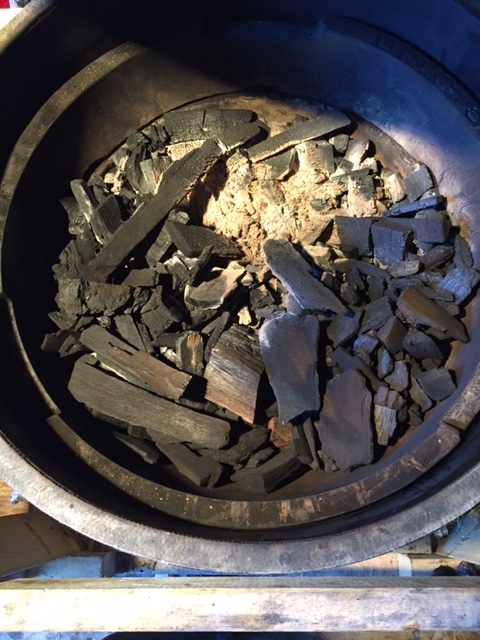
I am using Rockwood. For the brisket, the egg was completely clean and all new lump. For the butts there was a small amount of previously burned lump. Added new on top. I don't arrange the lump. Dump it, add some smoke wood chunks, and light it. I have attached a picture of the lump after my last fiasco. You can see a small circular area in the center where I lit it. Notice how the fire moved down and back. The back was all ash. The fire never spread to the sides or front. You can see a piece of smoke wood slightly embedded at the front. The lump and wood look just like they did before I lit the egg.
Please advise. My only solution is to ignite in multiple areas to encourage a more even lump burn. I apologize for the long post, but am trying to give all the info I can. Thanks.
Tommy
Middle of Nowhere, Northern Kentucky1 M, 1 XL, a BlackStone,1 old Webber, a Border Collie, a German Shepherd and 3 of her pups, and 2 Yorkies
Comments
-
sounds like you are chasing temps a bit. If your egg is stable at 250 or so for an hour before you put your meat on, you should be good to go.
Remember, you may see a temp spike a few minutes after any time you open the lid (adding more oxygen). It will go down when you add cool things (meat, ceramics) to the egg.
I find that if I start at around 250 or so, my temp will rise to about 300 after 4-6 hours, as the water evaporates from the meat and it is becoming less of a heat sink. I usually don't worry about it and just go at the higher temp.
NOLA -
@FarmerTom - here's a link to a current thread that may have some insights as you are looking at the same general issue. Maybe some XL owners will be along.
A little frustrated....
Louisville; Rolling smoke in the neighbourhood. Life is too short for light/lite beer! Seems I'm livin in a transitional period. CHEETO (aka Agent Orange) makes Nixon look like a saint. -
Looks like your lump burned straight down. Others might have some more suggestions, but here's what I would do:
Pull all of the lump from the fire box and make sure the vent holes in the fire box sides are clear.
Refill the fire box and add dry smoke wood. Make sure the fire box is FULL.
Light the lump just aft of center. Once it's lit, let it ride a few minutes, dome open. Put in all of your hardware and close the dome, leaving the bottom vent wide open and the daisy wheel either off or fully open.
Once the temp closes in on 200, start closing the bottom vent and daisy wheel. Keep closing them as needed and let the Egg ease up to the 250 target without overshooting. At 250, the bottom vent on my XL is open less than 1/2" and the daisy wheel top slots are about half open. Be patient.
Let the white smoke burn off as you get the temp stabilized. Once it's thin and blue with the temp steady, you're ready to cook. This might take a little while. Again, be patient.
I've noticed that the temp on my Egg will very slowly creep up as time goes by. If I'm within 25 degrees of target, I usually don't worry about, especially with butts.
Hope this helps!
Living the good life smoking and joking -
Tom, I have an XL, and I have experienced the same thing. Some of it is the weather situations I have had to deal with, as mine is outside with no shed. When the wind is upwards of 5-10 MPH or gusty, it plays heck with my XL and vents. When that type of weather happens I use the Guru. I will say, with the Guru, there is no issue, just the one you will have getting up at night to check the temp, which you will find, exactly right where you set it.
For 225-250, my lower vent is open maybe 1/4 to 1/2 an inch. The daisywheel is almost completely shut, no more than 1/10 to 1/8 of an inch. I let it stabilize, to a clean burn, with everything in, except food. On all multi hour cooks, I clean it out completely, prior to use. I have seen it fluctuate higher by 10-20 degrees, and I let it go.
The hardest thing for me to learn is patience. You need it with the XL. You should be able to stabilize your temps within an hour or so of the initial lighting. Sit back, and as Cap says a couple of adult beverages to help you get to a low earth orbit, helps pass the time, while you are catching your temp on the way up.
Hope this helps. Just a question.....Your Maverick, I had one person have some temp control issues with it, not because of the unit, but because she, in order to protect the leads against the heat, wrapped them very heavily in foil. So when she lowered the dome, air was getting in easily, as smoke was pouring out around the leads. We minimized the amount of foil on the leads, and it solved her issue of temp gain.
I hope this helps.
"Knowledge is Good" - Emil Faber
XL and MM
Louisville, Kentucky -
+1 I barely crack the bottom and the top just like SmokingPiney. Don't make drastic moves, once you open up the damper and bring in a bunch of air the temp rise will not be immediate. When you finally see it may be too late and then you over correct in closing it off and swing the temp in the other direction. Make small moves and don't change more that one variable at the same time....if you add some air wait to see what the effect is, if you dont get the temperature rise you want open the daisy wheel to increase draft flow. Always note wheel position and try to place it on the egg in a manner to limit its movement when lifting the lid. Also note wind direction, if it is gusting into the air register you will see swings. But keeping daisy wheel pinch back will minimize effects.SmokingPiney said:Looks like your lump burned straight down. Others might have some more suggestions, but here's what I would do:
Pull all of the lump from the fire box and make sure the vent holes in the fire box sides are clear.
Refill the fire box and add dry smoke wood. Make sure the fire box is FULL.
Light the lump just aft of center. Once it's lit, let it ride a few minutes, dome open. Put in all of your hardware and close the dome, leaving the bottom vent wide open and the daisy wheel either off or fully open.
Once the temp closes in on 200, start closing the bottom vent and daisy wheel. Keep closing them as needed and let the Egg ease up to the 250 target without overshooting. At 250, the bottom vent on my XL is open less than 1/2" and the daisy wheel top slots are about half open. Be patient.
Let the white smoke burn off as you get the temp stabilized. Once it's thin and blue with the temp steady, you're ready to cook. This might take a little while. Again, be patient.
I've noticed that the temp on my Egg will very slowly creep up as time goes by. If I'm within 25 degrees of target, I usually don't worry about, especially with butts.
Hope this helps!
League City, TX - XL & Med -
I was following the A little frustrated.... thread. But at the time I originally posted, it seemed to be leaning towards gasket issues. Not my problem. New egg, good alignment and no smoke leak at the felt line.
I do wrap the maverick leads in AF, but not very heavy or tight. I always check to make sure there is no smoke coming from where they exit the egg.
And I don't worry about a 15-20 degree temp change. But I was going back and forth between 220 and 300 the whole cook. I was making very small adjustments, maybe 1/8", not much more. And not several adjustments, just when it would approach the high or low end. I would make a small change hoping it would level out and it would for a short time, then start back the other direction and keep going.
I know I got off to a bad start both times getting too hot to begin with and had to close it down, get the temp down, and then get it settled in at desired range. It's just too tempting to leave and work on other chores. Both times I lost far more time correcting the temp overshoot than if I had sat and watched.
I'll do another low and slow soon and watch the start much better. But it will be something that won't take 16 hours to cook. No sir. I'm gonna get this figured out before doing another long cook. Maybe some slow baby backs or country style ribs.Tommy
Middle of Nowhere, Northern Kentucky
1 M, 1 XL, a BlackStone,1 old Webber, a Border Collie, a German Shepherd and 3 of her pups, and 2 Yorkies -
I think you're worrying too much about the temperature. If you put something on for an overnight, set an achievable goal, like "I want to keep it below 280F and not have the fire go out". Then in the morning, if you achieve that goal, adjust your temp to compensate for whatever temp you wake up to. Temperature is not all-important.
The cook can be loosely looked at as the amount of energy you're adding to the food. You have some factors cooking the food that work against you, like evaporation (the "stall"). Faster you cook it, the less that comes into play. And the reverse of that.
If you graph temp vs time, the area below the plot is an integral representing the heat energy you are using to cook your food.
I don't use my DigiQ, don't use a food or grate probe, just the dome thermometer and an instant read. It's a slow moving process and very forgiving, especially with butts. The most important thing is to pull it off when it's done. You can adjust to increase or prolong that time with small adjustment over long periods of time. Or gross adjustments over less time.
______________________________________________I love lamp.. -
You really might want to consider a pit controller for the Egg. I've done lots of low and slows without one without any problems, but a controller takes all of the worry out of it. You can truly set it and walk away for the entire duration of the cook.
Mine was the best investment I've made so far for Egg accessories.
Living the good life smoking and joking -
I may consider that on down the road. No doubt it would be a big help. But for now, I want to master this thing. Sort of a pride issue. And I think knowing how to control my eggs will ultimately improve my cooking skills.SmokingPiney said:You really might want to consider a pit controller for the Egg. I've done lots of low and slows without one without any problems, but a controller takes all of the worry out of it. You can truly set it and walk away for the entire duration of the cook.
Mine was the best investment I've made so far for Egg accessories.
Tommy
Middle of Nowhere, Northern Kentucky
1 M, 1 XL, a BlackStone,1 old Webber, a Border Collie, a German Shepherd and 3 of her pups, and 2 Yorkies -
As NOLLAEGGHEAD said he does not use WIRES. You don't need that stuff. Just practice. Hell I sold one controller and gave away another. No wires for food or grate probes as well. That stuff is not needed.Salado TX & 30A FL: Egg Family: 3 Large and a very well used Mini, added a Mini Max when they came out (I'm good for now). Just given another Mini to add to the herd.
-
I like my maverick. My egg is in a shed behind our house, maybe 40 feet away. I have a bad hip, held together with stainless straps and screws. Looking at joint replacement as soon as can get scheduled. I have to walk with a cane. The maverick saves me a lot of trips back and forth.Mickey said:As NOLLAEGGHEAD said he does not use WIRES. You don't need that stuff. Just practice. Hell I sold one controller and gave away another. No wires for food or grate probes as well. That stuff is not needed.Tommy
Middle of Nowhere, Northern Kentucky
1 M, 1 XL, a BlackStone,1 old Webber, a Border Collie, a German Shepherd and 3 of her pups, and 2 Yorkies -
So would a pair of binoculars, but whatever works for you. Just not a fan myself.FarmerTom said:
I like my maverick. My egg is in a shed behind our house, maybe 40 feet away. I have a bad hip, held together with stainless straps and screws. Looking at joint replacement as soon as can get scheduled. I have to walk with a cane. The maverick saves me a lot of trips back and forth.Mickey said:As NOLLAEGGHEAD said he does not use WIRES. You don't need that stuff. Just practice. Hell I sold one controller and gave away another. No wires for food or grate probes as well. That stuff is not needed.
Please keep us up on that joint replacement as you will find this is a hell of a close family. As you can tell we will place a fork in someone's forehead but we do all care about each other.Salado TX & 30A FL: Egg Family: 3 Large and a very well used Mini, added a Mini Max when they came out (I'm good for now). Just given another Mini to add to the herd. -
I have nothing to add, but that made me chuckleMickey said:
So would a pair of binoculars, but whatever works for you. Just not a fan myself.FarmerTom said:
I like my maverick. My egg is in a shed behind our house, maybe 40 feet away. I have a bad hip, held together with stainless straps and screws. Looking at joint replacement as soon as can get scheduled. I have to walk with a cane. The maverick saves me a lot of trips back and forth.Mickey said:As NOLLAEGGHEAD said he does not use WIRES. You don't need that stuff. Just practice. Hell I sold one controller and gave away another. No wires for food or grate probes as well. That stuff is not needed.
Please keep us up on that joint replacement as you will find this is a hell of a close family. As you can tell we will place a fork in someone's forehead but we do all care about each other. -
FarmerTom, I have had only a little experience with an XL at an Eggfest and all I have to offer is I also think you got off to a bad start with overshooting target temp. Also I think an 1/8" is a big adjustment and when you totally opened top and bottom vent to get it quickly back to temp I think the fire got way out of control/to hot. You might want to take a day load it up with lump no food and work on learning how that xl egg responds to adjustments. I'm sure you will figure it out in time. I have 5 different size eggs and not a one of them respond the same!FarmerTom said:I was following the A little frustrated.... thread. But at the time I originally posted, it seemed to be leaning towards gasket issues. Not my problem. New egg, good alignment and no smoke leak at the felt line.
I do wrap the maverick leads in AF, but not very heavy or tight. I always check to make sure there is no smoke coming from where they exit the egg.
And I don't worry about a 15-20 degree temp change. But I was going back and forth between 220 and 300 the whole cook. I was making very small adjustments, maybe 1/8", not much more. And not several adjustments, just when it would approach the high or low end. I would make a small change hoping it would level out and it would for a short time, then start back the other direction and keep going.
I know I got off to a bad start both times getting too hot to begin with and had to close it down, get the temp down, and then get it settled in at desired range. It's just too tempting to leave and work on other chores. Both times I lost far more time correcting the temp overshoot than if I had sat and watched.
I'll do another low and slow soon and watch the start much better. But it will be something that won't take 16 hours to cook. No sir. I'm gonna get this figured out before doing another long cook. Maybe some slow baby backs or country style ribs.
I'm only hungry when I'm awake!
Okeechobee FL. Winter
West Jefferson NC Summer
-
I have an XL. One of the luxuries of the XL is that the firebox is big enough that you can clear out a small space at the front - about the size of a baseball - to make sure a couple of holes on the fire grate are wide open. Even with no charcoal in that area you can still load plenty of coal for a 24+ hour cook. What you might be experiencing is the clogging and unclogging of those holes leading to variable air flow. Before I learned to do this my maximum temperature on some cooks was 350 (and sometimes 900) and my temps on overnight cooks was highly variable. Many solve this problem with an aftermarket grate (High-Q).
XXL BGE, Karebecue, Chargiller Akorn Kamado, Weber Smokey Mountain, Grand Turbo gasser, Weber Smoky Joe, and the wheelbarrow that my grandfather used to cook steaks from his cattle
San Antonio, TX
-
Kick Ash Basket would also do the job.
I'm only hungry when I'm awake!
Okeechobee FL. Winter
West Jefferson NC Summer
-
Will a KAB prevent the air holes from clogging? I can see how folks would like it for removing ash, however, I don't mind that chore. But if it will prevent the air holes from clogging, then I might have to start saving for one.
Tommy
Middle of Nowhere, Northern Kentucky
1 M, 1 XL, a BlackStone,1 old Webber, a Border Collie, a German Shepherd and 3 of her pups, and 2 Yorkies -
As you can tell we will place a fork in someone's forehead but we do all care about each other.Mickey said:
So would a pair of binoculars, but whatever works for you. Just not a fan myself.FarmerTom said:
I like my maverick. My egg is in a shed behind our house, maybe 40 feet away. I have a bad hip, held together with stainless straps and screws. Looking at joint replacement as soon as can get scheduled. I have to walk with a cane. The maverick saves me a lot of trips back and forth.Mickey said:As NOLLAEGGHEAD said he does not use WIRES. You don't need that stuff. Just practice. Hell I sold one controller and gave away another. No wires for food or grate probes as well. That stuff is not needed.
Please keep us up on that joint replacement as you will find this is a hell of a close family. As you can tell we will place a fork in someone's forehead but we do all care about each other.
Man, that's pretty tough, considering the disdain with which forks are held on this forum. I do appreciate the thought tho.
And I will solve this. Perhaps I rely too much on how my M behaves and need to realize the XL is an entirely different beast. I'm already deciding what to try next. Don't particularly like the thought of tinkering with an empty egg. Can't stand the thought of wasting lump.Tommy
Middle of Nowhere, Northern Kentucky
1 M, 1 XL, a BlackStone,1 old Webber, a Border Collie, a German Shepherd and 3 of her pups, and 2 Yorkies -
Yes the KAB will help with air flow for sure.FarmerTom said:Will a KAB prevent the air holes from clogging? I can see how folks would like it for removing ash, however, I don't mind that chore. But if it will prevent the air holes from clogging, then I might have to start saving for one.
I'm only hungry when I'm awake!
Okeechobee FL. Winter
West Jefferson NC Summer
-
@FarmerTom - I don't own a XL but from what I have read here, it does not need any after-market mods for air-flow. The grate is sized such that air-flow is not an issue. FWIW-Louisville; Rolling smoke in the neighbourhood. Life is too short for light/lite beer! Seems I'm livin in a transitional period. CHEETO (aka Agent Orange) makes Nixon look like a saint.
-
a maverick is a very different thing than a powered draft unit
[social media disclaimer: irony and sarcasm may be used in some or all of user's posts; emoticon usage is intended to indicate moderately jocular social interaction; the comments toward users, their usernames, and the real people (living or dead) that they refer to are not intended to be adversarial in nature; those replying to this user are entering into a tacit agreement that they are real-life or social-media acquaintances and/or have agreed to or tacitly agreed to perpetrate occasional good-natured ribbing between and among themselves and others] -
FarmerTom said:Perhaps I rely too much on how my M behaves and need to realize the XL is an entirely different beast.
It's kind of the difference between driving a freighter and a speed boat. The XL has a lot more volume to heat/cool so the reaction time to vent changes will be much slower.
NOLA -
I have an XL and here is what i can tell you that i do and I rarely have temp stabilization problems.
#1 make sure your air flow areas are clean and not obstructed
#2 dont use too much lump....in other words, with some practice you will get more comfortable with placing the right amount of lump in the egg to ensure you have a "healthy" fire.....not enough oxygen causes a bitter nasty taste.
#3 your descriptions of moving your vents and daisy wheel are too large based on my experiences.......when I adjust things it is usually in around 1/8 inch increments. it really is that sensitive.
#4 this one is crucial based solely on my experiences.....you have to catch the temp on the way up.....if you are shooting for 250 and you let it run up to 325 or 350 then it is truly frustrating getting it to play nice from there on out. and you also run the risk of limiting the oxygen once again and not running a clean fire. bad smoke comes from that.
following these steps have allowed me to cook in cold weather, rain, hot sunny days with very few issues. I bought a BBQ guru and used it for awhile but after more practice and experience and following the steps above I can't tell you how long its been since I used my guru. good luck.gettin lucky in kentucky! 2 XL eggs! -
Mickey said:As NOLLAEGGHEAD said he does not use WIRES. You don't need that stuff. Just practice. Hell I sold one controller and gave away another. No wires for food or grate probes as well. That stuff is not needed.
I agree with this, and @FarmerTom , by the time you master it, you won't want to use a controller. (The Maverick is a different beast, and while I quit using mine as well, I can see where it would be beneficial with your hip. Best wishes with that.
NOLA -
I had a medium before I traded up to a large and I was surprised at the difference in the way they operate. I'm sure there is a major adjustment going up to the XL.FarmerTom said:
As you can tell we will place a fork in someone's forehead but we do all care about each other.Mickey said:
So would a pair of binoculars, but whatever works for you. Just not a fan myself.FarmerTom said:
I like my maverick. My egg is in a shed behind our house, maybe 40 feet away. I have a bad hip, held together with stainless straps and screws. Looking at joint replacement as soon as can get scheduled. I have to walk with a cane. The maverick saves me a lot of trips back and forth.Mickey said:As NOLLAEGGHEAD said he does not use WIRES. You don't need that stuff. Just practice. Hell I sold one controller and gave away another. No wires for food or grate probes as well. That stuff is not needed.
Please keep us up on that joint replacement as you will find this is a hell of a close family. As you can tell we will place a fork in someone's forehead but we do all care about each other.
Man, that's pretty tough, considering the disdain with which forks are held on this forum. I do appreciate the thought tho.
And I will solve this. Perhaps I rely too much on how my M behaves and need to realize the XL is an entirely different beast. I'm already deciding what to try next. Don't particularly like the thought of tinkering with an empty egg. Can't stand the thought of wasting lump.One large BGE in Louisville, KY. -
+1 on lousubcap's comment. The large egg seems to be the breaking point ... smaller eggs greatly benefit from the extra airflow. Larger eggs ... not so much.
The large egg has a vocal contingent on both sides of the argument. But, notice how few have purchased the Fishbone, High-Que, or KAB and say they wasted their money.
I have two large eggs and they are not twins ... they have subtle differences in how they react to the same settings. Going from lots of experience on a medium to controlling an XL will probably be similar to going from a Jon boat to a party boat ... riding mower to a CAT belted ag tractor ...
Washington, IL > Queen Creek, AZ ... Two large eggs and an adopted Mini Max
-
lousubcap, yes, the grate is huge on my XL compared to my M. I don't think there could be any issue there. But I'm not certain about the side air vents. How much do they affect the burn? They are what seem to clog with pieces of charcoal sometimes and there aren't many of them.
Darby_Crenshaw I realize the maverick is nothing more than a fancy remote thermometer, but it does save me a lot of back and forth. I can see where the powered draft units would all but eliminate any temp control issues, but I want to master this temp problem before even considering one. Sort of like learn to drive a stick before getting an automatic.
Tommy
Middle of Nowhere, Northern Kentucky
1 M, 1 XL, a BlackStone,1 old Webber, a Border Collie, a German Shepherd and 3 of her pups, and 2 Yorkies






Categories
- All Categories
- 184.1K EggHead Forum
- 15.8K Forum List
- 460 EGGtoberfest
- 1.9K Forum Feedback
- 10.4K Off Topic
- 2.2K EGG Table Forum
- 1 Rules & Disclaimer
- 9K Cookbook
- 13 Valentines Day
- 93 Holiday Recipes
- 224 Appetizers
- 520 Baking
- 2.5K Beef
- 88 Desserts
- 167 Lamb
- 2.4K Pork
- 1.5K Poultry
- 33 Salads and Dressings
- 324 Sauces, Rubs, Marinades
- 548 Seafood
- 175 Sides
- 122 Soups, Stews, Chilis
- 44 Vegetarian
- 102 Vegetables
- 313 Health
- 292 Weight Loss Forum