




I like my butt rubbed and my pork pulled.
Member since 2009
Welcome to the EGGhead Forum - a great place to visit and packed with tips and EGGspert advice! You can also join the conversation and get more information and amazing kamado recipes by following Big Green Egg to Experience our World of Flavor™ at:
Want to see how the EGG is made? Click to Watch
Facebook | Twitter | Instagram | Pinterest | Youtube | Vimeo
Share your photos by tagging us and using the hashtag #BigGreenEgg.
Share your photos by tagging us and using the hashtag #BigGreenEgg.
Want to see how the EGG is made? Click to Watch
When theory doesn't match observations...
Comments
-
True. In our tests, we were in the 275 to 300 range with smaller fires. The smoke profile improved, but I personally thought it was too much work.Darby_Crenshaw said:You can't hold 250 by building a "smaller hotter fire".
Inless you are wide open, the small chunk of charcoal which is butning is pretty much burning at one temperature. The dome temp is a result of how much lump is burning, not how hot it is burning.
To a certain extent (until you are probably above 'smoking temps') the lower vent is a throttle which controls the SIZE of the fire, not how hot the fire itself is.
A fire that is getting a free flow of oxygen, one that is free to grow (like vents wide open, or dome open) can certainly get hotter, where the lump is 1200, 1400 etc. Blacksmiths force air into lump and reach smelting temps, white hot, etc. But that's not a naturally drafting fire
in our eggs, for iur purposes, it's more like: the lump of a 225 fire is the same temperature as the lump of a 400 degree fire. There's just less lump in the 225 fire.
You are right that if you could get a very small fire of much hotter lump (forcing air to it), you'd get more smoke from whatever wood was involved, but in an egg, with extra lump all around, that fire wiuld grow in size and dome temps would rise.
Blah blah blah whatever stike, just keep blabbingJust a hack that makes some $hitty BBQ.... -
This is one of those "agree to disagree" moments I've heard so much about.SkySaw said:
I don't doubt the science that he refers to in the article - never did. What I doubt is the inference that he makes about ceramic cookers producing bad smoke because the fire is too cool; and apparently you doubt this too when you say you think the smoke from the Egg isn't that dirty. I can produce dirty smoke in my Egg, and clean smoke, and I can taste the difference. There's no cool-aid being passed around in this thread. I have read several statements about offsets producing a different smoke profile because the volume of smoke is completely different, and that makes total sense. So when you say the smoke profile from a ceramic cooker is inferior, I take it that you mean that it is impossible for a ceramic cooker to get as much clean smoke onto the food as an offset, and no one has disputed that. I do dispute your assertion that ceramic cookers cannot get into the sweet spot for good smoke production, and this has to do with the statement made earlier in this thread that a ceramic cooker running at 250º is burning cleanly and is different from a ceramic cooker that was running at 400º and is being choked off to bring it down to 250º.cazzy said:
Again, the science is correct...I just don't think it matters because it isn't that dirty. If you ran wood instead of lump at the same temps, the story would be completely different.SkySaw said:I don't think it's necessary to measure the temperature of the lump, and here's why: our tastebuds are a very accurate measure of good smoke versus bad. I don't doubt the sections of the Amazingribs article about the requirements for producing good smoke, which basically suggests that a hot fire is required to produce smoke that doesn't smoulder and produce sooty smoke.
If our ceramic cookers are producing smoked food that doesn't taste sooty, then our ceramic cookers are using hot fires, even if they are small. And so I disagree with his opinion that ceramic cookers produce cool fires.
Something interesting that I have learned from this thread is that in order to produce good smoke in traditional offset cookers, the cooking chamber ends up being somewhere between 250º - 275º, which explains a lot of the low/slow phenomenon. Apparently a ceramic cooker can produce good smoke in a cooking chamber at 250º and at 350º, whereas an offset may not be able to do the same thing. It also explains why a boston butt is just as good cooked as a turbo butt on an Egg as when it is cooked at 250º on an Egg.
As mentioned before, all this means to us is that our smoke profile is inferior to what can be achieved on an offset. I know we love our green kool-aid, but this is a fact. This is mainly because we're not in that sweet spot for great clean smoke. You can improve the smoke profile by building smaller hotter fires. Just a hack that makes some $hitty BBQ....
 -
Maxes out at 968 degrees FahrenheitHDmstng said:
Great thread!Brisket_Fanatic said:Have the egg stabilized at 250 and shot the charcoal with a IR gun. Hottest spot I could get was 760 degrees!
What's the temperature range on your IR gun, you might be outside the range.NW IA
2 LBGE, 1 SBGE, 22.5 WSM, 1 Smokey Joe and Black Stone
-
You guys are doing a great job of sucking all of the fun out of egging!
-
It's been scientifically proven that a large dog on a leash is the only thing that can suck the fun out of egging.DoubleEgger said:You guys are doing a great job of sucking all of the fun out of egging! -
SkySaw said:
It's been scientifically proven that a large dog on a leash is the only thing that can suck the fun out of egging.DoubleEgger said:You guys are doing a great job of sucking all of the fun out of egging!
Disagree! A large dog not on a leash can do it thoughSteve
Caledon, ON
-
Does the brand of lump contribute to the quality of the fire or smoke? Do they burn at the same temperatures?
-
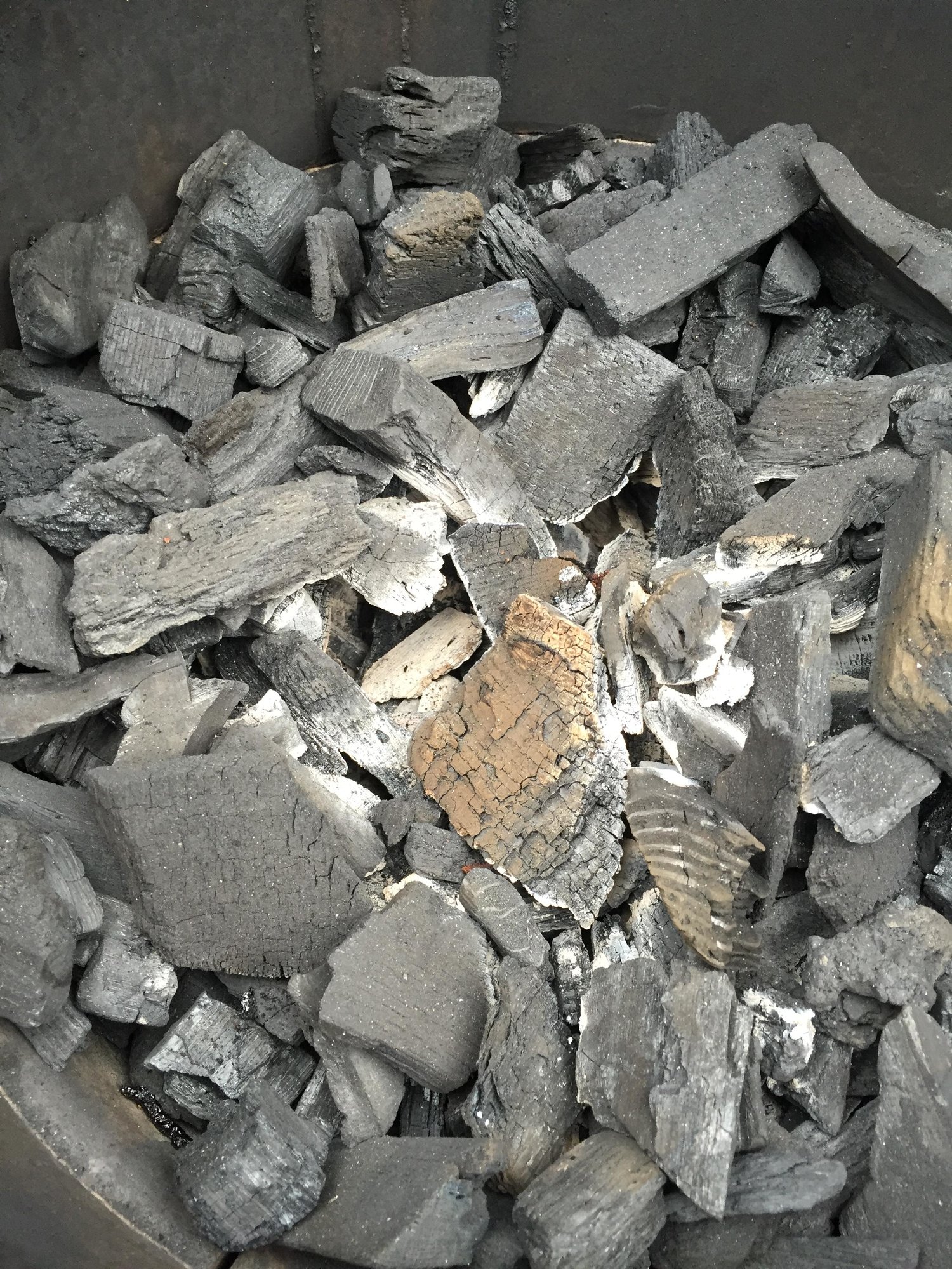
When I did a turbo butt last weekend, I changed up my technique by mixing lump throughout the center of the lump bed, adding it throughout. I feel because the small fire burrowed through the center of the pile it used the smoke wood throughout a majority of the cook. I think the smoke flavor was better than I've ever had it. Opening it up after the cook I see that the fire did seem to burn a majority of the smoke wood.
-
Post had me looking at the Dentist's power point presentation for a backyard Peoria Custom Cooker. F this post.BrandonQuad Cities
"If yer gonna denigrate, familiarity with the subject is helpful." -
Hey man. I was trying to simplify ****
charcoal burns at one basic temp. Dome temp is a result of how much lump there is
[social media disclaimer: irony and sarcasm may be used in some or all of user's posts; emoticon usage is intended to indicate moderately jocular social interaction; the comments toward users, their usernames, and the real people (living or dead) that they refer to are not intended to be adversarial in nature; those replying to this user are entering into a tacit agreement that they are real-life or social-media acquaintances and/or have agreed to or tacitly agreed to perpetrate occasional good-natured ribbing between and among themselves and others] -
That's not true, but for the sake of argument, it might help people stop tripping out.Darby_Crenshaw said:Hey man. I was trying to simplify ****
charcoal burns at one basic temp. Dome temp is a result of how much lump there is
The temperature of a fire is highly dependent on the concentration of oxygen. You run 100% oxygen and it's much hotter than 20%. Inside the egg O2 reacts with the lump and the effluent is less than 20% O2, must of that depends on bypass gas, opening of dampers, barometric pressure, etc. Oxygen/propane is much hotter than oxygen/air. The dynamics in the egg aren't really that simple. You're running a reducing flame - O2 is the limiting reagent. If the fire is waning because it's too big for the O2 supply, the O2 concentration will drop and some part of the fire - say lump over burning lump - will cool to the point combustion fails.
Fires burn hotter at higher pressures. Everything else equal, an egg in Seattle has less oxygen dense air.
From wiki:
https://en.wikipedia.org/wiki/Flame#Flame_temperature
andSmouldering
Smouldering is the slow, low-temperature, flameless form of combustion, sustained by the heat evolved when oxygen directly attacks the surface of a condensed-phase fuel. It is a typically incomplete combustion reaction. Solid materials that can sustain a smouldering reaction include coal, cellulose, wood, cotton, tobacco, peat, duff, humus, synthetic foams, charring polymers (including polyurethane foam) and dust. Common examples of smouldering phenomena are the initiation of residential fires on upholstered furniture by weak heat sources (e.g., a cigarette, a short-circuited wire) and the persistent combustion of biomass behind the flaming fronts of wildfires.
______________________________________________I love lamp.. -
SCIENCE!!
-
Here's another way of looking at it. Small and hot - say you have a single piece of lump right next to the bottom vent where all the air flowing through the egg enters. That lump would be glowing being fed 20% oxygen. Contrast that with that same lump sitting in the center of the egg in an atmosphere of whatever - 10% O2. The lump sits in it's own waste, which has a smothering effect. There's not a lot you can do as a small fire works its way around your lump pile, to keep it hot. This is actually why we pay a price having an efficient smoker with this design in terms of smoke quality vs the complete opposite system - a stick burner.
______________________________________________I love lamp.. -
And that's why we can't burn pure wood in the egg without turning out some disgusting food. The fire isn't hot enough.
______________________________________________I love lamp.. -
I hope I never sit in my own waste.
-
@theyolksonyou Stand, sit, you can't avoid it. Humanity is like a vat of fermenting beer. One fermentation product is ethanol (fvck yeah!). Yeast just keeps multiplying and the ethanol level in a closed system (analogy - Earth) builds up until it kills all the yeast.
Also you might find this fun/revolting: http://www.bbc.com/news/science-environment-24820279
______________________________________________I love lamp.. -
This is why I will still purchase a Lang or Gator.XL Big Green Egg
-
Yeah, but will it do ribs?"Knowledge is Good" - Emil Faber
XL and MM
Louisville, Kentucky -
That link was great!nolaegghead said:@theyolksonyou Stand, sit, you can't avoid it. Humanity is like a vat of fermenting beer. One fermentation product is ethanol (fvck yeah!). Yeast just keeps multiplying and the ethanol level in a closed system (analogy - Earth) builds up until it kills all the yeast.
Also you might find this fun/revolting: http://www.bbc.com/news/science-environment-24820279Coleman, Texas
Large BGE & Mini Max for the wok. A few old camp Dutch ovens and a wood fired oven. LSG 24” cabinet offset smoker. There are a few paella pans and a Patagonia cross in the barn. A curing chamber for bacterial transformation of meats...
"Bourbon slushies. Sure you can cook on the BGE without them, but why would you?"
YukonRon





Categories
- All Categories
- 184K EggHead Forum
- 15.8K Forum List
- 459 EGGtoberfest
- 1.9K Forum Feedback
- 10.4K Off Topic
- 2.2K EGG Table Forum
- 1 Rules & Disclaimer
- 9K Cookbook
- 13 Valentines Day
- 93 Holiday Recipes
- 224 Appetizers
- 520 Baking
- 2.5K Beef
- 88 Desserts
- 167 Lamb
- 2.4K Pork
- 1.5K Poultry
- 33 Salads and Dressings
- 324 Sauces, Rubs, Marinades
- 548 Seafood
- 175 Sides
- 122 Soups, Stews, Chilis
- 44 Vegetarian
- 102 Vegetables
- 313 Health
- 292 Weight Loss Forum