Welcome to the EGGhead Forum - a great place to visit and packed with tips and EGGspert advice! You can also join the conversation and get more information and amazing kamado recipes by following Big Green Egg to Experience our World of Flavor™ at:
Want to see how the EGG is made? Click to Watch
Facebook | Twitter | Instagram | Pinterest | Youtube | Vimeo
Share your photos by tagging us and using the hashtag #BigGreenEgg.
Share your photos by tagging us and using the hashtag #BigGreenEgg.
Want to see how the EGG is made? Click to Watch
Dry Brisket - Please Help

Everyone,
I have owned a Big Green Egg for almost a year. Most of the items I cook turn out well except for my brisket. Despite all the research I have done, I still get the results shown in the photos.
Setup
Spyder accessory from CGS with two deflector plates.
Eggspander accessory which holds a water pan underneath the "grill area" supporting the brisket.
Lump charcoal used from Big Green Egg and Jealous Devil.
18 lb brisket from Costco.
Brisket was cooked with the fat cap down.
Cook Process
Most of the time, the brisket was cooked at a temperature of 225 degrees F. It was wrapped with butcher paper at 265 degrees when the bark formation looked almost complete. The meat appeared to have a late stall (it moved through the 260-270 degrees F range pretty quickly but got stuck at the 280-285 degrees F range). Eventually, I read online that you should move up the cooking temperature to 250-275 degrees at this range. My problem maybe that this was accomplished late - in part - to the smoker running out of fuel. Once more lump charcoal was added, the brisket cooked around 250-275 degrees for the last 2 hours of the cook.
Taking the brisket off was a difficult decision because one side had that "butter smooth" feel when I put the temperature probe into the brisket (208 degrees F temperature). The other side had a little more resistance at a temperature of 197 degrees F. I was worried the "208 degrees" side would overcook if it stayed on longer. At the end of the day, it didn't matter; both sides had a dry taste to them.
I appreciate any advice given; after much research and trying different things, the results are not what they should be.
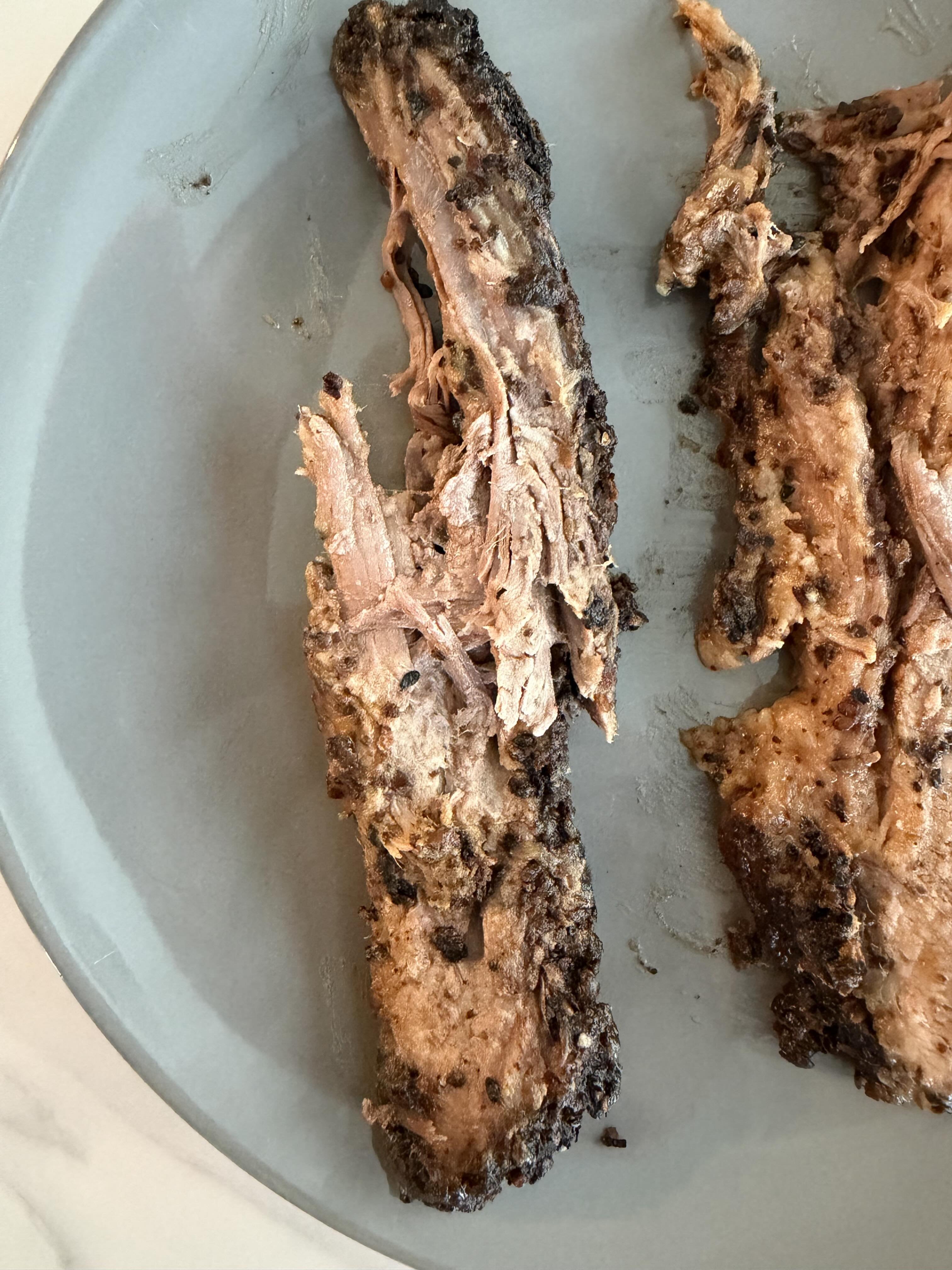
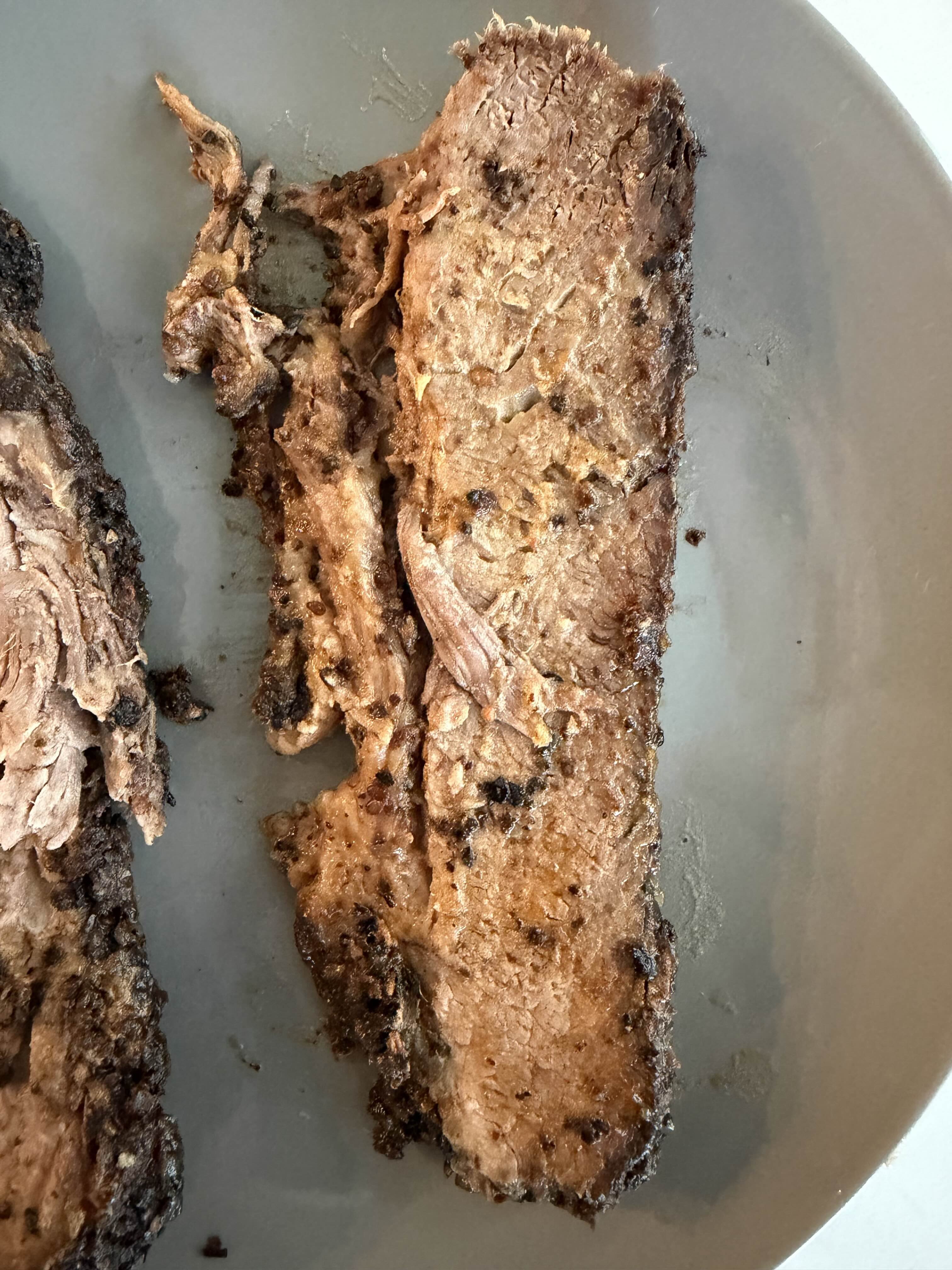
I have owned a Big Green Egg for almost a year. Most of the items I cook turn out well except for my brisket. Despite all the research I have done, I still get the results shown in the photos.
Setup
Spyder accessory from CGS with two deflector plates.
Eggspander accessory which holds a water pan underneath the "grill area" supporting the brisket.
Lump charcoal used from Big Green Egg and Jealous Devil.
18 lb brisket from Costco.
Brisket was cooked with the fat cap down.
Cook Process
Most of the time, the brisket was cooked at a temperature of 225 degrees F. It was wrapped with butcher paper at 265 degrees when the bark formation looked almost complete. The meat appeared to have a late stall (it moved through the 260-270 degrees F range pretty quickly but got stuck at the 280-285 degrees F range). Eventually, I read online that you should move up the cooking temperature to 250-275 degrees at this range. My problem maybe that this was accomplished late - in part - to the smoker running out of fuel. Once more lump charcoal was added, the brisket cooked around 250-275 degrees for the last 2 hours of the cook.
Taking the brisket off was a difficult decision because one side had that "butter smooth" feel when I put the temperature probe into the brisket (208 degrees F temperature). The other side had a little more resistance at a temperature of 197 degrees F. I was worried the "208 degrees" side would overcook if it stayed on longer. At the end of the day, it didn't matter; both sides had a dry taste to them.
I appreciate any advice given; after much research and trying different things, the results are not what they should be.
Comments
-
Hey there. I’m confused by your temps, but will offer what I’ve learned…
counterintuitively, DRY brisket is UNDERCOOKED.
FALLING APART brisket is OVERCOOKED.
WHY? The collagen needs to break down. If it doesn’t, you get that dry sensation.Now - everyone’s brisket method is totally different and their own, but I’d keep that Egg temp at 225° throughout. It’s a low-and-slow. Let it ride.Finished temps in the meat will vary, though I’ll never see them hit 208°, personally. The only way to tell if the brisket is done is the probe test. There shouldn’t be ANY resistance. When it hits that, wrap in foil and then a towel and let rest for at least an hour in a cooler. It needs that rest to absorb the juices, further combating your dryness.Again - there are as many methods as there are pit masters. But if you’re seeing this as a consistent result, it’s time to change something up..Large BGE and Medium BGE
36" Blackstone - Greensboro! -
I'm also confused - particularly by this:
"The meat appeared to have a late stall (it moved through the 260-270 degrees F range pretty quickly but got stuck at the 280-285 degrees F range)."XXL BGE, Karebecue, Chargiller Akorn Kamado, Weber Smokey Mountain, Grand Turbo gasser, Weber Smoky Joe, and the wheelbarrow that my grandfather used to cook steaks from his cattle
San Antonio, TX
-
@eat2much, I think we are all hoping there is a typo and all of those 200 degree numbers should actually be 100 degree numbers..
Briskets can be notoriously difficult because of the characteristics of each are different. My two pennies would be to get a fatty one, trim and place the lean trimmed fat into your inside oven at 200 degrees for tallow, and read and follow what others have posted...
If all else fails you can always finish it in an insta-pot, because it doesn't matter how you get across the finish line..Have:
XLBGE / Stumps Baby XL / Couple of Stokers (Gen 1 and Gen 3) / Blackstone 36 / Maxey 3x5 water pan hog cooker
Had:
LBGE / Lang 60D / Cookshack SM150 / Stumps Stretch / Stumps Baby
Fat Willies BBQ
Ola, Ga -
My apologies. The temperature Foghorn mentioned should be 100 degrees less…
Cook Process
Most of the time, the brisket was cooked at a temperature of 225 degrees F (ambient air of smoker). It was wrapped with butcher paper at 265 degrees (ambient air of smoker) when the bark formation looked almost complete. The meat appeared to have a late stall (it moved through the 160-170 degrees F range pretty quickly but got stuck at the 180-185 degrees F range). Eventually, I read online that you should move up the ambient air temperature of the smoker to 250-275 degrees at this stage. My problem was maybe this was accomplished late - in part - to the smoker running out of fuel. Once more lump charcoal was added, the brisket cooked in an ambient air temperature of 250-275 degrees for the last 2 hours of the cook.
Does this make sense now? -
That definitely makes more sense and is what I suspected.
More questions:
Was it prime beef?
When you opened up the butcher paper to slice it - was there a lot of "brisket juice" in the paper?
Did you slice it immediately after pulling it off the Egg - or did it get a rest period in a cooler before slicing?XXL BGE, Karebecue, Chargiller Akorn Kamado, Weber Smokey Mountain, Grand Turbo gasser, Weber Smoky Joe, and the wheelbarrow that my grandfather used to cook steaks from his cattle
San Antonio, TX
-
My .02
Get rid of that water pan. You don’t need to add moisture using an egg like you do using a metal cooker.Don’t chase 225F. The egg cooks better in the 250-275F range. -
First cooking at 225 to 250F is okay. Higher, you run the risk of the smoke ring part being dry and hard, while the inside is okay.
I've seen stall at 140F to 170F.
I'm wondering if you didn't hit a pocket of fat with your probe ... and that was rendering, while the rest of the meat was drying out.
Also, I inject my meat with beef broth, or vegetable broth (both unsalted) ... I do this before I cook. Then before serving, I will reinject. I typically wrap in foil, so I can collect the juices that came out of the meat, and I use that to reinject. Always moist then.Napoleon Prestige Pro 665, XL BGE, Lots of time for BBQ! -
To answer everyone’s questions:
I do not remember if it was prime beef. It was purchased at Costco if that helps. While the bottom of the butcher paper was wet, there was not a “pool of liquid fat/grease” at the bottom like has occurred for previous cooks. The brisket was taken off the smoker, left wrapped in butcher paper, and sliced after about 9 hours. It was not placed in a cooler.
Initially, the temperature probe was in a fatty area; but, it was moved to a different spot. Even with that, I tested the temperature in several spots with another probe before taking it off the smoker.
Other information:
My wife mentioned that the brisket was more tender and juicy in the center/middle when compared to the outside. This is contradictory as probing the brisket with the temperature thermometer had more resistance in the middle compared to one side (which was “butter” smooth). I had a slice of brisket from the “butter” smooth side and it was dry.
For me, this is why cooking brisket has been a challenge. I have tried to follow so much “conventional” wisdom that I have researched and get less than ideal results.
-
What was the internal temp of the brisket after 9 hours not in a cooler. I’ve gone 9 hours in a cooler with a hot bean pot full of beans without it getting below 145 internal before without problems with cheap flats beforeeat2much said:To answer everyone’s questions:
What was the internal temp of the brisket after nine hours not in a cooler. I’ve gone 9 hours in a cooler with a big hot bean pot in there and things were still hot
I do not remember if it was prime beef. It was purchased at Costco if that helps. While the bottom of the butcher paper was wet, there was not a “pool of liquid fat/grease” at the bottom like has occurred for previous cooks. The brisket was taken off the smoker, left wrapped in butcher paper, and sliced after about 9 hours. It was not placed in a cooler.
Initially, the temperature probe was in a fatty area; but, it was moved to a different spot. Even with that, I tested the temperature in several spots with another probe before taking it off the smoker.
Other information:
My wife mentioned that the brisket was more tender and juicy in the center/middle when compared to the outside. This is contradictory as probing the brisket with the temperature thermometer had more resistance in the middle compared to one side (which was “butter” smooth). I had a slice of brisket from the “butter” smooth side and it was dry.
For me, this is why cooking brisket has been a challenge. I have tried to follow so much “conventional” wisdom that I have researched and get less than ideal results.fukahwee maineyou can lead a fish to water but you can not make him drink it -
I did not take the temperature of the brisket after the 9 hour rest.fishlessman said:
What was the internal temp of the brisket after 9 hours not in a cooler. I’ve gone 9 hours in a cooler with a hot bean pot full of beans without it getting below 145 internal before without problems with cheap flats beforeeat2much said:To answer everyone’s questions:
What was the internal temp of the brisket after nine hours not in a cooler. I’ve gone 9 hours in a cooler with a big hot bean pot in there and things were still hot
I do not remember if it was prime beef. It was purchased at Costco if that helps. While the bottom of the butcher paper was wet, there was not a “pool of liquid fat/grease” at the bottom like has occurred for previous cooks. The brisket was taken off the smoker, left wrapped in butcher paper, and sliced after about 9 hours. It was not placed in a cooler.
Initially, the temperature probe was in a fatty area; but, it was moved to a different spot. Even with that, I tested the temperature in several spots with another probe before taking it off the smoker.
Other information:
My wife mentioned that the brisket was more tender and juicy in the center/middle when compared to the outside. This is contradictory as probing the brisket with the temperature thermometer had more resistance in the middle compared to one side (which was “butter” smooth). I had a slice of brisket from the “butter” smooth side and it was dry.
For me, this is why cooking brisket has been a challenge. I have tried to follow so much “conventional” wisdom that I have researched and get less than ideal results. -
Most people got you but I’d repeat
- 250-270 is a happy spot for the egg
- when learning, cooking to 195 and rest 30min and hot hold in the oven overnight at 150f (probe to ensure beef stays above 140) finishes the last mile tenderness perfectly every time no skill required on the probe feel
- all is not lost. While disappointing, overcooked brisket makes awesome chopped brisket sandwiches. Undercooked cube it and add to chili or stew -
OK, perhaps suggestions for next time.
- inject vegetable broth before you put on.
- leave fat on the flat (to protect it), trim fat on the point.
- probe point, try and get right in the middle
- cook at 225F to 250F indirect.
- wrap at stall (140F to 170F).
- cook to 200F internal.
- keep wrap on, and then wrap with towels, and put in cooler for at least 1h (this also retains moisture).
- collect juices once unwrapped, and consider reinjecting in the brisket before you cut and serve
Napoleon Prestige Pro 665, XL BGE, Lots of time for BBQ! -
Was just curious what the brisket temp was. The bigger problem is the 40/140 rule. You put the brisket in a danger zone by putting in an environment below 140 for way to long, not that I have not done that but it’s not the best thing if feeding to a crowdeat2much said:
I did not take the temperature of the brisket after the 9 hour rest.fishlessman said:
What was the internal temp of the brisket after 9 hours not in a cooler. I’ve gone 9 hours in a cooler with a hot bean pot full of beans without it getting below 145 internal before without problems with cheap flats beforeeat2much said:To answer everyone’s questions:
What was the internal temp of the brisket after nine hours not in a cooler. I’ve gone 9 hours in a cooler with a big hot bean pot in there and things were still hot
I do not remember if it was prime beef. It was purchased at Costco if that helps. While the bottom of the butcher paper was wet, there was not a “pool of liquid fat/grease” at the bottom like has occurred for previous cooks. The brisket was taken off the smoker, left wrapped in butcher paper, and sliced after about 9 hours. It was not placed in a cooler.
Initially, the temperature probe was in a fatty area; but, it was moved to a different spot. Even with that, I tested the temperature in several spots with another probe before taking it off the smoker.
Other information:
My wife mentioned that the brisket was more tender and juicy in the center/middle when compared to the outside. This is contradictory as probing the brisket with the temperature thermometer had more resistance in the middle compared to one side (which was “butter” smooth). I had a slice of brisket from the “butter” smooth side and it was dry.
For me, this is why cooking brisket has been a challenge. I have tried to follow so much “conventional” wisdom that I have researched and get less than ideal results.fukahwee maineyou can lead a fish to water but you can not make him drink it -
OK. At this point I can't state anything with certainty. However, I have to think there are 2 things you could do on the next one to improve it.
1) Make sure you start with prime beef. In my experience when you unwrap the butcher paper there is a fair amount of brisket juice in the bottom of it. How much is there depends on how early you wrap. I have sometimes wrapped during the stall (not recommended) and when I've done that the amount of liquid when I unwrap is at least a pint, maybe a quart. The amount of liquid is also proportional to how much fat is in the brisket.
2) When you take the brisket off the Egg, you should do something to preserve it's warmth and moisture. Most of us wrap it in foil and put it in a cooler. Many do "FTC" - Foil, Towel, Cooler. This will keep the brisket temperature above 140F for many hours - which keeps it foodsafe (as mentioned above). It also will keep it moist.
Just my $0.02.XXL BGE, Karebecue, Chargiller Akorn Kamado, Weber Smokey Mountain, Grand Turbo gasser, Weber Smoky Joe, and the wheelbarrow that my grandfather used to cook steaks from his cattle
San Antonio, TX





Categories
- All Categories
- 184.1K EggHead Forum
- 15.8K Forum List
- 460 EGGtoberfest
- 1.9K Forum Feedback
- 10.4K Off Topic
- 2.2K EGG Table Forum
- 1 Rules & Disclaimer
- 9K Cookbook
- 13 Valentines Day
- 93 Holiday Recipes
- 224 Appetizers
- 520 Baking
- 2.5K Beef
- 88 Desserts
- 167 Lamb
- 2.4K Pork
- 1.5K Poultry
- 33 Salads and Dressings
- 324 Sauces, Rubs, Marinades
- 548 Seafood
- 175 Sides
- 122 Soups, Stews, Chilis
- 44 Vegetarian
- 102 Vegetables
- 313 Health
- 292 Weight Loss Forum