Welcome to the EGGhead Forum - a great place to visit and packed with tips and EGGspert advice! You can also join the conversation and get more information and amazing kamado recipes by following Big Green Egg to Experience our World of Flavor™ at:
Want to see how the EGG is made? Click to Watch
Facebook | Twitter | Instagram | Pinterest | Youtube | Vimeo
Share your photos by tagging us and using the hashtag #BigGreenEgg.
Share your photos by tagging us and using the hashtag #BigGreenEgg.
Want to see how the EGG is made? Click to Watch
For You Bread Bakers...A Measuring Question

Judy Mayberry
Posts: 2,015
I have baked a lot of cakes and bread. I always measure flour by the "spoon and level" method. Some professionals, like Martha Stewart, use the "scoop and level" method, which uses more flour. I'm not talking about weighing/baker's percentages here...I only want to know any comments you have about those two methods of measuring flour. Especially if you've tried both and can compare them as to the result.
I hope to get some input!
I hope to get some input!
Judy in San Diego
Comments
-
I usually weigh, but when I don't I scoop in packed flour and scrap across the top to smooth off. Being careful not to pack it.
I would rather light a candle than curse your darkness.
-
I go by weight. This is mainly because seeded flours are less dense than standard bread flour, so if I go by volume, there will less of the seeded flour in the mix than I need. Even with normal bread flour, some might be packed tighter than others.
Ken Forkish's "Flour, Water, Salt, Yeast" book has a good section on this topic.
-----------------------------------------------------------------------
| Cooking and blogging with a Large and Minimax in deepest, darkest England-shire
| My food blog ... BGE and other stuff ... http://www.thecooksdigest.com
----------------------------------------------------------------------- -
Forkish says to pour out some flour into a bowl, fluff with a fork, then spoon into a measuring cup and level with a flat instrument.
I like to bake some bread, but I'm a bumbling amateur at best. If you have recipes that you have tried and tested , and are dialled in, then I wouldn't change what you are doing.
Weighing all ingredients would work better if you are trying to share recipes with others, since it would minimize variance between different methods of measuring by volume.#1 LBGE December 2012 • #2 SBGE February 2013 • #3 Mini May 2013A happy BGE family in Houston, TX. -
I can't give a good answer as I always weigh the ingredients for bread. I use a $10 scale that sits on the counter. That said when I make biscuits I scoop into the bag and level with a knife - I do that because I adjust the liquid until it "looks right."Coleman, Texas
Large BGE & Mini Max for the wok. A few old camp Dutch ovens and a wood fired oven. LSG 24” cabinet offset smoker. There are a few paella pans and a Patagonia cross in the barn. A curing chamber for bacterial transformation of meats...
"Bourbon slushies. Sure you can cook on the BGE without them, but why would you?"
YukonRon -
The way I read it, he says this for people that don't have kitchen scales, but it's better to go by weight. This is all on page 27 of FWSY. I just prefer weight because of the different flours I use.caliking said:Forkish says to pour out some flour into a bowl, fluff with a fork, then spoon into a measuring cup and level with a flat instrument.
-----------------------------------------------------------------------
| Cooking and blogging with a Large and Minimax in deepest, darkest England-shire
| My food blog ... BGE and other stuff ... http://www.thecooksdigest.com
----------------------------------------------------------------------- -
Weight is better. Being able to rate a scale and dump
more in means less measuring cups to wash.
That being said, if you are happy with the results and can get consistent bakes do what works. -
 Judy Mayberry said:"spoon and level" method. Some professionals, like Martha Stewart, use the "scoop and level" method, which uses more flour. I'm not talking about weighing/baker's percentages here...I only want to know any comments you have about those two methods of measuring flour.LBGE 2013 & MM 2014Die Hard HUSKER & BRONCO FANFlying Low & Slow in "Da Burg" FL
 -
I don't know. I weigh stuff. However, it appears you get different answers depending on who you ask (a shock, I know). Google flour spoon and level vs scoop and level
This guy (artisan bread in five) says spoon and level gives too little flour. On the other hand, the way he does it (scoop) gives him a 5 oz cup. Which is interesting cuz KA's weight chart (http://www.kingarthurflour.com/learn/ingredient-weight-chart.html) says 1 cup = 4 1/4 oz, not 5. That's a pretty big difference, but it's what you need to do if you expect to use his recipes. If following someone else's recipe, you need to know how they measured!
I hate it when I go to the kitchen for food and all I find are ingredients!
MichaelCentral Connecticut -
I weigh. That's the only way to get consistent amounts. You can easily get a 30% variance when you scoop. Kitchen scales are really pretty cheap and well worth using. The scoop vs spoon decision is choosing between two bad methods.Southeast Florida - LBGE
In cooking, often we implement steps for which we have no explanations other than ‘that’s what everybody else does’ or ‘that’s what I have been told.’ Dare to think for yourself. -
Thank you all for your comments. I have a scale, I can weigh, and I have. I wanted to know if anyone has actually tried the two methods and can say what they observed.Judy in San Diego
-
Interesting. I just weighed 1 cup of KA bread flour.
• Scooped right out of the bag and leveled, 169 g
• Spooned and leveled, 141 g
• KA weight chart says 1C=120 g so I weighed 120 g into a measuring cup. It was almost full, not quite.
If I have a recipe that gives weight, I weigh out whatever it calls for. If I have one that lists cups only, I don't scoop or spoon, I just use the KA chart and weigh. I have no idea whether the recipe writer scooped or spooned (but it was undoubtedly not what I did). I try to avoid such recipes.
In my limited experience, the breads are turning out okay. Would they be better if I used more or less flour? Beats me.
I hate it when I go to the kitchen for food and all I find are ingredients!
MichaelCentral Connecticut -
And that is why weight is the way for serious bakers to obtain consistent results. SWMBO does all the baking in our house and she often complained that her results differed from batch to batch. She usually uses the spoon and level method, but sometimes used scoop and level if getting flour out of the 40# bag in the pantry as the canister in the kitchen was low.Carolina Q said:Interesting. I just weighed 1 cup of KA bread flour.
• Scooped right out of the bag and leveled, 169 g
• Spooned and leveled, 141 g
• KA weight chart says 1C=120 g so I weighed 120 g into a measuring cup. It was almost full, not quite.
If I have a recipe that gives weight, I weigh out whatever it calls for. If I have one that lists cups only, I don't scoop or spoon, I just use the KA chart and weigh. I have no idea whether the recipe writer scooped or spooned (but it was undoubtedly not what I did). I try to avoid such recipes.
In my limited experience, the breads are turning out okay. Would they be better if I used more or less flour? Beats me.
Much like as noted above, there is a difference. She now uses the digital scale and all is good.Delta B.C. - Whiskey and steak, because no good story ever started with someone having a salad! -
@Carolina Q: I just took the bread out of the oven and will make a post with the pictures when I slice it. I used spoon and level to make the dough last night, so it will be light on the flour.Judy in San Diego
-
I just repeated the exercise with KA AP flour (KA says 4.25 oz per cup).Carolina Q said:Interesting. I just weighed 1 cup of KA bread flour.
• Scooped right out of the bag and leveled, 169 g
• Spooned and leveled, 141 g
• KA weight chart says 1C=120 g so I weighed 120 g into a measuring cup. It was almost full, not quite.
If I have a recipe that gives weight, I weigh out whatever it calls for. If I have one that lists cups only, I don't scoop or spoon, I just use the KA chart and weigh. I have no idea whether the recipe writer scooped or spooned (but it was undoubtedly not what I did). I try to avoid such recipes.
In my limited experience, the breads are turning out okay. Would they be better if I used more or less flour? Beats me.
• Scooped right out of the container and leveled, 138, 145, and 147 g
• Spooned and leveled, 119, 125, and 125 g
• KA weight chart says 1C=120 g so I weighed 120 g into a measuring cup. It was full.
The flour in the container was stirred before scooping or spooning and not packed in - that should make a difference.
The weights per cup do vary depending on source. In fact King Arthur used to say that AP flour was 4 oz per cup and now they say 4.25 oz per cup.Southeast Florida - LBGE
In cooking, often we implement steps for which we have no explanations other than ‘that’s what everybody else does’ or ‘that’s what I have been told.’ Dare to think for yourself. -
So I figure I'm just as good measuring by spooning and leveling by the cupful, as far as accuracy goes! Unless a recipe specifically says to scoop (Martha always does).Judy in San Diego
-
-
I think the beauty of the ABin5, and recipes like it, is the simplicity. All you need are some measuring scoops, a butter knife, a spoon, a bowl, and wooden spoon. Slash with the same serrated knife you cut the bread with.
Toss it in the fridge for a couple of weeks, when you want bread, reach in and lop off a chunk with the serrated knife.
I do weigh out various pizza dough recipes.
BrandonQuad Cities
"If yer gonna denigrate, familiarity with the subject is helpful." -
the first decade or two that I made bread by hand, it was by measure.
Since then, I've created my own recipes and revisited old recipes and I always get reproduceable results using a kitchen scale.
IMNSHO, baking requires measuring with a scale if you want repeatability.
My customized recipes always reproduce themselves when I publish the weight measures and hardly ever do when I publish the volume measures when others recreate my recipes.
Baking repeatability requires precision measurements and by-volume measurements can be off by as much as 50%. By-weight measurements can be duplicated across the globe regardless of the local weather (and humidity)
-
Weighing is the way to go. It gives the most consistent results.
-
To answer the OP question, yesterday I did an experiment. My usual bread mix is 50:50 by weight strong white bread flour and Wessex Mill Six Seed, 300g of each.
What I did yesterday is measure 1 household mug of each flour and made a loaf from that. The result was a slightly less seeded loaf than normal, didn't have the taste and texture I normally get. I measured the actual weight after making the loaf with the flours used, I had 320g of white flour and 265g of the seeded flour.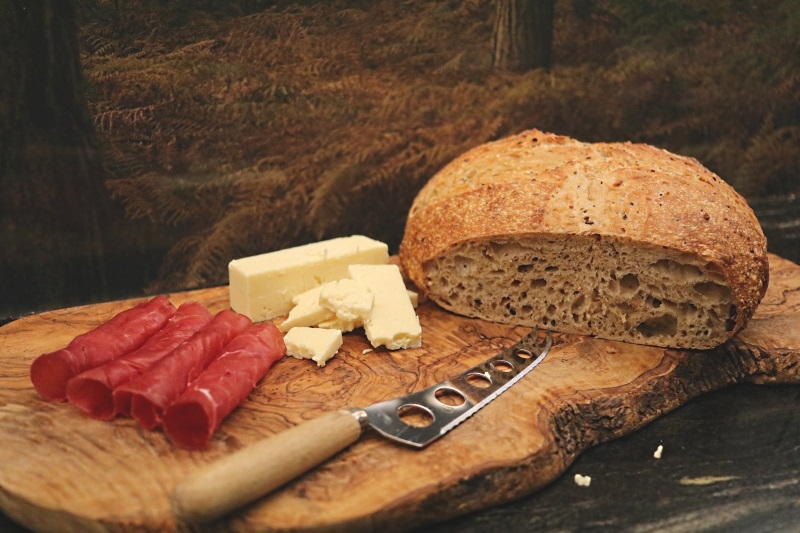
So the result is different, and it is due to the less dense seeded flour. Without doing another experiment, if I used 100% strong white flour, I think it would make little difference to the end result regardless of whether I used by weight or volume. That is on the assumption that the flour is fluffed up to remove the factor of packing density.
-----------------------------------------------------------------------
| Cooking and blogging with a Large and Minimax in deepest, darkest England-shire
| My food blog ... BGE and other stuff ... http://www.thecooksdigest.com
-----------------------------------------------------------------------







Categories
- All Categories
- 184.1K EggHead Forum
- 15.8K Forum List
- 460 EGGtoberfest
- 1.9K Forum Feedback
- 10.4K Off Topic
- 2.2K EGG Table Forum
- 1 Rules & Disclaimer
- 9K Cookbook
- 13 Valentines Day
- 93 Holiday Recipes
- 224 Appetizers
- 520 Baking
- 2.5K Beef
- 88 Desserts
- 167 Lamb
- 2.4K Pork
- 1.5K Poultry
- 33 Salads and Dressings
- 324 Sauces, Rubs, Marinades
- 548 Seafood
- 175 Sides
- 122 Soups, Stews, Chilis
- 44 Vegetarian
- 102 Vegetables
- 313 Health
- 292 Weight Loss Forum