Welcome to the EGGhead Forum - a great place to visit and packed with tips and EGGspert advice! You can also join the conversation and get more information and amazing kamado recipes by following Big Green Egg to Experience our World of Flavor™ at:
Want to see how the EGG is made? Click to Watch
Facebook | Twitter | Instagram | Pinterest | Youtube | Vimeo
Share your photos by tagging us and using the hashtag #BigGreenEgg.
Share your photos by tagging us and using the hashtag #BigGreenEgg.
Want to see how the EGG is made? Click to Watch
Vent Settings, a Visual Guide
Options
Comments
-
Hi All,
A few variables need to be taken into consideration. I'm an XL owner and just did a brisket at 250 for 17 hours. Lower vent was about 1/8-1/4" open and DFMT holes were half open.
I know this is an old thread (originally) but I was stoked to find it. I always seem to need my lower vent MUCH wider on my XL egg. I'm really confused. I just cleaned all the ash out of the bottom, so I don't think that should be impeding airflow. I seem to be going through a ton of lump and my fire keeps going out on overnights even with a much more open setup than this. Any other ideas?
My Egg is on an outside patio and the bottom is enclosed, will still air require a much wider vent (2-3") to pull air and hold temp?
Calibrating the thermo today but it can't be off by THAT much! I really appreciate getting great feedback from the folks here, I love cooking on the Egg, but I must admit to feeling some frustration and unrealized expectations.
Cheers all -
B_B
I think the main variable is how you are lighting your egg. When you light it, how long are you leaving the lid open before closing the dome? I use starter squares and wait until they born out before closing the dome. 1 square in the middle for low temps, 2 squares at 3 & 9 for midrange (300-400) 3 squared at 11, 4, & 8 for high temps. Then I close the lid with DFMT off and bottom vent wide open. When I get to 50 degrees from my temp, I start closing things down. Bottom vent to half closed and DFMT on but wide open. Temp will drop, but then restabilize. Adjust until you get there.
The key is also to be patient. Allow the egg to remain stable at your desired temp for at least 10 minutes before cooking. Also, if using an indirect setup, heat the stone or platesetter up with the egg. If you forget, put in the indirect piece and let the egg come to temp. Don't mess with the vents. It takes a lot of energy to heat the ceramic to equal the dome temp. It will get there. The indirect piece will drop your dome temp by 50 degrees or more depending on the temp of the piece when it goes into the egg.
Hope this helped.
Mark Annville, PA -
Thanks Cort,
A few variables need to be taken into consideration. I'm an XL owner and just did a brisket at 250 for 17 hours. Lower vent was about 1/8-1/4" open and DFMT holes were half open.
I think the main variable is how you are lighting your egg. When you light it, how long are you leaving the lid open before closing the dome? I use starter squares and wait until they born out before closing the dome. 1 square in the middle for low temps, 2 squares at 3 & 9 for midrange (300-400) 3 squared at 11, 4, & 8 for high temps. Then I close the lid with DFMT off and bottom vent wide open. When I get to 50 degrees from my temp, I start closing things down. Bottom vent to half closed and DFMT on but wide open. Temp will drop, but then restabilize. Adjust until you get there.
The key is also to be patient. Allow the egg to remain stable at your desired temp for at least 10 minutes before cooking. Also, if using an indirect setup, heat the stone or platesetter up with the egg. If you forget, put in the indirect piece and let the egg come to temp. Don't mess with the vents. It takes a lot of energy to heat the ceramic to equal the dome temp. It will get there. The indirect piece will drop your dome temp by 50 degrees or more depending on the temp of the piece when it goes into the egg.
Hope this helped.I do think it's been a problem of not letting things equilibrate enough, then chasing temp, possibly also coupled to not enough lump. My mantra for the next overnighter is more fuel, more patience. Thinking about doing a brisket this afternoon...Cheers -B_BFinally back in the Badger State!
Middleton, WI -
This is a great thread and a lot of work went into it obviously. That being said, it's not an exact science and you cannot use the above as more than a reference. Climates differ, lump differs, conditions differ, what you have in the egg makes a difference. It's a nice place to start but don't set it and run out to the store or go to bed thinking you have it locked in.The set up would not be the same in winter in Calgary and summer in Orlando (or even summer and winter in Calgary, for that matter).great reference point and a great place to start but you are going to have to make minor adjustments that fit your circumstancesKeepin' It Weird in The ATX FBTX
-
Cen-tex makes a good point. On low and slows, I monitor temp for an hour or more after the meat goes on before going to bed.There is no exact science to any of it. Trial and error to find your method is part of the learning curve.
If the wind picks up, you may have to change settings. Especially if the wind is blowing right at the draft door. My egg definitely reaches temp faster in warm weather.
However, for the most part, if you stabilize your temp, it will stay within 20 degrees of the desired temp.Mark Annville, PA -
Bump to the top.
Hey hey I know this thread is ancient. First time I've seen it. Bumping to the top cause I feel that it's good knowledge and something people ask about a lot. Like others said this is a guide. Lump, lighting, elevation, egg size, and what day it is on the lunar calendar all play into you egg settings but this is an amazing place to start._______________________________________________XLBGE -
It is ok @mrcookingnurse it makes it easier to find latet. Really, if there was only 1 sticky thread this should be it.
-
Thanks for sharing this info again. I always use you descriptions to initially set my BGE for the temp I'm aiming for...then I fine tune it to my liking. Thanks again...you've been a big help to me and others, I'm sure.Fairview, Texas
-
My settings for 250º are pretty close to his but starting to shut down the vents within 30 or 45 seconds of lighting would be lights out for my fire maybe using alcohol is the difference still I would imagine the available oxygen would be used up real fast. I don't even try to regulate the events until at least 10 minutes have passed but there many roads to most destinations.Gerhard
-
-
I'm setting up for my first low and slow tonight (pulled pork) I walked away for 10 minutes. When I returned, the egg was 800°!gerhardk said:My settings for 250º are pretty close to his but starting to shut down the vents within 30 or 45 seconds of lighting would be lights out for my fire maybe using alcohol is the difference still I would imagine the available oxygen would be used up real fast. I don't even try to regulate the events until at least 10 minutes have passed but there many roads to most destinations.GerhardI finally took the plunge and bought my large Big Green Easter Egg from Roswell Hardware in Roswell, GA 03/31/2012 -
186.3K views must be some kind of record here.
Gittin' there... -
Well I am somewhat surprised you get these temps with these settings and they seem very varied and almost identical results. My bottom setting is always open more than that. Probably about the width of a quarter is the minimum. the daisy wheel is usually open about the width of a dime and that will settle about 350 degrees which is an average cooking temp I use alot for chicken, pork loin etc. My question is is there a difference to fuel efficiency by controlling with the top vs bottom vent? It seems the top vent is going to keep the heat in by being open minimally vs the bottom since heat rises and this would result in slower charcoal consumption? Any thoughts anyone? Bobmugge@roadrunner.comGrandpas Grub said:Please, Calibrate your dome thermometer, if you don't know how, ask.
There are many ways to reach any given temperature and any method is fine. I tend to use the lower vent for course temperature control and the DFMT to fine tune the final temperature.
Hopefully the following will give new users a head start in learning to control and stabilize their egg.
The following are settings on my Large. The setting for my medium, small and mini settings will vary somewhat.
A stable clean burn can be seen by looking at the dome pictures below. You want a clear or light blue smoke coming out of the egg.
265° Using 1/16” open lower vent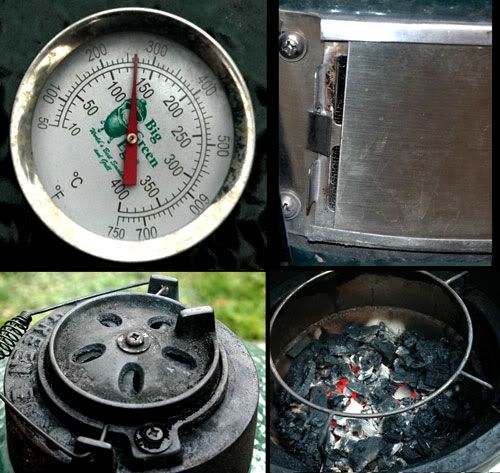
315° Using 1/16” open lower vent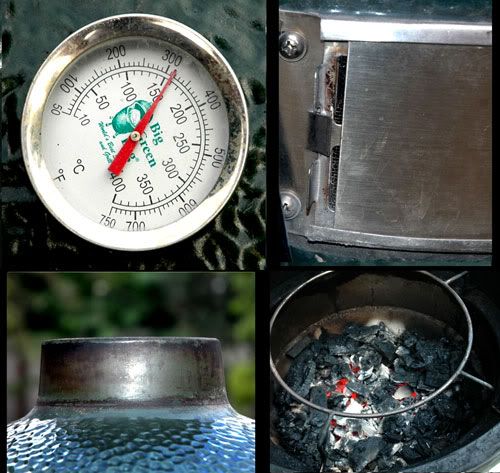
The following have a larger lower vent opening
250°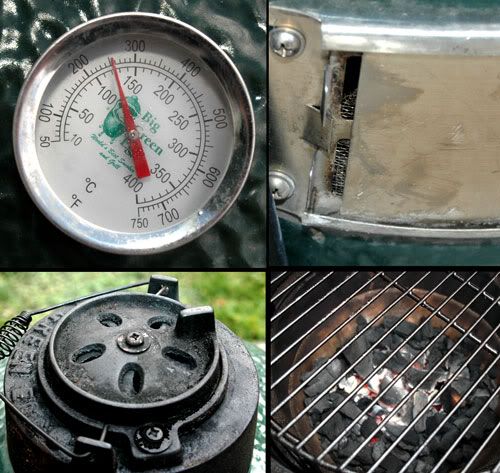
300°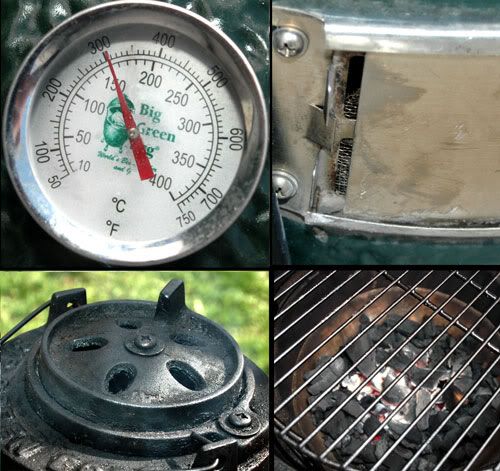
370°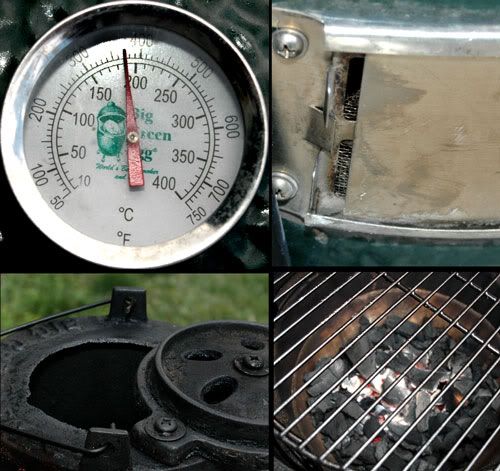
390°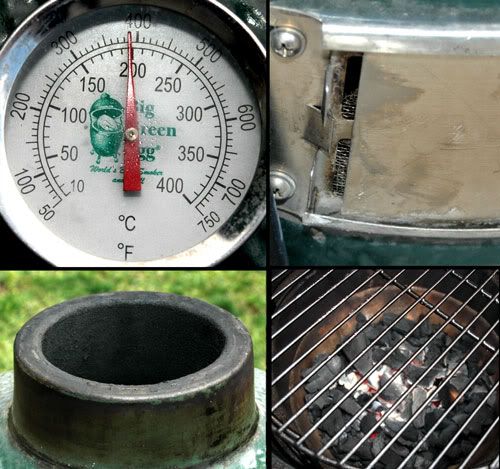
I need to open the lower vent to go higher. 450°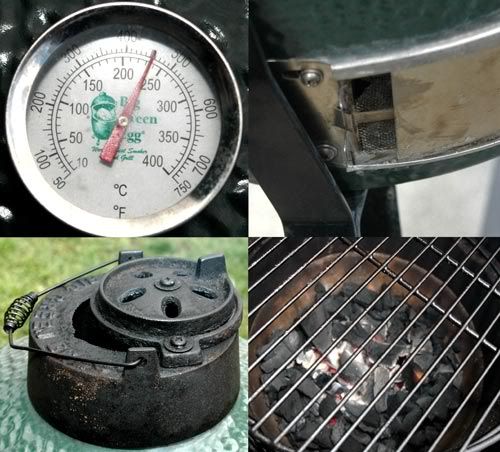
GG
-
It's good to BUMP this thread once a year or so for the noobs, this is one of my few bookmarks.:-bd_____________
Tin soldiers and Johnson's coming...
-
I have to tell you, sir.......YOU are the freakin MAN!!!!! I have struggled with temperature control since I got my LBGE a couple months ago, but you "starting point" has helped the lightbulb to go off in my hillbilly head! Thanks so much for posting this!
-
I see @Grandpas Grub was last Active -May 2012, anyone know what happened to him, is he still 'with' us?I've slow smoked and eaten so much pork, I'm legally recognized as being part swine - Chatsworth Ca.
-
Kent is doing well. I see him on the other forum from time to time (where this thread originated). June 12 the latest. I've never seen him here.
I hate it when I go to the kitchen for food and all I find are ingredients!
MichaelCentral Connecticut -
@Carolina Q ... there's 'another' forum? In the words of Johnny Carson ' I did not know that' ... I like this forum.I've slow smoked and eaten so much pork, I'm legally recognized as being part swine - Chatsworth Ca.
-
I was also wondering the same thing. Can anyone who knows more than me answer this?bobmugge said:My question is is there a difference to fuel efficiency by controlling with the top vs bottom vent? It seems the top vent is going to keep the heat in by being open minimally vs the bottom since heat rises and this would result in slower charcoal consumption? Any thoughts anyone? Bobmugge@roadrunner.com -
Same charcoal burn rate for the same temps. The egg is an air limited fire. Whether you limit air by bottom or top, or both vents, same thing. More airflow=more fire=more lump consumption.tdgator13 said:
I was also wondering the same thing. Can anyone who knows more than me answer this?bobmugge said:My question is is there a difference to fuel efficiency by controlling with the top vs bottom vent? It seems the top vent is going to keep the heat in by being open minimally vs the bottom since heat rises and this would result in slower charcoal consumption? Any thoughts anyone? Bobmugge@roadrunner.comThey/Them
Morgantown, PA
XL BGE - S BGE - KJ Jr - HB Legacy - BS Pizza Oven - 30" Firepit - King Kooker Fryer - PR72T - WSJ - BS 17" Griddle - XXL BGE - BS SS36" Griddle - 2 Burner Gasser - Pellet Smoker -
So leaving the top vent all the way open does not let the heat escape like one would think? It actually makes it hotter? Sorry for the newbie questions. Just confused by the pictures (like the 315 pics). Usually I leave the top and bottom barely open and get the same temp.Same charcoal burn rate for the same temps. The egg is an air limited fire. Whether you limit air by bottom or top, or both vents, same thing. More airflow=more fire=more lump consumption. -
Let me say that I'm a total egg noob, and finding all of the community support to be awesome. One quik thought on the top vent. So lots of folks don't seem to think the top vent is as important, and lots of folks not using it at all. I would think that the daisy is super important to air speed and convection action. The air does not just go from bottom to top, it has a true circulating convection air flow? If true, the top vent would be super important to things like dryness and texture of any skin or bark on the meat. Also how much smoke flows over the meat when smoking.
Thoughts? -
Tat very helpful. ThanksLbge. Maverick 733, ss top, 30" fire pit, gas grill, small charcoal grill, electric smoker, 65 qt yeti, 35 qt yeti.
-
Thanks so much for the awesome post, it really helped me control my temps!
-
Bump it up once a year they say.. lots of good info here
-
2009 was a good year.They don’t want a population of citizens capable of critical thinking. They don’t want well informed, well educated people capable of critical thinking. They’re not interested in that. That doesn’t help them. That's against their interests. - George Carlin
-
Vintage.Ozzie_Isaac said:2009 was a good year.Sandy Springs & Dawsonville Ga -
great visuals here
-
My go to post, but now there are photobucket errors. Can we repost pics. @Grandpas Grub
-
I haven't seen @Grandpas Grub post here in a long time.cdthomas23 said:My go to post, but now there are photobucket errors. Can we repost pics. @Grandpas Grub
I've seen so many tutorials, examples, how-to's, etc on all my forums (motorcycles, photography, pizza, Egg, home theater, etc) disappear when Photobucket went to a paid service. I don't have any problem with a company wanting to make a profit, but so many people depended on their free service for so long, it really was a huge step back when they went to a pay service, especially at the ridiculous price of $400/yr (iirc). I've moved to (paid) smugmug, but I won't be going back to repost eight years of photos from the past._____________Tin soldiers and Johnson's coming...


Categories
- All Categories
- 182.7K EggHead Forum
- 15.7K Forum List
- 459 EGGtoberfest
- 1.9K Forum Feedback
- 10.3K Off Topic
- 2.2K EGG Table Forum
- 1 Rules & Disclaimer
- 9K Cookbook
- 12 Valentines Day
- 91 Holiday Recipes
- 223 Appetizers
- 516 Baking
- 2.4K Beef
- 88 Desserts
- 164 Lamb
- 2.4K Pork
- 1.5K Poultry
- 30 Salads and Dressings
- 320 Sauces, Rubs, Marinades
- 543 Seafood
- 175 Sides
- 121 Soups, Stews, Chilis
- 35 Vegetarian
- 100 Vegetables
- 313 Health
- 293 Weight Loss Forum