Share your photos by tagging us and using the hashtag #BigGreenEgg.
Want to see how the EGG is made? Click to Watch
Dome Temp vs Grate Temp

On average what is the difference in dome temp vs grate temp? I have been strictly going by grate temp with my Redi Check and it seems like my cooks are taking forever and sometimes not coming out right (pork shoulder). Then I checked the difference between my dome temp vs grate temp at it was a 70 degree difference (done 240, grate 311). How often are the Redi Check probes sent out calibrated incorrect? How do I set those?
I was assuming it is more likely that my dome thermometer is off however due to cook times it seems my Redi Check probe is off.

Comments
-
I calibrated my dome thermometer in boiling water and I have the Thermoworks smoke thermometer for the grate. I have only been seeing about 30-40 degrees hotter in the dome.
-
generally recipes off the forum are by dome temp if theres just mention of a temp. also if your getting recipes from other sources i add about 10/20 percent to oven temps for dome temps.
fukahwee maineyou can lead a fish to water but you can not make him drink it -
How are you setting you the probe on the grate? Are you using the little triangle with holes in it or foil to keep it about an 1" of the grate? I use foil. When I do a low & Slow mine grate temp and dome temp are around a 50 degree difference, but get to about a 20 degree or less as the cook goes on. Do like @Todd_n_amanda said with the REDI CHEK with some boiling water and see what it reads. Water boiling point is 212 and if the the water is bubbling and your gauge is real high it needs reset, I am not sure how to calibrate the REDI CHEK.
As for pork shoulders I cook them between 250 and 275 most of the time and that is using the dome temp. That usually gives me about a pound and hour. Now I have done them turbo at 350+ and had a 9 pound shoulder done in about 6 hours cooking at 350. I go more by internal temp and feel and as long as the egg is 225 or more its not a problem for me on low & slows.
XL, WSM, Coleman Road Trip Gas GrillKansas City, Mo. -
Give both the dome thermo and probe the boiling water test. Dome thermo can be calibrated with nut on the back, I don't know if the redi-check (my maverick has this name on the box as well) can. Cooking temps on the forum are dome readings. Yes the temps vary a great deal between dome and grid and get closer the longer the cook progresses. Unless you are doing low and slow there is no need for a grid reading and there are several respected members who will tell you it isn't even necessary then. Others will attach grid probe to the dome stem. Just a heads-up, if you use the grid probe on a direct cook 400* or above you run the risk of ruining the probe wires..Nerk Ahia LBGE
-
I just purchased my egg a few weeks ago and the dome thermometer was reading about 20 degrees cold when I did the boil test.
-
I have no idea. I've never measured grid temp and don't care what it is. BGE puts their thermo in the dome, my kitchen stove mfg put their temp sending unit at the top of the oven and most recipes specify dome temp or "oven" temp. I have a Maverick, but haven't used it in years. Not worth the bother.
I hate it when I go to the kitchen for food and all I find are ingredients!
MichaelCentral Connecticut -
That makes sense why my pork shoulders aren't coming out that well and my ribs are taking forever if I am basing the temps off grate temp. I would set the bge to 250ish grate temp however this would only be 200ish dome temp.
@Ladeback69 I use the triangle with holes in it and place back right on the grate in probably the hottest part of the grate. I will check probes and thermometer with boiling water. Is there anyway to calibrate the Redi Check probe?
Thanks
-
Just about the only time the dome and grate temps are the same is towards the end of a long lo-n-slo cook.
If you are cooking direct, any food exposed to the lump's glow will be getting hotter than what the dome therm reads. For instance, w. a dome above 500F for a direct sear, the bottom of a steak at the fire ring level is getting about 1800F. If you are cooking indirect, and there is a big mass of cold pork sitting above a cold plate setter, and a drip pan w. water in it, within an inch or two of the meat the air temp can be under 200F, while the warmer air that passed by the sides of the 'setter is gathering around the dome and is around 275.
W. a little practice, you will end up w. a pretty good estimate of how the food is cooking. I hardly look at my dome therm anymore, and just pay attention to how much the vents are open.
-
Would cooking at a dome temp of roughly 185-210 also cause the temp to fluctuate more? I guess what I am trying to say is it harder to hold temps in the 185-210 range. Seems like I have been chasing temps a little bit on the longer cooks. Wonder if I when I bump the dome temp to 250-275 if it will hold better.
-
he who has two thermometers never knows the correct temp.
 i only use a grate thermo for overnighters because it has an alarm to go off if temps are dropping. i dont pay much attention to the actual temp, just spikes and drops. 250 plus minus dome temp works well for me, i set the grate temp with a low alarm of 170 and a high alarm around 280. you put that grate temp gage near a cold piece of meat and it throws the readings way off, it affects the dome gage as well, thats why we stabilize the egg for an hour before the butt goes on and do not pay attention to readings for several hours, trust the egg, not the gages so much
fukahwee maineyou can lead a fish to water but you can not make him drink it -
Most low and slow egg cooks are at 250°. Some are able to maintain 225°, but I don't recall hearing of anyone at 185-210° dome. Eggs like 250-275°.
Many folks turbo cook (350°). Done much quicker (overnight not needed) and just as good.I hate it when I go to the kitchen for food and all I find are ingredients!
MichaelCentral Connecticut -
jerky 145 to 175 for 8 hours. have not made that in a whileCarolina Q said:Most low and slow egg cooks are at 250°. Some are able to maintain 225°, but I don't recall hearing of anyone at 185-210° dome. Eggs like 250-275°.
Many folks turbo cook (350°). Done much quicker (overnight not needed) and just as good.
fukahwee maineyou can lead a fish to water but you can not make him drink it -
I have never been able to get my XL to stay much below 225 for long cook except for maybe at the very beginning. As for being more stable at a set temp, it is all in how you catch it on the way up. If I want to smoke/cook at 225, I start closing down the vents when the dome temp is at 190 to 200. I usually set the bottom at about an 1/8" to 3/16" and the same for the top. If I want to cook at 250, I start shutting the vents down around 220 to 230 or a little sooner with the same vent settings.outdoorsmin said:Would cooking at a dome temp of roughly 185-210 also cause the temp to fluctuate more? I guess what I am trying to say is it harder to hold temps in the 185-210 range. Seems like I have been chasing temps a little bit on the longer cooks. Wonder if I when I bump the dome temp to 250-275 if it will hold better.
Also remember when you put on a large piece of cold meat the temp will drop a little. Don't mess with your settings, just let it ride and you desired temp should come back in about 30 to 40 minutes or so.
The key is to get it set at the temp you want for at least 40 to 60 minutes so you know it is good to go. Don't worry if the temp changes a few degrees or even 10. If you start messing with it, it is hard to get it set right.
I have a dual gauge temp meter, but use the grate temp like @fishlessman does as an alarm if it gets to hot or to low. I have had some issues my egg dropping over night when it got colder then expected or it started to rain. The SmokeWare SS Cap has fixed most of that and my egg is now almost set it and forget it till it is done.XL, WSM, Coleman Road Trip Gas GrillKansas City, Mo. -
For ribs I only use the dome temp and do a 2-1-1 most of the time at 225-250 and my ribs come out great every time. For best cooking/smoking temps to me is between 250 and 275 depending on what you are cooking. Brisket I start out at 225, but will raise it to 250 to 275 sometimes to finish it up.outdoorsmin said:That makes sense why my pork shoulders aren't coming out that well and my ribs are taking forever if I am basing the temps off grate temp. I would set the bge to 250ish grate temp however this would only be 200ish dome temp.
@Ladeback69 I use the triangle with holes in it and place back right on the grate in probably the hottest part of the grate. I will check probes and thermometer with boiling water. Is there anyway to calibrate the Redi Check probe?
Thanks
If I cook ribs straight through I go with 275 for about 4 to 5 hours and they come out great that way too, I just like the flavor profile the 2-1-1 gives me better.XL, WSM, Coleman Road Trip Gas GrillKansas City, Mo. -
There has been speculation that the problem w. temps down around 180 means there are only 1 or 2 pieces of lump burning. The big downside is that the pieces will burn away w/o kindling another piece. Even if another piece starts burning, at 1st, it will only be a small portion. Thus the fluctuation. Fires that produce a 250 dome usually have a large area of lump going, so unless the fire burns straight down, all the lump will eventally be kindled.outdoorsmin said:Would cooking at a dome temp of roughly 185-210 also cause the temp to fluctuate more? I guess what I am trying to say is it harder to hold temps in the 185-210 range.
-
This is reverse of what is normally reported. Most people find the dome temps to be HIGHER than grid temps. You are probably placing the grid probe in a hot air draft. A 25º higher dome temp in the early part of a low and slow is typical. Grid temps will often rise to match the dome later in the cook.outdoorsmin said:That makes sense why my pork shoulders aren't coming out that well and my ribs are taking forever if I am basing the temps off grate temp. I would set the bge to 250ish grate temp however this would only be 200ish dome temp.
@Ladeback69 I use the triangle with holes in it and place back right on the grate in probably the hottest part of the grate. I will check probes and thermometer with boiling water. Is there anyway to calibrate the Redi Check probe?
Thanks
My guess is that your 250º grid temp is draft influenced and not really typical of grid temps. The 200º dome probably is really a 175º grid, which will not get your pork shoulders and ribs done. Try moving the grid probe away from any drafts, but not too close to the cold meat.Southeast Florida - LBGE
In cooking, often we implement steps for which we have no explanations other than ‘that’s what everybody else does’ or ‘that’s what I have been told.’ Dare to think for yourself. -
I agree completely.Carolina Q said:I have no idea. I've never measured grid temp and don't care what it is. BGE puts their thermo in the dome, my kitchen stove mfg put their temp sending unit at the top of the oven and most recipes specify dome temp or "oven" temp. I have a Maverick, but haven't used it in years. Not worth the bother.
NOLA -
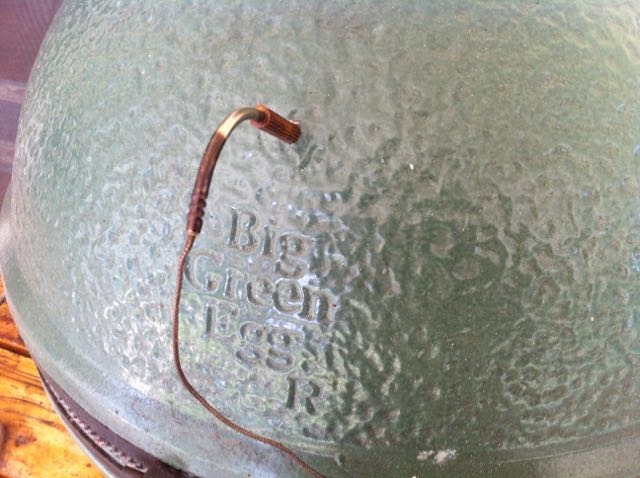
If you like the functionality of a remote thermometer, use it a replacement for the BGE dome thermometer and not an addition.
Southeast Florida - LBGE
In cooking, often we implement steps for which we have no explanations other than ‘that’s what everybody else does’ or ‘that’s what I have been told.’ Dare to think for yourself. -
@jtcboynton Could it be the result of outside temperature air being at 25-30 degrees? Or the combination of putting the grid probe in where the air is going around the pacesetter and directly hitting my probe combined with cool outside temperature affected the dome probe?
-
I find that it is very hard to get consistent results using a grid probe in an egg. After loading the grid with food, it is hard to find a spot that will not get direct hot air drafts and are far enough away from the meat to not be influenced by the cold meat. Dome temps seem to be steadier and close enough.outdoorsmin said:@jtcboynton Could it be the result of outside temperature air being at 25-30 degrees? -- doubtful
Or the combination of putting the grid probe in where the air is going around the pacesetter and directly hitting my probe combined with cool outside temperature affected the dome probe? -- most likely just the air going around the platesetter and directly hitting the probeSoutheast Florida - LBGE
In cooking, often we implement steps for which we have no explanations other than ‘that’s what everybody else does’ or ‘that’s what I have been told.’ Dare to think for yourself. -
@jtcboynton that makes sense. Just easier to monitor on long cooks with the wireless probe. I will try using the Maverick probe in the dome as you suggested above. This should do the trick. Thanks for you help!
-
After 15-20 years of doing this stuff, I found that "egg temp" makes very little difference in the final product. It's mostly about pulling the meat at the correct internal temp, especially for "grilling meats" like steaks, chicken, etc.. For "BBQ meats" like brisket, pork shoulder & pulled beef, it's most important to go by "probe tenderness" as each one finishes at a temp a little different.Packerland, Wisconsin
-
The best solution to make these temperatures the same is to put in a dome thermometer that reaches the grate. Problem solved.
______________________________________________I love lamp.. -
Make sure the grid probe is not exposed to burning lump, it must be in the shadow of a setter leg.Delta B.C. - Whiskey and steak, because no good story ever started with someone having a salad!
-
I'm a new Egger and did the same comparisons w/ my XL after calibrating the thermometers. I found approx the same delta as you, but reversed. The dome temp was up to 70deg higher than the grate temp... but the longer I left it, the less the delta became. It never got closer than ~20deg.outdoorsmin said:I checked the difference between my dome temp vs grate temp at it was a 70 degree difference (done 240, grate 311).
First make sure your grate probe is over the platesetter, at least over one of its legs... not over one of the open gaps between the platesetter and egg.
Ultimately I just allow for the difference. If I want a low and slow 225deg, I get the dome thermometer to 250-275deg. As the cook progresses, I don't worry about 25-30deg fluctuations. Notice one of the old timers above said he set his high/low alarms at about 100deg delta. It won't hurt your cook.
Most important to me on a whole bird or hunk of meat is the meat probe AND then an instant read check at various points in the meat. Don't get hung up on 20-30-40deg temp variations at the dome or grid. Just my .02
Of all the lies I tell, "Just kidding" is my favorite.
XLBGE, Jordan Lake, NC


Categories
- All Categories
- 184K EggHead Forum
- 15.8K Forum List
- 459 EGGtoberfest
- 1.9K Forum Feedback
- 10.4K Off Topic
- 2.2K EGG Table Forum
- 1 Rules & Disclaimer
- 9K Cookbook
- 13 Valentines Day
- 93 Holiday Recipes
- 224 Appetizers
- 520 Baking
- 2.5K Beef
- 88 Desserts
- 167 Lamb
- 2.4K Pork
- 1.5K Poultry
- 33 Salads and Dressings
- 324 Sauces, Rubs, Marinades
- 548 Seafood
- 175 Sides
- 122 Soups, Stews, Chilis
- 44 Vegetarian
- 102 Vegetables
- 313 Health
- 292 Weight Loss Forum