Share your photos by tagging us and using the hashtag #BigGreenEgg.
Want to see how the EGG is made? Click to Watch
ThermoWorks vs. Reverse Sear?

I was interested in the recommended procedure for a Rib Roast (in an oven, but the principles all would be the same for the Egg) by ThermoWorks, maker of the Thermapens most of us love. I was surprised to read this:
We chose to pre-sear the roast prior to putting it in the oven. Searing first allows us to achieve the desired browning on the surface without overcooking. If we were to sear after cooking we risk over cooking a quarter to half inch of the meat closest to the surface leaving a thin layer of gray meat. While this doesn’t completely ruin the roast, it does not achieve the goal of edge to edge even coloration and doneness.
I hadn't really thought about it, before, but suddenly it made sense to me:
- When searing before a low-temp roast, the meat is colder and raw when seared, so the searing heat would have a harder time getting raw meat below the surface overcooked, whereas
- When searing occurs after the low-temp roast, the meat is already hot, has been cooked nearly to finished temperature, so the searing heat on the surface doesn't have to raise the temperature of the already hot, nearly cooked to perfection meat below the surface very far to overcook it.
What do you reverse sear enthusiasts think?
Comments
-
i don't reverse sear roasts for this reason. plus, the long slow cook gives you way more rare/medium/rare meat in the cross section (each slice, i mean)
drying it before hand actually makes for a better all over golden brown than searing does too, INSMHO
[social media disclaimer: irony and sarcasm may be used in some or all of user's posts; emoticon usage is intended to indicate moderately jocular social interaction; the comments toward users, their usernames, and the real people (living or dead) that they refer to are not intended to be adversarial in nature; those replying to this user are entering into a tacit agreement that they are real-life or social-media acquaintances and/or have agreed to or tacitly agreed to perpetrate occasional good-natured ribbing between and among themselves and others] -
Do you not sear at all on larger beef cuts?Darby_Crenshaw said:i don't reverse sear roasts for this reason. plus, the long slow cook gives you way more rare/medium/rare meat in the cross section (each slice, i mean)
drying it before hand actually makes for a better all over golden brown than searing does too, INSMHOI would rather light a candle than curse your darkness.
-
I only so steaks so far. I haven't seared a roast or large beef cut on the egg. I have seared a roast before putting it in a crock pot back in the day.
XL, WSM, Coleman Road Trip Gas GrillKansas City, Mo. -
Sounds good, but I have read well reasoned discussions that show that it is actually the opposite. Reverse sear will actually get less heat into the interior during searing, leaving less internal gray.Southeast Florida - LBGE
In cooking, often we implement steps for which we have no explanations other than ‘that’s what everybody else does’ or ‘that’s what I have been told.’ Dare to think for yourself. -
I confess that I usually just cook steaks on a pretty high heat and flip them often, but when I've had a really thick, special steak, from time to time, I've T-Rex'd them (searing first). I've never tried a reverse sear, so I can't say from experience whether I like it better or worse. The main reason I've been sort of against the idea was just that when the final cooking stage is the low-and-slow, you can be very precise in pulling it at exactly the temp you want because that temp is rising pretty slowly. I would have thought that when the final cooking stage is the sear, the difference between perfectly done and a little overcooked might be a few seconds. It just feels safer to me to do the sear first, and then take my time cooking them to perfection on a lower fire.
Again, though, I've never done it, and can't speak from any experience with reverse sear. That's why I figured I'd see what people here say who've done it both ways.
-
The main reason to for me to reverse sear as it's easier to heat the egg than to cool it. If I'm doing a steak in the kitchen, I'll sear in the cast iron first, and then finish in the oven.
NOLA -
It is safer to sear first then low heat than to reverse sear. The differences are subtle, but you can get less interior gray with reverse sear, if done perfectly. On the egg, it is easier to raise cooking temp than to lower it, thus leading many to reverse sear.Southeast Florida - LBGE
In cooking, often we implement steps for which we have no explanations other than ‘that’s what everybody else does’ or ‘that’s what I have been told.’ Dare to think for yourself. -
Theophan said:I confess that I usually just cook steaks on a pretty high heat and flip them often, but when I've had a really thick, special steak, from time to time, I've T-Rex'd them (searing first). I've never tried a reverse sear, so I can't say from experience whether I like it better or worse. The main reason I've been sort of against the idea was just that when the final cooking stage is the low-and-slow, you can be very precise in pulling it at exactly the temp you want because that temp is rising pretty slowly. I would have thought that when the final cooking stage is the sear, the difference between perfectly done and a little overcooked might be a few seconds. It just feels safer to me to do the sear first, and then take my time cooking them to perfection on a lower fire.
Again, though, I've never done it, and can't speak from any experience with reverse sear. That's why I figured I'd see what people here say who've done it both ways.
you have a good point. I think you can have problems either way. With a forward sear, if the meat is not dry and the steak isn't real thick and the pan (or fire) isn't real hot, the center can get overcooked by the time you get the desired char. your point about the reverse sear is also true - you have to judge how much time/temp the charring will take and factor that into the temp that you pull after the low and slow. When I do the reverse sear, I do it with a thick steak and I pull at 100* IT, then sear at full thermonuclear blast.I don't do a lot of big beef roasts but agree w above. a dry, well seasoned roast can have plenty of crust without needing any sear at all.
Xmas Eve will be a whole filet, reverse seared, like a steak. Hard to beat. Mmmmm steak.
Chicago, IL - Large and Small BGE - Weber Gasser and Kettle -
Little Steven has suggested no sear at all on a rib roast, not all the time, just for some cooks. Depends if you like that crust that is appealing on a steak, but many don't mind it being absent on a roast. The sear is for looks and presentation, IMO.Ozzie_Isaac said:
Do you not sear at all on larger beef cuts?Darby_Crenshaw said:i don't reverse sear roasts for this reason. plus, the long slow cook gives you way more rare/medium/rare meat in the cross section (each slice, i mean)
drying it before hand actually makes for a better all over golden brown than searing does too, INSMHO
Last two rib roasts were done in the Trés Booblay (SV) and hit with a torch for looks. Edge to edge the same.....Delta B.C. - Whiskey and steak, because no good story ever started with someone having a salad! -
@Skiddymarker,
Seems legit.
I wonder if an egg sear, before SV and torch, would help add a little texture and flavor?
Need to try a low heat (250s and let cruise up), rotisserie roast. Maybe over the holidays?BrandonQuad Cities
"If yer gonna denigrate, familiarity with the subject is helpful." -
In my mind this is only true if you don't have the fire hot enough. A super hot fire shouldn't overcook the outer portion.
I've done reverse sear with whole tenderloin with perfect results, but I've never done a rib roast.
If the fire is crazy hot and you keep the roast moving, reverse sear should still work.
Quite honeslty, either method, if done correctly to a good hunk of beast, will give a great result.Pittsburgh, PA - 1 LBGE -
I think when searing first you have more control, but as @buzd504 said, it is harder to cool the egg down from 650 than it is to crank it up to 650.
-
The water bath tends to soften everything (my experience) not sure if a sear before would result in a crust with some texture. Have a small 2 rib roast in the freezer, might just try it.Focker said:@Skiddymarker,
Seems legit.
I wonder if an egg sear, before SV and torch, would help add a little texture and flavor?
Need to try a low heat (250s and let cruise up), rotisserie roast. Maybe over the holidays?
One of my favourite ways to do eye of round for Italian beef was using the spit on the gasser, until I got a kamado. SWMBO does not care for smokey rib roasts so the egg gets the day off most cooks.Delta B.C. - Whiskey and steak, because no good story ever started with someone having a salad! -
@Ozzie_Isaac i dont sear large cuts. I prefer a dark crisp brown crust, and find searing tends to burn fat rather than brown it
I dont sear not because i dont want color and crust, but because i get a better one by roasting. And a better (full cross section) of medium rare with no grey outer layer
[social media disclaimer: irony and sarcasm may be used in some or all of user's posts; emoticon usage is intended to indicate moderately jocular social interaction; the comments toward users, their usernames, and the real people (living or dead) that they refer to are not intended to be adversarial in nature; those replying to this user are entering into a tacit agreement that they are real-life or social-media acquaintances and/or have agreed to or tacitly agreed to perpetrate occasional good-natured ribbing between and among themselves and others] -
I reverse sear larger cuts all the time and easily get edge to edge uniform doneness. Much prefer to reverse sear...plus Alton Brown proved it to be best. If AB is sold then so am I.Joe - I'm a reformed gasser-holic aka 4Runner Columbia, SC Wonderful BGE Resource Site: http://www.nakedwhiz.com/ceramicfaq.htm and http://www.nibblemethis.com/ and http://playingwithfireandsmoke.blogspot.com/2006/02/recipes.html
What am I drinking now? Woodford....neat -
Leave the lid open when letting the fire grow for searing and the ceramics will not heat up nearly as much. Then when the lid is closed for the rest of the heating, it's not bad. This works well for steaks. For a big roast, I agree with Darby. It will look fine just from roasting for an hour or more without needing a sear.BYS1981 said:I think when searing first you have more control, but as @buzd504 said, it is harder to cool the egg down from 650 than it is to crank it up to 650.Cooking on an XL and Medium in Bethesda, MD. -
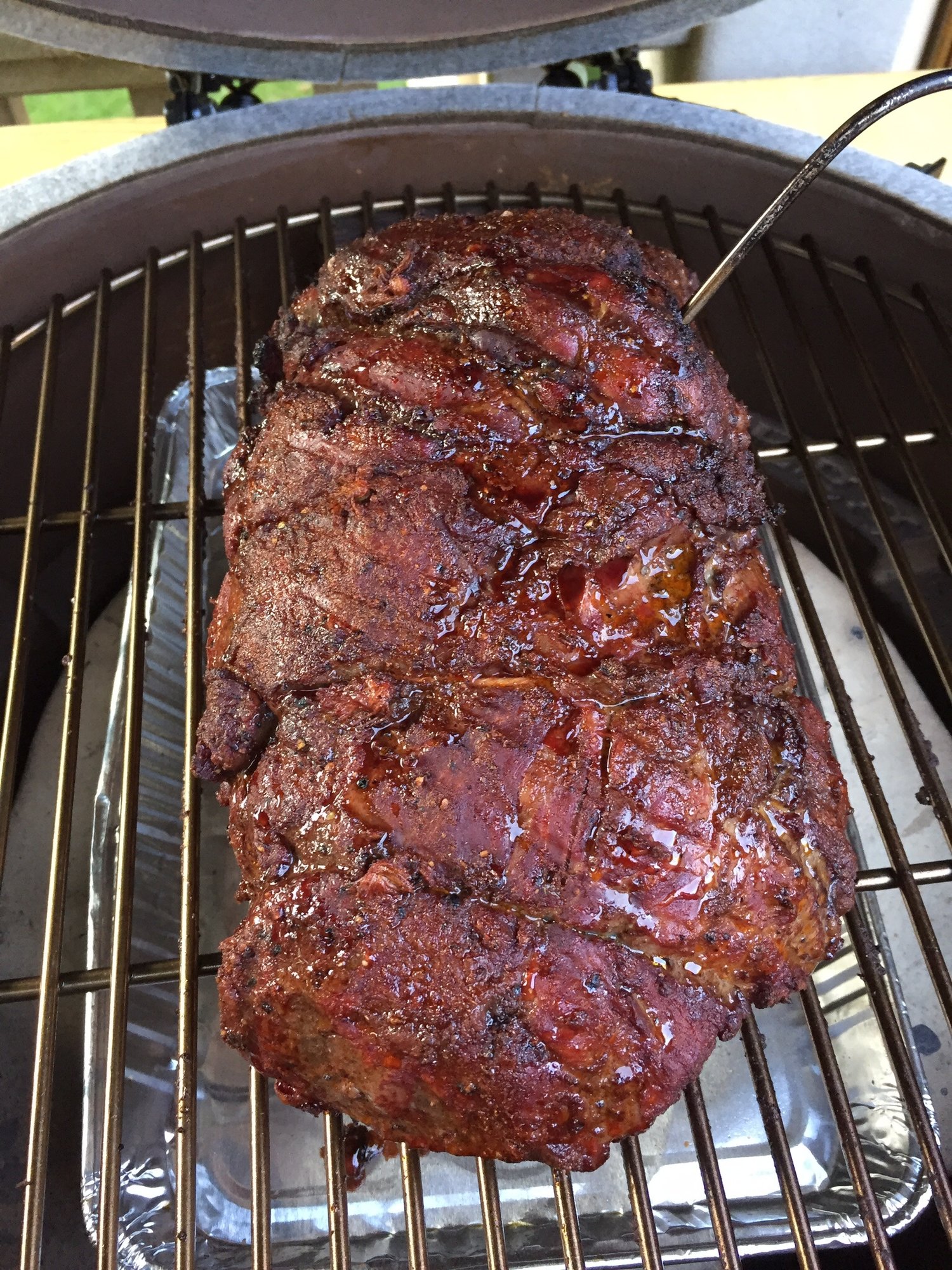 Don't care for the reverse sear on a roast. Usually pull at about 125 internal. Good color all the way through. Have tried reverse sear on thick filets. Have 2 LBGE, so low on one and immediately to the other for the sear. Can't tell much difference. Have been cooking on the BGE for almost thirty years so old habits are hard to break. Heck, I still use the ceramic lid to control temp on one. Trying to get used to the daisy wheel on the other.
 -
Honestly, I don't see much of a difference in sear-first or reverse sear. If I'm in the kitchen, I generally sear first, just because it's easy to sear and throw the whole cast-iron pan into the oven. Outside, I'll tend to reverse sear, because as has been mentioned it's easier to heat than to cool.
That said, one of the key benefits for me with the reverse-sear has to do with resting. I like to rest my steaks 10-15 minutes after cooking, and roast up to 30 minutes. With a reverse-sear, you can do that rest in between the cooking and the sear....meaning that when the table is all set and you're ready to eat, you sear the meat and put it right on the plate. This timing benefit works out the best for me. -
Personally, I like the reverse sear more. When you sear first, it looks good but it's a soggy wet sear by the time you are done cooking. When you reverse sear, you end up a nice sear that isn't too wet and it looks good.
Aledo, Texas
Large BGE
KJ Jr.
Exodus 12:9 KJV
Eat not of it raw, nor sodden at all with water, but roast with fire; his head with his legs, and with the purtenance thereof. -
searing a rib roast used to be just a higher heat start, under 500 degrees, not really a sear. i just start at 450/500 for some color, then drop temps and finish, a modified trex approach. searing a ribroast after a low and slow has never worked for me, the fat is too runny by that time. darbys approach of dry aging is the better approach but i never have advanced plans for this cook, i see a good roast at a good price on friday and its on the grill by sunday
this works for other things as well, chicken comes to mind, get the skin cooked first and your not overshooting finished temps by searing later
fukahwee maineyou can lead a fish to water but you can not make him drink it




Categories
- All Categories
- 184K EggHead Forum
- 15.8K Forum List
- 459 EGGtoberfest
- 1.9K Forum Feedback
- 10.4K Off Topic
- 2.2K EGG Table Forum
- 1 Rules & Disclaimer
- 9K Cookbook
- 13 Valentines Day
- 93 Holiday Recipes
- 224 Appetizers
- 520 Baking
- 2.5K Beef
- 88 Desserts
- 167 Lamb
- 2.4K Pork
- 1.5K Poultry
- 33 Salads and Dressings
- 324 Sauces, Rubs, Marinades
- 548 Seafood
- 175 Sides
- 122 Soups, Stews, Chilis
- 44 Vegetarian
- 102 Vegetables
- 313 Health
- 292 Weight Loss Forum