Welcome to the EGGhead Forum - a great place to visit and packed with tips and EGGspert advice! You can also join the conversation and get more information and amazing kamado recipes by following Big Green Egg to Experience our World of Flavor™ at:
Want to see how the EGG is made? Click to Watch
Facebook | Twitter | Instagram | Pinterest | Youtube | Vimeo
Share your photos by tagging us and using the hashtag #BigGreenEgg.
Share your photos by tagging us and using the hashtag #BigGreenEgg.
Want to see how the EGG is made? Click to Watch
Cheesburger Soup

Gunnar
Posts: 2,307
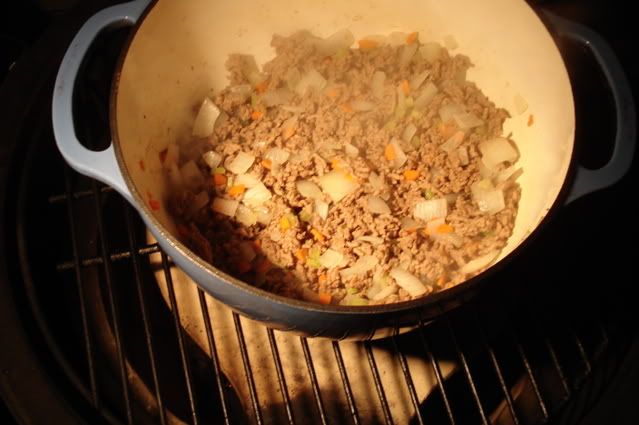
Yeah, I know it was supposed to be brisket burgers tonight. The store only had two 12 & 14 lb whole briskets and I didn’t want a burger that bad. I did want to try this soup I came across. Yes, it’s whimsical, but what the heck. Ground beef, onions, celery and carrots.
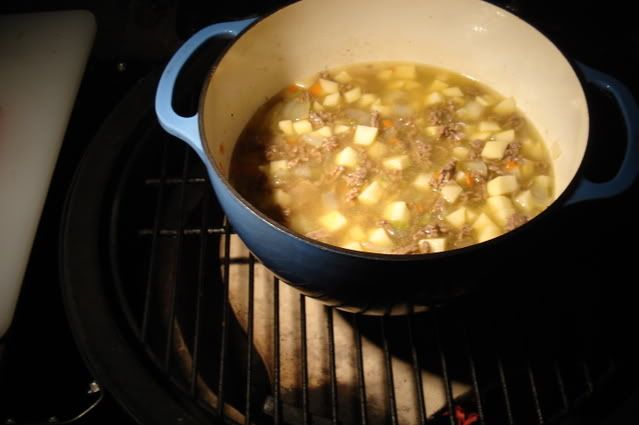
Added chicken broth and diced potato's.
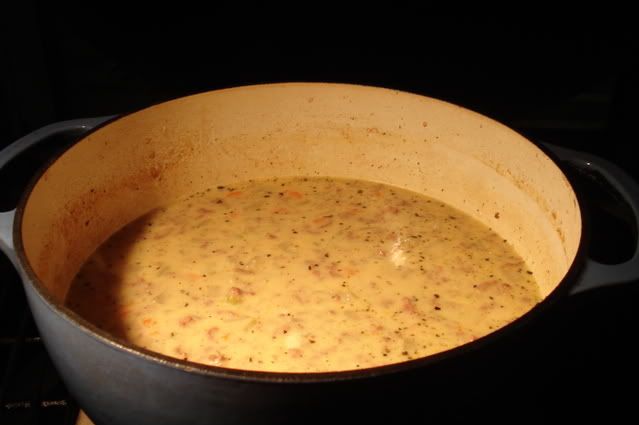
Some rue from butter, flour and milk. Added cheese, salt, pepper and yes ketchup and mustard when finished.
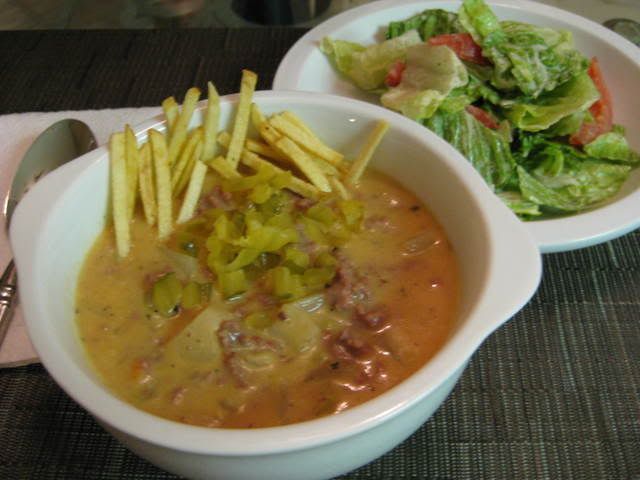
Some shoestring potato's and diced pickle for garnish.
Added chicken broth and diced potato's.
Some rue from butter, flour and milk. Added cheese, salt, pepper and yes ketchup and mustard when finished.
Some shoestring potato's and diced pickle for garnish.
LBGE Katy (Houston) TX
Comments
-
Hi Gunnar. That looks mighty tasty. Comfort food to the max.
Just wondering....I am still learning about roux and other ways to thicken soups, etc, but I always thought you had to add your liquid to a roux, not the other way around. Did you add the roux to the soup?? If so, how....and did you have a problem with clumping?
Or did you make a sort-of bechamel sauce, by adding milk to your flour/butter roux, then add that to the soup??
And finally....wow...ketchup? LOL.
Looks really yummy.
Thanks!
Chris -
I have made it and added the roux to the liquid and vice versa. When adding the liquid to the roux be very careful that it does not overboil and make a mess. Adding the roux to the liquid have a hot liquid or it might lump. The mixture will thicken as ait cooks.
Perhaps this will help.
Roux, Paul Prudhomme
Directions:
1 A roux is a mixture of flour and oil. The cooking of flour and fat together to make a roux is a process that seems to go back as far as my ancestors of four hundred years ago. Traditionally, the fat used was animal fat, though today various oils are used, and the roux was, and often still is, made by very slow cooking. For example, when I was a boy, my mother used to start with a paste of animal fat and flour and cook it for several hours. Over the years I've developed a way to cook roux so it can be made in a matter of minutes, over very high heat, and with very few exceptions this is the method used in this book's recipes.
2 The basic reason for making a roux is for the distinctive taste and texture it, lends to food, This roux taste and texture is characteristic of many dishes that Louisiana Cajuns make.
3 The first few times, making a roux may seem difficult, and, certainly, using oil heated to over 500F has an element of danger to it. However, once you've made roux several times and become more accustomed to handling the high temperature, you will find it to be extremely rewarding because of the uniqueness of the finished product-and, as lagniappe, you're sure to get praise from everyone who tastes your cooking.
How to Make a Roux
1 A few overall points may be helpful:
2 The usual proportion of oil to flour is fifty-fifty. Roux can be made in advance, cooled and then stored in an air tight jar for several days, in the refrigerator or at room temperature. If roux is made ahead, pour off excess oil from the surface and reheat (preferred), or let it return to room temperature before using.
3 In general, light and medium-brown roux are used in sauces or, gravies for dark, heavy meats such as beef, with game such as elk and venison, and with dark-meat fowl such as duck, geese and blackbirds. They give a wonderful, toasted nutty flavor-just the right enhancement-to these sauces and gravies. Dark red-brown and black roux are used in sauces and gravies for sweet, light, white meats such as pork, rabbit, veal, and all kinds of freshwater and saltwater fish and shellfish. In addition, black roux are best to use in gumbos because the darkest roux result in the thinnest, best-tasting gumbos of all; but it takes practice to make black roux without burning them, and dark red-brown roux are certainly acceptable for any gumbo. You'll notice that I make exceptions to these general guidelines in some recipes. These Conceptions simply reflect my preference for the flavor of a particular roux with the combined flavors of the other ingredients in certain dishes. (For example, I prefer the flavor of a medium-brown roux in Grillades and Grits-a veal dish-and in Sticky Chicken, rather than a darker roux.)
4 My approach to roux derives from the tradition of Cajun cooks, who view roux as being essentially of two types-medium brown and black; and who also classify meats as basically of two types-heavy, dark, somewhat bitter ones, and light, white, sweet ones. Traditionally, Cajun cooks use light roux with dark meats and dark roux with light meats. This is because they know intuitively, whether they can verbalize it or not, that these particular combinations lead to wonderful-tasting food. Working within this tradition, I've developed variations and given you in this book the roux-meat combinations which I think are best. You'll find that as you gain more experience and skill in making roux, you'll want to experiment with the, endless combinations of roux colors and the flavors of other ingredients you're using-especially meats-to find those combinations that excite your taste buds the most!
Several words of advice are essential:
1 Cooked roux is called Cajun napalm in my restaurant's kitchen because it is extremely hot and sticks to your skin; so be very careful to avoid splashing it on you; it's best to use a long-handled metal whisk or wooden spoon.
2 Always begin with a very clean skillet or pot-preferably one that is heavy, such as cast iron (and never a non-stick type). If possible, use a skillet with flared sides because this makes stirring easier and thus makes it less likely the roux will burn. In addition, use a large enough skillet so that the oil does not fill it by more than one-fourth of its capacity.
3 The oil should be smoking hot before the flour is added.
4 Once the oil is heated, stir in the flour gradually (about a third at a time) and stir or whisk quickly and constantly to avoid burning the mixture. (Flour has moisture in it, and adding it to hot oil often creates steam-another good reason for using long-handled whisks or spoons.)
5 If black specks appear in the roux as it cooks, it has burned; discard it (place it in a heat-proof container to cool before discarding), then start the roux over again--c'est la vie!
6 As soon as the roux reaches the desired color, remove it from the heat; stir in the vegetables, which stop the burning process and enhance the taste of the finished dish, and continue stirring until the roux stops getting darker (at least 3 to 5 minutes).
7 While cooking roux (bringing it to the desired color), if you feel it is darkening too fast, immediately remove it from the heat and continue whisking constantly until you have control of it.
8 Care and concentration are essential for you to be successful with this fast method of making roux. Especially the first few times you make a roux, be certain that any possible distractions including children-are under control. In addition, have all cooking utensils and required vegetables or seasoning mixtures prepared ahead of time and near at hand before you start cooking.
Servings: 1
Recipe Type
Sauce
Recipe Source
Author: Paul Prudhommes
Source: Food Network, Paul Prudhommes, Louisiana Kitchen
From: Paul Prudhomme's Louisiana Kitchen ISBN 0-688-02487-0 -
My wife made the rue on the (can I say this here) stove. 3T of butter, 1/4 cup flour and 1 1/2 cups milk. Added it to the soup when it thickened.LBGE Katy (Houston) TX
-
Thanks! The butter and the flour is the roux, but I think once you add the milk it becomes a bechamel sauce. That also explains why you were able to add it to the soup without it turning into blobs.
Much appreciate the info! Happy new year to you.
Chris -
Howdy Richard. That is a nice read. Thanks for posting it. I understand about making a roux, and adding liquid and ingredients to it once it is done (to the desired color). I was actually wondering about the roux itself being added to a soup (but Gunnar already clarified that it was really a sauce that he added to the soup and not a roux).
Please tell me more about how you add roux to liquid. That is what I am curious about. Do you take your thick roux paste and just whisk it into hot soup?
Thanks!
Chris -
Yes Gunnar...We are allowed to use a stove! :laugh: And Nature Boy is correct, once the milk was added it was no longer a roux but a bechemel (minus a few ingredients)
To help avoid future problems for both of you, if you are using a roux to thicken, allow the roux to cool before adding to a hot pot of soup, etc. As long as the roux is cool, and the stock is hot, there will be no clumping issues.
So, hot soup + cool roux = no clumps
Or, in New Orleans style, sautee your veg's in butter or oil, add the flour, cook it down, now you have an instand roux. Just be careful that you do not add too much flour. You can always thicken later, but can end up with a gooey mess if too much flour is used at the beginning. -
I like to add the roux to the liquid so that I can control the thickness of the finished product.
Here is one meal I like to make.
Stew, Gumbo, Turkey & Sausage, Richard Fl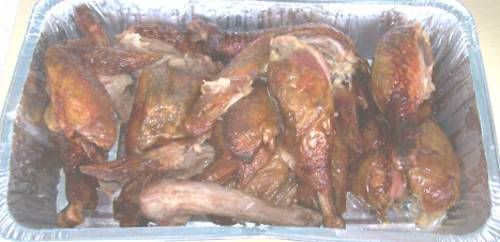
Oh! What to do with all those great turkey leftovers? A friend of mine who works in a BBQ joint gave me the legs and wings of 4 BBQ'd turkeys yesterday and asked me to make some gumbo. TUFF Project!!
INGREDIENTS:
3 Stalks Celery, Diced Small
1 Cup Bell Pepper, Red and Yellow (Seeded and Diced Small) Green will also work.
2-3 Cups Onions, Chopped Large
1 Cup Carrots, Diced
3-4 Bunches Scallions, Sliced Small
2-3 Lbs. Okra, Sliced
2-3 Tbs Garlic, Chopped
2 Lbs Andouille Sausage, (Cut in 1/4 length wise and then 1/4 in. pieces)
6 Cups Turkey, Cooked, Chopped (1 in. pieces)
10-12 Cups Turkey/Chicken Stock
2-3 Tbs Creole Seasoning
2 Tbs Indian River Pepper Blend
File
1 Can Rotel, Hot ( Optional )
Roux
1/2-3/4 Cup Oil, Peanut or Canola
3/4-1 Cup Flour
Equiptment:
1 9 Qt Dutch Oven
Handful Apple Wood small chunks
Procedure:
1 I did all the preliminary cooking on the stove. ESPECIALLY the roux to control the temperature. After all was assembled and brought to a boil, it was then placed on the BGE.
2 In a heavy bottom Dutch oven/stock pot saute in cooking oil (olive not recommended because of flavor) celery, bell peppers, onions, carrots and garlic until softened. Remove and then sauté sausage. Remove and drain. Next make the roux in the pot. When ready Slowly add some hot broth. and the rest of the ingredients. Some of the okra and broth may have to be added after an hour or so as there will be more room.. If you want hot add the Rotel the last hour.
Roux
1 If doing the roux in a separate pot:--In the dutch oven or a heavy duty skillet, cast iron works best, heat up the oil slowly and whisk in the flour a 1/4 at a time. Bring heat up and whisk constantly. Careful not to burn. if it burns start over, a cheap investment. It will get to the color of peanut butter or a new shiney copper penny, 10-15 minutes. Mix 1/4 cup or so to the rest of the pot and stir slowly BE CAREFUL, THE HOT ROUX MAY SPLATTER. Stir slowly and let simmer for an hour or so, stir often as the gumbo may stick to the bottom and burn if left unattended. Enjoy!
Cooking:
1 BGE Set up indirect, inverted, legs up, plate setter at 350°F, with little spacers between plate setter and pot, unless it has its own feet. Cook with some smoke, I used apple. Stir every hour or so for 3-4 hours. May need to add more broth or so! Ready.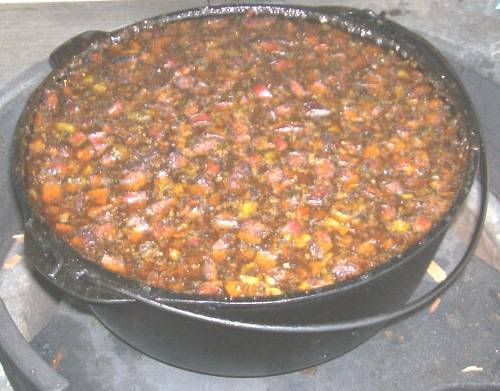
2 This particular batch I put on at 7PM and shut down the BGE at 3:30 AM, leaving the pot in until 9 AM Great flavor.
3 Place in a serving bowl, over rice works for some, and then add a little file. Enjoy !!!
Recipe Type
Dutch Oven, Main Dish, Poultry
Recipe Source
Source: BGE Forum, Richard Fl, 2008/01/23 -
Good heads up. Doing some of these cooks on the BGE tends to stretch the cooking times; as well as the effort to take everything outside. The sauce was done inside and cooled before I needed it. I guess I backed into a happy ending.LBGE Katy (Houston) TX
-
Interesting. I always thought adding the roux to the liquid like that would clump. Amazing what you never try when it actually works. I have been afraid to do that with roux for years, and instead always gradually worked liquids into it. Live and learn! Thanks for the info.
Chris -
Thanks!!
That is what I was be lookin fo'.
Much appreciate!
Chris -
Hey Guys...I've told you cold roux, hot soup, etc. What I did not mention is a true roux should be equal parts fat (Butter, oil, chicken fat, etc) and flour. Cook it long enough so it becomes "liquidly bubbly" (have to see it to understand), for a blonde rue. That ensures that the starches in the flour are saturated with the fat of choice.I think I may post a rue lesson for the whole forum...but definately not tonight.
I failed to say, beautiful post! I may have to try cheeseburger soup myself! BT would love it! :laugh: :woohoo: -
I usually add some soup to the roux first, before adding the roux to the soup to avoid clumps. It's similar to tempering an egg but for a much different reason. HTH.


Categories
- All Categories
- 184K EggHead Forum
- 15.8K Forum List
- 459 EGGtoberfest
- 1.9K Forum Feedback
- 10.4K Off Topic
- 2.2K EGG Table Forum
- 1 Rules & Disclaimer
- 9K Cookbook
- 13 Valentines Day
- 93 Holiday Recipes
- 224 Appetizers
- 520 Baking
- 2.5K Beef
- 88 Desserts
- 167 Lamb
- 2.4K Pork
- 1.5K Poultry
- 33 Salads and Dressings
- 324 Sauces, Rubs, Marinades
- 548 Seafood
- 175 Sides
- 122 Soups, Stews, Chilis
- 44 Vegetarian
- 102 Vegetables
- 313 Health
- 292 Weight Loss Forum