Welcome to the EGGhead Forum - a great place to visit and packed with tips and EGGspert advice! You can also join the conversation and get more information and amazing kamado recipes by following Big Green Egg to Experience our World of Flavor™ at:
Want to see how the EGG is made? Click to Watch
Facebook | Twitter | Instagram | Pinterest | Youtube | Vimeo
Share your photos by tagging us and using the hashtag #BigGreenEgg.
Share your photos by tagging us and using the hashtag #BigGreenEgg.
Want to see how the EGG is made? Click to Watch
Burnt ends

okesmokie
Posts: 150
Will someone be so kind to explain to me the burnt ends thing? Where and when to remove it from the brisket, what tempt to cook it? The tempt when done? Do you chop it then? If someone would explain this in detail I would appreciate it.
Thanks in advance[p]
Thanks in advance[p]
Comments
-
okesmokie,
In simple terms it is the overcooked part of the brisket. Or I think I understand it to be that. Dizzy Pig mentions it in their brisket recipe: http://www.dizzypigbbq.com/recipesBrisket.html[p]Also, I saw one of Bobby Flay's shows where a restaurant in Kansas City (I believe) actually makes and sells burnt ends because their customers demand them. In their case, they cut out certain parts of the brisket and serve one way, but then they cut up the rest into chunks, cover with a thick layer of BBQ sauce and cook in the smoker again.[p]I'm sure someone else will chime in soon. I'm just up early.[p]Spring "Burnt Feathers Don't Smell So Good, Especially When They're Yours" Chicken
Spring Texas USA
[ul][li]Dizzy Pig Brisket[/ul] -
okesmokie,
Burnt Ends come from the point of the brisket. You need to have a whole packer brisket to ger the point. The point is connected to the flat by a segment of fat. What you do is cook your brisket with the point attached as normal but when your brisket is done you separate the point and cook it for an addtional 2-3 hours lows and slow. At this point you can add more smoke, rub, sauce, etc.[p]You might get the point almost ready to be cut off when you trim down your brisket so it is easy to remove.
-
<p />okesmokie,[p]Burnt ends are a specialty of mine. They are quite possibly one of the favorite types of barbecue, some folks don't even know how much they like them until they try one. I make them for most any get together. Click the link to see my take on this classic. Look in the BEEF section.[p]~thirdeye~[p]
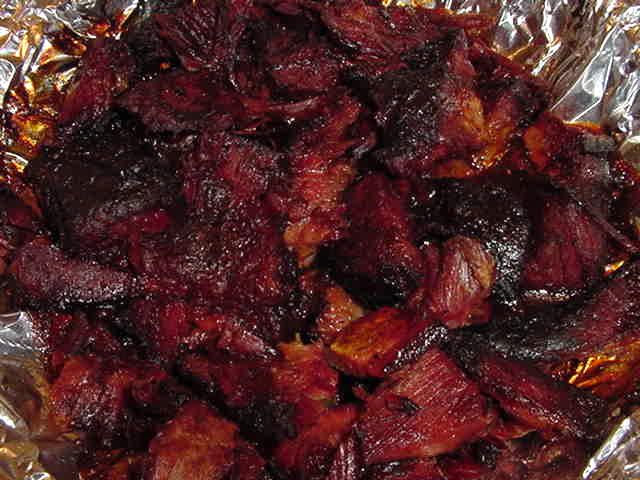
[ul][li]Click Here[/ul]Happy Trails~thirdeye~Barbecue is not rocket surgery -
thirdeye,[p]Something interesting in your directions. You separate the point AFTER you've let it rest? That is one I haven't seen. You think it makes that much diff or just "the way you do it?"[p]mShark
-
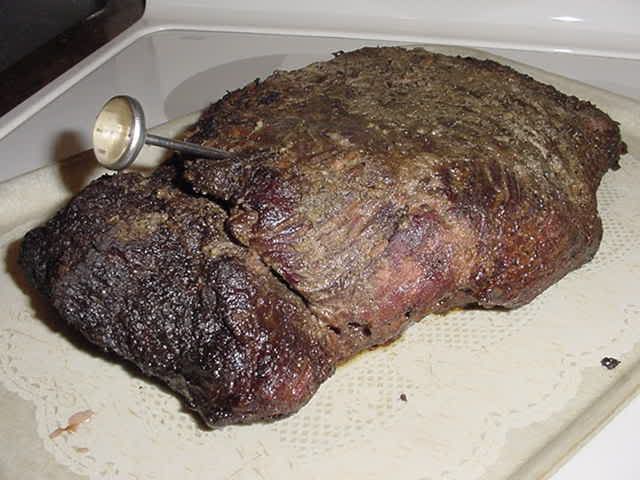
mollyshark,[p]Thanks for pointing that out. Ya know what? I need to make a clarification change on that. In my mind resting and coolering are two different things. It should say something like "let the brisket rest 30 minutes before removing the point". This is for the benefit of the flat, not really the point. Keeping the flat moist is important in my book. I wouldn't want anyone to get the sharp end of a knife close to one until those juices have settled down. One thing I do when trimming a packer is to make a V notch in the hard fat to give the natural separation a head start when cooking. (pictures below) Sometimes it only takes your hand or the backside of a knife to separate. This really keeps the moisture in the flat. This will reduce or eliminate the rest time.[p]For the record, I've noticed that most folks don't do a long coolering cycle like I do. They slice and serve the flat within an hour after it comes off the pit anyway. On the other hand, I cooler whole ones or the flat after removing the point for 4 to 6 hours. I guess what I'm saying.....Some of my personal practices don't always match up with the general guidelines in the techniques on my site. That much cooler time is hard for some to swallow. But the brisket won't be. Heheeee.[p]Here is one that almost separated himself.[p]
 [p]
[p]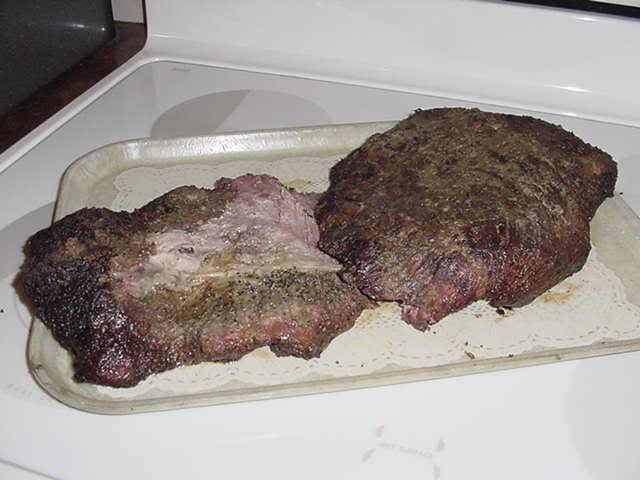 [p]~thirdeye~[p]
Happy Trails~thirdeye~Barbecue is not rocket surgery -
thirdeye,[p]Excuse my ignorance, but what is the purpose of coolering butts and briskets? Does it actually assist the "cooking" process, or is it just a place to keep it warm while you polish off another beer?[p]Ottawa_egger
-
Ottawa_egger,
All meat will continue to "cook" until it cools down after you remove it from the fire.[p]Wrapping it it foil and towels and putting it in a cooler will let the juices settle in as mentioned and is likely resulting in more tender meat.
-
thirdeye,[p]On your site you mention to let the brisket rest for 30 minutes before separating to let the juices settle. Is the brisket foiled or put in cooler or is it allowed to cool at room temp?[p]Thanks,
Howard
-
Howard,[p]You know, MollyS brought up the same question earlier today and I modified some of the instruction on my burnt end page...... I guess what I really wanted to stress is to not cut into the brisket too early because even though burnt ends are a wonderful treat, there is nothing worse than a dry flat.[p]The best answer would be to let it rest on the cutting board at least 30 minutes. A longer time in foil in a cooler will only make it better.[p]~thirdeye~[p]
Happy Trails~thirdeye~Barbecue is not rocket surgery



Categories
- All Categories
- 184K EggHead Forum
- 16.1K Forum List
- 461 EGGtoberfest
- 1.9K Forum Feedback
- 10.5K Off Topic
- 2.4K EGG Table Forum
- 1 Rules & Disclaimer
- 9.2K Cookbook
- 15 Valentines Day
- 118 Holiday Recipes
- 348 Appetizers
- 521 Baking
- 2.5K Beef
- 90 Desserts
- 167 Lamb
- 2.4K Pork
- 1.5K Poultry
- 33 Salads and Dressings
- 322 Sauces, Rubs, Marinades
- 548 Seafood
- 175 Sides
- 122 Soups, Stews, Chilis
- 40 Vegetarian
- 103 Vegetables
- 315 Health
- 293 Weight Loss Forum