Welcome to the EGGhead Forum - a great place to visit and packed with tips and EGGspert advice! You can also join the conversation and get more information and amazing kamado recipes by following Big Green Egg to Experience our World of Flavor™ at:
Want to see how the EGG is made? Click to Watch
Facebook | Twitter | Instagram | Pinterest | Youtube | Vimeo
Share your photos by tagging us and using the hashtag #BigGreenEgg.
Share your photos by tagging us and using the hashtag #BigGreenEgg.
Want to see how the EGG is made? Click to Watch
Fire Building

I need some tips on building a good fire. I have read all the theories (Elder Ward's, putting the biggest chuncks in the bottom, etc) and I just can't get it done. I'm cooking for 30+ Friday night, 20+ lbs of butt and I don't want to be on my hands and knees all night blowing air into the bottom gasket like last time...
Comments
-
Matty ,
I subscribe to the Elder Ward method of building a fire when I am doing an extended cook re;butts;brisket etc; and the dumping method when doing aal other cooks.
I find that I have less worry about the fire going out or running out of lump on a long cook using Elder's method. Yes, it takes longer, but worth the time.
You apparently don't want to take the time to do it, so do it your way.
Hammer
-
Matty , once a clean egg, I just pour right from the bag, and keep puring till it runs out, no fancy lump building here.
Never a problem wit hot fires.
-
Matty ,
I have done tons of overnight cooks and i just poor right out of the bag unless it is just the bottom small pieces left in the bottom of a near empty bag. Get a guru or check it often and it will be fine. Never had one go out yet.
-
Matty ,
I also pour right out of the bag. Fill the fire box to the top and then some.The ticket is to get you a propane torch, the one that you can use to burn leaves in the yard and get the fire going all around the top of the coals. Once the fire is going well, it will do it's thing. The longer the coal burns it will work it's way to the bottom. Trust me, I have had my Egg stay around 250 for more than 20 hours and would probably have gone for many more. [p]Chef Jerry (one that does not post much anymore)
-
Matty ,[p]I do make it a point to put the larger pieces of charcoal on top of the heap after lighting, which does make a difference on long (or slow) cooks. [p]As for starting fires---I've used every imaginable means possible to light the Egg and frankly I am not much into standing around holding in one hand a million degree MAPP. Especially, with an adult beverage in the other hand. I am sure to get slammed on this BUT I prefer the Picnic eco-start gel. It's non-petroleum (contains ethanol) , odorless and smokeless and IMHO works much like sterno. Just another option that works and has NO effect on the taste or integrity of the BGE.[p]David[p]
[ul][li]http://www.packserv.com/Content-Public/Products-By-Brand/Page.asp?iID=3[/ul] -
Matty ,[p]This will not help you for Friday, but I'd get a BBQ Guru or Stoker. If you are indeed in Southern CA, Riverside or Eastrn LA County specifically, we get a lot of wind conditions here others don't face. You know what I mean. I didn't even try an overnight until I had one because I live on a coastal canyon with a very exposed yard. OK, I just didn't want to risk it.[p]That being said, I do try to build my fire carefully for long cooks. The closest to after morning coffee and the farthest from happy hour the better. ;-) I basically follow Elder Wards guidelines and add some of the old Indian Guides tricks too. For example, I make sure I have a "Tee Pee" of sorts in the bottom. This is for *airflow* as lighting happens from the top and the fire will burn toward the air supply. [p]After a bunch or overnights with a Guru, I sort of learned the vent settings. That with the detailed information here helped me manage to get through an overnight when my guru failed. I used a nickle for both vents once I had an established fire. I think guavagreg posted that trick. Anyway, practice when you don't have to get a meal done might help. I have a copy of table of vent settings for desired target temp if you want it. It's also in the postings archive.[p]BP
-
Matty,
I too am a fan of the pour in and stir method, but since I have about 50 feet between my garage (where I store my lump) and my eggs I hate to carry a bag back and forth plus through our home at that! My solution was luckily finding an old fashioned (but new) coal bucket. With its capacity and front protuding snout it makes filling the eggs a breeze plus the lump dust settles to the bottom. Look around you may be able to buy one - even if it is at an antique store. BTW I only paid $12 for this brand new one.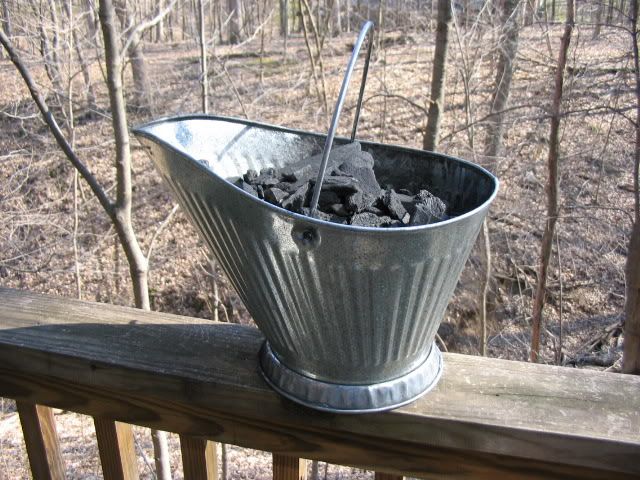
furthermore if your source of lump makes you believe their warehouse gorillas use the lump sacks like bean bag tosses due to all the dust in the bag you might want to make yourself a strainer rack box like this one that I made using scrap wood with a piece of 1/2" hardware cloth nailed to the bottom.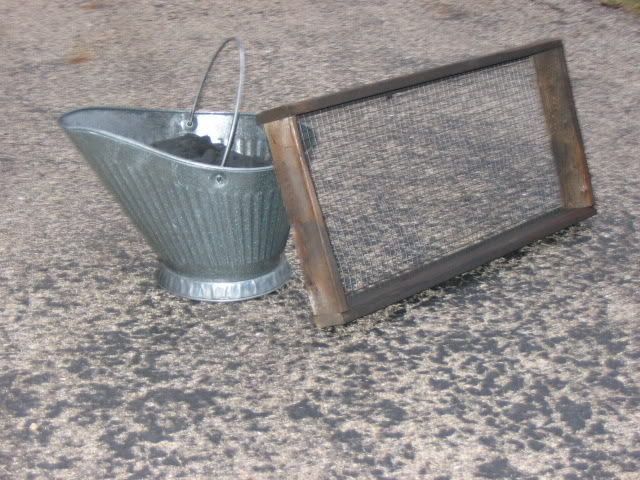
Re-gasketing the USA one yard at a time -
Matty ,
I have found that three things make a difference.
1). The lump -- I have used Big Green Egg lump and now B&B lump (from Weimar, Texas). The BGE lump seems much lighter in weight versus the B&B. On my first long low and slow with BGE lump the fire went out after about 11 hours. With the B&B I was able to use one full load for 22 straight hours, and still had some left at the end. Make sure you use plenty of lump.
2). The loading -- I really think it makes sense to load larger pieces on the bottom, and I agree with the Tee-Pee method of stacking the lump. If you just think about it, the more air you have coming through the bottom of the air holes where the lump rests, when you have the bottom vent almost closed for a long cook so not much air coming in, the better you are -- you want as much of the air circulating as is possible, even if restricted. If you just pout the lump into the bottom, you will clog up most of those holes. Make sure on a low and slow that you load the lump at the top of the fire box. This will give you enough fuel to keep going for the long haul.
3). The vents -- if you shut them down too low, your fire will go out. If you open them up too much, your fire will burn too hot and your lump will be used up. I really abide by the method of closing down the vents as you approach you target temp, then ensuring that your temp is really stable before putting on the meat. Then really watching for about an hour after the meat is on to ensure that the temp is again stable. After that, go to bed and trust the egg. All other things considered.
Hope this helped.
-
Matty ,
i havent seen mention on the forum lately about wiggle sticks, alot of the older eggers have them. all you need is a heavey coat hanger straightened out with abend in the end to reach thru your lower vent up into the grate holes. about 6-8 hours into the cook you use it to shake the ash out of the grate. frees up the air flow and the cook continues. i may put a few big pieces right on the grate and then pour the lump in, sometimes i just pour if the lump looks big enough. i also open the dome after shaking the bottom vent and push the lump with the wiggle stick toward the center as ive had fires start to go out from center burn were the fire burns straight down an doesnt catch the surrounding lump on fire. cooking with a dome over 250 also helps keep the fire going with less work
fukahwee maineyou can lead a fish to water but you can not make him drink it -
Matty ,[p]Like a few others here, I'm just a "pour out of the bag and stir" kinda guy. I usually try to arrange it so I get a couple of big pieces in the middle and surround them with smaller pieces, but I don't think even that's really critical as the thermodynamic efficiency of the Egg makes it really forgiving. My theory is there's 3 critical things to have a long, low-n-slow fire going, and in order of execution are: 1) Clean out the ashes well, and make sure all of your holes aren't clogged with small pieces of lump. 2) Fill to the bottom of the fire ring (the one time I lost a butt because the fire went out, it was because I didn't fill 'er up). 3) Before throwing your food on, make sure you have a good, steady dome temperature and keep your vents set there. There'll be an initial drop in temp after you put your food on, but it'll come back up in a few minutes. Trust your Egg and rare will be the time she lets you down.
I've never done such a big cook as the one you're going to do (the most I did was 2 5lb butts last weekend which took about 12 hours and still had plenty of lump left), but I'd be worried about overstuffing your Egg with so much food will cause the airflow will be so restricted that the fire goes out (and probably uses up more lump faster to boot). Maybe a couple or three cooking sessions are in order here?
My 2 cents worth. Good luck, and happy Egging. [p]Dan


Categories
- All Categories
- 184K EggHead Forum
- 16.1K Forum List
- 461 EGGtoberfest
- 1.9K Forum Feedback
- 10.5K Off Topic
- 2.4K EGG Table Forum
- 1 Rules & Disclaimer
- 9.2K Cookbook
- 15 Valentines Day
- 118 Holiday Recipes
- 348 Appetizers
- 521 Baking
- 2.5K Beef
- 90 Desserts
- 167 Lamb
- 2.4K Pork
- 1.5K Poultry
- 33 Salads and Dressings
- 322 Sauces, Rubs, Marinades
- 548 Seafood
- 175 Sides
- 122 Soups, Stews, Chilis
- 40 Vegetarian
- 103 Vegetables
- 315 Health
- 293 Weight Loss Forum