Share your photos by tagging us and using the hashtag #BigGreenEgg.
Want to see how the EGG is made? Click to Watch
eat your bacon and drink to your health


Chemopreventive effects of lupulone, a hop {beta}-acid, on human colon cancer-derived metastatic SW620 cells and in a rat model of colon carcinogenesis.
Abstract
The bitter acids of hops (Humulus lupulus L.) mainly consist of humulones or alpha-acids and lupulones or beta-acids. We aimed to evaluate the antiproliferative mechanisms of lupulones on a human metastatic colon carcinoma-derived cell line (SW620 cells) and to assess their chemopreventive effects in a model of colon carcinogenesis. SW620 cell growth was inhibited by 70% after a 48 h exposure to lupulones (40 microg/ml). Lupulones up-regulated the expression of Fas receptor (Fas) and Fas ligand (FasL) as well as TNF-related apoptosis inducing ligand (TRAIL)-R1 (DR4) and -R2 (DR5) receptor proteins, suggesting the involvement of Fas and TRAIL receptors-mediated pathways in lupulone-induced apoptosis. Lupulones also increased the mitochondrial membrane permeability. Colon carcinogenesis was initiated in Wistar rats by intra-peritoneal injections of azoxymethane (AOM), once a week for 2 weeks. One week after the last injection, rats received lupulones (0.001 or 0.005%) in drinking water, and AOM-control rats received the excipient. After 7 months of treatment, the colon of rats receiving 0.001 and 0.005% lupulones showed, respectively, a 30 and a 50% reduction (P < 0.05) of the number of preneoplastic lesions (aberrant crypt foci). In addition, we observed a drastic reduction (70-80%) of the total number of tumors in the colon of rats treated with lupulones when compared with the AOM control group. Lupulones induced apoptosis in SW620 colon-derived metastatic cells by activating both Fas and TRAIL death receptor signaling pathways, and antagonize at a low dose (4 mg/kg/day) colon cancer development. These observations suggest the use of lupulones for colon cancer chemoprevention trials.
Comments
-
Yeah!
I was just about to say that.
"Too bad all the people who know how to run the country are busy driving cabs and barbecuing." - George Burns -
You had me at hops!
-
I don't know what that said but I agree.
Not to get technical, but according to chemistry alcohol is a solution...
Large & Small BGE
Stockton Ca.
-
tl;dr version: hops in beer fixes the baddies in bacon.They/Them
Morgantown, PA
XL BGE - S BGE - KJ Jr - HB Legacy - BS Pizza Oven - 30" Firepit - King Kooker Fryer - PR72T - WSJ - BS 17" Griddle - XXL BGE - BS SS36" Griddle - 2 Burner Gasser - Pellet Smoker -
Adding an antioxidant to the bacon before cooking mitigates the formation of carcinogens especially nitrosamines. That said, beer is good.______________________________________________I love lamp..
-
Could someone please translate that into Pig Latin?Ellijay GA with a Medium & MiniMax
Well, I married me a wife, she's been trouble all my life,
Run me out in the cold rain and snow -
Aconb oodg!
-
Addingway anway antioxidantway otay ethay aconbay eforebayookingcay itigatesmay ethay ormationfay ofway arcinogenscayespeciallyway itrosaminesnay. Atthay aidsay, eerbay iswayoodgay______________________________________________I love lamp..
-
Nola, pardon my ignorance but is this a serious statement? I'm not drunk. Just too lazy to research. How would one add antioxidant to the bacon? Since being diagnosed with diabetes, I've dramatically increased my bacon consumption and since I'm down 65 lbs in the process, my Dr. Is ok with my increased bacon. I make homemade bacon frequently.nolaegghead said:Adding an antioxidant to the bacon before cooking mitigates the formation of carcinogens especially nitrosamines. That said, beer is good.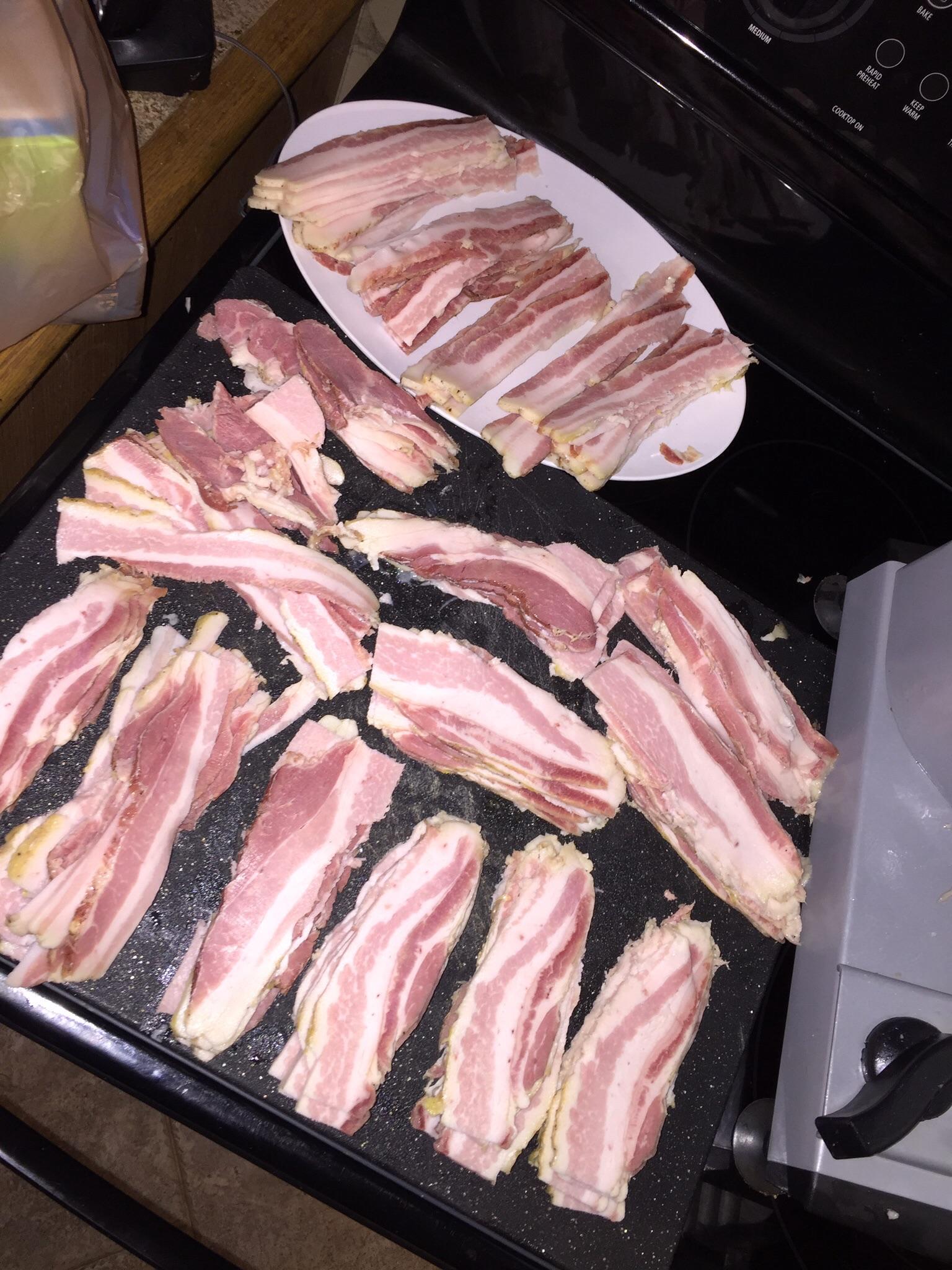 I cook. I eat. I repeat. Thornville, Ohio
 -
"Too bad all the people who know how to run the country are busy driving cabs and barbecuing." - George Burns
-
 I love people that love bacon...
The Dude..a Mini and a Large Egg..a DigiQ DX (BGE Green)..some Cast Iron...a Thermapen.............and an Ol' Fashion
_____________________________________________________________________________
Glenbeulah, WI
-
@hibby You add ascorbic acid (vitamin C) to your cure. This helps prevent the nitrites from forming nitrosamines. This is done commercially and has likely saved countless lives. You can buy food grade ascorbic acid on Amazon.
https://www.bulletproofexec.com/is-bacon-healthy-paleo-pork/
______________________________________________I love lamp.. -
Nola, thanks much. I'm heading to Amazon.I cook. I eat. I repeat. Thornville, Ohio
-
@nolaegghead How much ascorbic acid to lets say, the standard 1 tsp of cure for 5 lbs of meat?
-
https://en.wikipedia.org/wiki/Nitrosamine
Under acidic conditions the nitrite forms nitrous acid (HNO2), which is protonated and splits into the nitrosonium cation N≡O+ and water: H2NO2+ = H2O + NO+. The nitrosonium cation then reacts with an amine to produce nitrosamine.[4]
These processes lead to significant levels of nitrosamines in many foodstuffs, especially beer, fish, and fish byproducts, and also in meat and cheese products preserved with nitrite pickling salt. The U.S. government established limits on the amount of nitrites used in meat products in order to decrease cancer risk in the population.[5] There are also rules about adding ascorbic acid or related compounds to meat, as the compounds inhibit formation of nitrosamines.[6]


Categories
- All Categories
- 184.1K EggHead Forum
- 15.8K Forum List
- 460 EGGtoberfest
- 1.9K Forum Feedback
- 10.4K Off Topic
- 2.2K EGG Table Forum
- 1 Rules & Disclaimer
- 9K Cookbook
- 13 Valentines Day
- 93 Holiday Recipes
- 224 Appetizers
- 520 Baking
- 2.5K Beef
- 88 Desserts
- 167 Lamb
- 2.4K Pork
- 1.5K Poultry
- 33 Salads and Dressings
- 324 Sauces, Rubs, Marinades
- 548 Seafood
- 175 Sides
- 122 Soups, Stews, Chilis
- 44 Vegetarian
- 102 Vegetables
- 313 Health
- 292 Weight Loss Forum