Welcome to the EGGhead Forum - a great place to visit and packed with tips and EGGspert advice! You can also join the conversation and get more information and amazing kamado recipes by following Big Green Egg to Experience our World of Flavor™ at:
Want to see how the EGG is made? Click to Watch
Facebook | Twitter | Instagram | Pinterest | Youtube | Vimeo
Share your photos by tagging us and using the hashtag #BigGreenEgg.
Share your photos by tagging us and using the hashtag #BigGreenEgg.
Want to see how the EGG is made? Click to Watch
Probe wires, how to route?

Whit
Posts: 3
Hello all. I'm a newbie here, but enjoying and soaking up a lot of info. I've got a large egg and I recently bought a wireless thermometer set up. My question is how to route the temperature probe wires. I've read a lot about how fragile these are and prone to kinks and crimps. How do you guys route your probe wires to avoid damaging them with the lid?
Thanks in advance for the suggestions.
Whit
Thanks in advance for the suggestions.
Whit
Comments
-
simply close the dome carefully - the gasket will cushion around the cable.Re-gasketing the USA one yard at a time
-
Like Ron said...put meat on the BGE...insert probe...set desired temp..close BGE...wait until alarm goes off....easy peasy..

-
Ok, I guess I was reading too much into the sensitivity of the probes. Glad to hear there's no modifications to the egg required!
Thanks for the quick responses.
Whit -
I've always routed mine through the daisy wheel. It helped keep them out of the muck, until I loaded the Egg up with 5 butts. That was messy...worth it, but messy.
-
You like to live dangerously. Open that lid and have that daisy set wrong and your probe wire is toast.
-
They are sensitive. You can cut them, drown them and even cook them. Keeping the probe between the felt severely curtails the cutting part.
Keep the braids dry when cleaning prevents drowning and keeping the temp below the high temp reating can prevent them from being cooked. -
You are correct, but I put a high temp sleeving over my wires to protect them. That's a key part that I have taken for granted. Sorry, no more advice from me...especially without all the details. Thanks Pete! :unsure:
-
I need to buy one of these. Which would anyone recommend?Large & MiniMax in Lexington, KY
-
whit, Welcome to the forum.

When I have probe wires going into the egg and I am using my plate-setter I will route my pit probe cables across the base where the plate-setter leg is. I do this so I can shroud as much heat from the cables as possible. Sometimes even using a piece of foil on the inside may help. Tim
Maverick et-73 probe cables are notorious for burning up and don't ever immerse one in water. Least wise not past the crimp because water can ruin you probe as well.
It's all part of the fun! :woohoo: Tim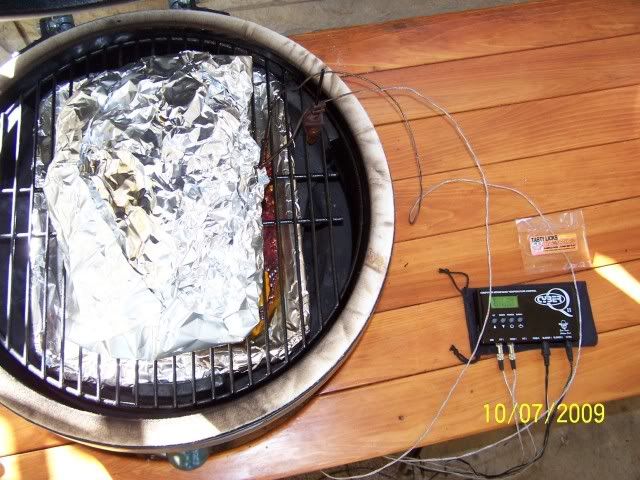
-
Keep giving the advice.. Just try to remember the details :woohoo:
-
I just got the Maverick ET-73. It's in the mail, havent had a chance to play with it, so I cant recommend it yet. Hope it works out good.
-
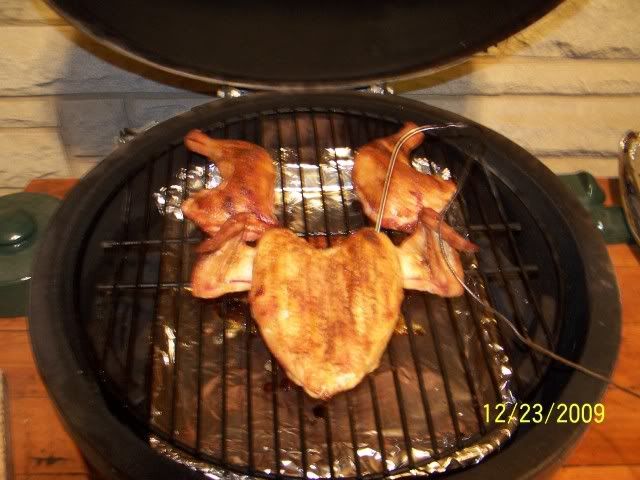
methinks your lid needs adjusting
-
Kentucky Wildcat Fan, Welcome to the forum ! As with everything else it's all personal preference. I use a Maverick ET-73. It has a pit probe to monitor the pit and it has a meat probe to monitor the meat. It does have some other options as well. I will leave you this link to do your own research.
http://www.maverickhousewares.com/et73.htm
Here the white ones are the Maverick ET-73.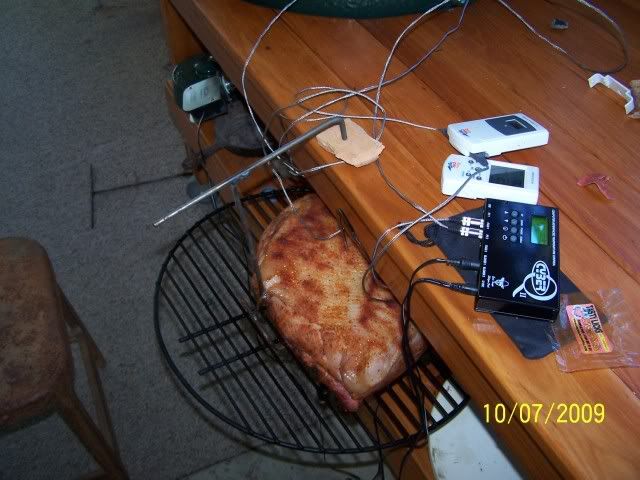
Here is a very useful link to a lot of research done by our own Grandpas Grub
http://www.eggheadforum.com/index.php?option=com_simpleboard&func=view&id=746787&catid=1 -
Hey Pete! Good eye. That is a pic from when I had recently installed the Nomax gasket. I did some more adjusting since then but, I still have some seepage on the left side. I also have an offset on the left side I tried to correct and I tried everything including washers I finally restored it back to the way it is today.
-
FYI, I received an ET-73 for Christmas and tried to use it the day after.
I followed the instructions to "register" the transmitter and receiver, but was never able to get the receiver to read out the data from the transmitter. The transmitter display was reading the meat and smoker temps but didn't appear to be transmitting the info to the receiver. The transmitter has a small red light on the front which I understand flashes when it transmit data to the receiver, mine was not flashing or showing the "antenna symbol" in it's display window.
The folks at Marverick said to return it for replacement. Hope you have better luck. The ET-73 is the unit I want, looking forward to getting a working unit soon. -
field hand, Can I assume you almost simultaneously turned the transmitter on then the receiver? To bad. I'm sure they will get you straightened out. :(
-
2Fategghead, Thanks for your comment. I tried all the transmitter/receiver turn-on/off combinations I could think of, including simultaneous and near simultaneous. All this in additon to the "register" procedure in the manual. The lady at Maverick thought the fact that the transmitter red light was not flashing and that the antenna symbol wasn't appearing was significant. I have an Oregon Scientific transmitter/receiver thermometer and it's transmitter red light flashes with each data pulse. Thanks again for your comment, will see what the folks at Maverick do.
Barry
Marthasville, MO -
2Fategghead, Thanks for your comment. I tried all the transmitter/receiver turn-on/off combinations I could think of, including simultaneous and near simultaneous. All this in additon to the "register" procedure in the manual. The lady at Maverick thought the fact that the transmitter red light was not flashing and that the antenna symbol wasn't appearing was significant. I have an Oregon Scientific transmitter/receiver thermometer and it's transmitter red light flashes with each data pulse. Thanks again for your comment, will see what the folks at Maverick do.
Barry
Marthasville, MO -
They will get you fixed up. Tim


Categories
- All Categories
- 184K EggHead Forum
- 16.1K Forum List
- 461 EGGtoberfest
- 1.9K Forum Feedback
- 10.5K Off Topic
- 2.4K EGG Table Forum
- 1 Rules & Disclaimer
- 9.2K Cookbook
- 15 Valentines Day
- 118 Holiday Recipes
- 348 Appetizers
- 521 Baking
- 2.5K Beef
- 90 Desserts
- 167 Lamb
- 2.4K Pork
- 1.5K Poultry
- 33 Salads and Dressings
- 322 Sauces, Rubs, Marinades
- 548 Seafood
- 175 Sides
- 122 Soups, Stews, Chilis
- 40 Vegetarian
- 103 Vegetables
- 315 Health
- 293 Weight Loss Forum