Welcome to the EGGhead Forum - a great place to visit and packed with tips and EGGspert advice! You can also join the conversation and get more information and amazing kamado recipes by following Big Green Egg to Experience our World of Flavor™ at:
Want to see how the EGG is made? Click to Watch
Facebook | Twitter | Instagram | Pinterest | Youtube | Vimeo
Share your photos by tagging us and using the hashtag #BigGreenEgg.
Share your photos by tagging us and using the hashtag #BigGreenEgg.
Want to see how the EGG is made? Click to Watch
Thermo calibration question

smoky b
Posts: 648
Another noob question: Calibrated my BGE thermometer last night by sticking it in boiling water. (Was nearly 60* off...) After I made the adjustment to the hex nut, I set the thermometer on the counter. Several hours later, it was giving an ambient temp reading of 90* (it is no more than 75* in my house). Put it back in boiling water and it was reading just over 212*. I live in north AL and am relatively close to sea level (600 feet above or so). Seems like something is off to me but I wanted to check with the experts. Thanks!
Comments
-
As long as it's right at boiling don't worry to much about it reading ambient incorrectly....a thermometer is it's most accurate at the middle of its range...and realistically..we don't cook at 90° anyway...mine sometimes read around 150° sitting out in the sun..
-
I agree with Wess, as long as it is calibrated to 212º your good to go. I think my BIL's was 50º off and mine was at least 40º off. Once calibrated they both read 100º or so. If you have a thremopen use it to verify the temp of your "boiling" water. I have noticed that when taken off the heat that water starts cooling fast. It only takes a minute or two and you can be 10º or more off. If you leave the water on the heat you can get a reading higher then 212º. I set my dome to what ever my thermopen says the temperature of the water is. Ya, I know, I'm a bit obsessive about accuracy.
Gator
-
how are you gonna get a temp higher than 212?ed egli avea del cul fatto trombetta -Dante
-
Thanks guys. That is the answer I was hoping for. Been wondering why I have had a hard time staying low and slow.
-
How about off your heat source. Water will boil at 212º but the burner on stove will get a lot hotter.
Gator -
As long as the probe is not touching the pan, the water will be 212 degrees (or whatever the actual boiling point is). Any water that is over 212 degrees will be steam (bubbles). So, yes, you can calibrate your thermometer by placing the probe in boiling water while the pan is on the burner as along as the probe is just touching water and not the pan.The Naked Whiz
-
You can use oil and a candy thermometer.
-
if the probe is in water, it's 212.
only way the water is hotter is in a pressurized situation. just don't touch the tip to the bottom of the pan....ed egli avea del cul fatto trombetta -Dante -
why?
boil water, make sure it's close to 212, call it a day.
(anyway, how do you know if your candy thermometer is accurate?)
hahahahaed egli avea del cul fatto trombetta -Dante -
Because simply adjusting to 212* isn't a "calibration." At best, you'll be reasonably sure your thermometer is accurate at 212*, not typically a level one runs one's dome. If you use a two-point calibration, at least you can verify that the unit will be fairly linear over a span of values instead of just one.
And oil baths are a very common way of calibrating thermocouples and RTDs. -
Are you saying to use oil and a candy thermometer to verify the calibration of your Egg thermometer? As in heating the oil up to 250°, then verifying (or calibrating) your Egg thermometer to read 250°?
How do you check the candy thermometer first, in boiling water?Happy Trails~thirdeye~Barbecue is not rocket surgery -
-
Yes, if you want to check the BGE thermo at higher temps, that's the way I'd do it. I suppose you could check the candy thermo beforehand, but it's probably close enough for doing the BGE. If you really want to dial your instrumentation in, you can get a lab thermometer or even a calibrated RTD probe to establish your references.
-
It's probably good enough to use a mercury- or digital-type candy/deep fryer thermometer. Most go to 400 degrees or so, so you'll have plenty of range.
-
those types of thermometers are linear, and if they aren't, then they are sprung and it's time to get a new one.
like a bathroom scale... the operating part of the thermometer is intended to be linear. it deforms "x" at a temp, and "2x" at twice that temp. i'm guessing it's a simple torsion spring with a bimetallic strip at the tip. very, very, very difficult to screw that up unless it loses elasticity from being held at some crazy temps for a long time.
if it doesn't, it isn't 'calibratable' even with two point calibration.
guys are trying to turn a two-dollar dome thermometer into a geiger counter.
you can't calibrate it at two points anyway. boil water, see check the temp, turn the screw to make it rwad 212. if you then stuck it in 350 degree oil and decided you needed to dial back ten degrees, well, you just undid the 212 calibration. time to toss the thing anyway, because it is designed to read 350 at 350, just as it should read 212 at 212.
i need to retreat to my original point, that it makes no difference to adjust for altitude for our purposes. i know the engineers are wigging out, but unless we are in a submersible or on top of everest, it's not a big deal. i could hand you three dome thermometers. each one purposefully calibrated differently: one at 212, one at 221 PLUS fiuve degrees, and one at 212 MINUS 5 degrees. if you picked any one at random without knowing which it was, i don't believe you'd notice any difference in any of your cooks. not one that you could attribute to the dome temp anyway.ed egli avea del cul fatto trombetta -Dante -
how do you calibrate a dome thermo to two different temps?ed egli avea del cul fatto trombetta -Dante
-
if the candy thermometer is "probably close enough", then what is the purpose of dialing the dome thermo to 211.88 instead of 212 just to take into account my altitude?
we're cooking over a natural fire with hot spots and cold spots, and with ten or more years experience cooking on gassers that say nothing more than "low-med-hi". hahaha
i can cook without a dome thermo for crying out loud. please guys, don't tell me i gotta start sending the thermo to a lab.
sounds like you don't even do the thing you are proposing yourself. i.e. calibrating the dome thermo at higher temps?ed egli avea del cul fatto trombetta -Dante -
That actually makes more sense to us at higher elevations..... water boils at 203° at my place and I'm usually cooking at 250° to 300°. Accuracy at those temps would be better for me. Of course, that's dome temp, not actual temp...... So I would have to subtract 25° or 30° to arrive at the grate temp. There goes your accuracy.
The best route for me would be to verify that my grate thermometer is correct at 250°-300° and call it good.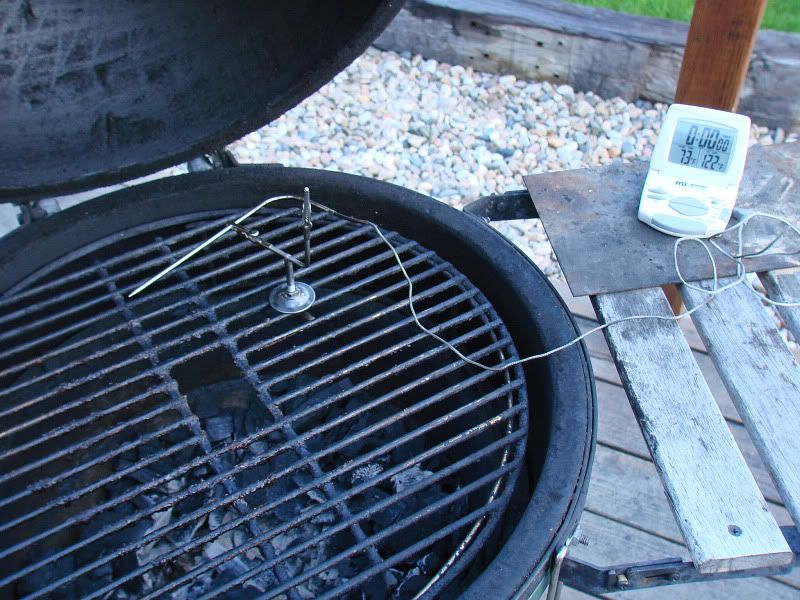 Happy Trails~thirdeye~Barbecue is not rocket surgery
 -
You really can't, but what you can do is do a best-fit type adjustment that gives you the least amount of error in the range you use the most. It might be off 20* at 200 and off 20* at 400, but right on at 300. That's better than being right on at 200 and off 40 or 50 degrees at 400.
-
The purpose is to minimize the error of the reading over the used range of the unit. If you zero the unit in at 212*F, all you're fairly sure of is that it's ready right there. Zero it at two points, and you'll still have error over the range, but the error will be in an acceptable amount.
-
those types of thermometers are linear, and if they aren't, then they are sprung and it's time to get a new one.
Exactly right. But if you simply calibrate to a single point - 212* - you'll never know if the unit has sprung as the needle will dutifully return to that reading when dunked in boiling water.
Your description of adjust, dunk, adjust, dunk is spot-on, too. I've calibrated enough instruments in my time to know that's essentially how a lot of them are done: You "walk" the settings into a best-case scenario. Since our dome thermos only have one adjustment, we're stuck with turning that until the units are good enough to use over the range we use them. If they're still 80 degrees off at 200 and 400 when spot-on at, say, 300*, then it's time to replace them. -
if it isn't linear, then it is going to be off all along the whole range and calibrating it to an average between two points is not going to do anything for you. it would be time to get a new dome thermometer
don't mean to beat a dead horse, but if you calibrated it at one temp, and it was off at another temp, then it can't be calibrated at alled egli avea del cul fatto trombetta -Dante -
Linearity and slope are two different things. A thermometer might be perfectly linear, but have the wrong slope. If so, and the error in slope isn't terribly bad, the unit may still be made serviceable by centering the point at which it crosses the ideal temperature curve to the middle point of where you cook.
For example, if the thermometer is linear but displays an error of 30* over a 200* rise in temperature, you can have the point at which the gauge temperature is equal to the actual temperature at 100*, but it will be 30* off at 300 and likely 45* off at 400. Or...you can put the gauge/actual crossover at, say, 300* where it will only be off 15* at 200 and 400 and just right at 300.


Categories
- All Categories
- 184K EggHead Forum
- 16.1K Forum List
- 461 EGGtoberfest
- 1.9K Forum Feedback
- 10.5K Off Topic
- 2.4K EGG Table Forum
- 1 Rules & Disclaimer
- 9.2K Cookbook
- 15 Valentines Day
- 118 Holiday Recipes
- 348 Appetizers
- 521 Baking
- 2.5K Beef
- 90 Desserts
- 167 Lamb
- 2.4K Pork
- 1.5K Poultry
- 33 Salads and Dressings
- 322 Sauces, Rubs, Marinades
- 548 Seafood
- 175 Sides
- 122 Soups, Stews, Chilis
- 40 Vegetarian
- 103 Vegetables
- 315 Health
- 293 Weight Loss Forum