Welcome to the EGGhead Forum - a great place to visit and packed with tips and EGGspert advice! You can also join the conversation and get more information and amazing kamado recipes by following Big Green Egg to Experience our World of Flavor™ at:
Want to see how the EGG is made? Click to Watch
Facebook | Twitter | Instagram | Pinterest | Youtube | Vimeo
Share your photos by tagging us and using the hashtag #BigGreenEgg.
Share your photos by tagging us and using the hashtag #BigGreenEgg.
Want to see how the EGG is made? Click to Watch
Pizza Napoletana Update

Willie Lump Lump
Posts: 229
This is my first update in my quest for pizza Napoletana.
Thanks to all with my earlier information request. I followed SOME of the suggestions from one of the links given and think I am going in the right direction.
I made my dough at a much higher hydration then is usual for me. It was a wet sticky mess and I did what to me is a reverse autolyse, that is I usually have all my flour dampened but not saturated.
I use a food processor and I’m really guessing as to how it matches the author’s electrolux.
I didn’t have the courage to try 800 degrees and cooked at my usual 550. With my normal dough I have to be careful and pull the pizza just when the cheese is browning or the crust is black on the bottom. This happens even with an air space under the stone.
Tonight I had a startling difference. With the higher hydration dough the crust was not even browned. The quality of the crust was much higher then past crusts, A lot of large air spaces and higher crispness. This seems like a good direction to go but I will need a lot of practice to handle the wet dough.
Next time I will be brave enough for a much higher temp.
Sorry I don’t own a digital camera so no pics. I understand that there are eggers that are doing this and hope to hear from them.
Thanks to all with my earlier information request. I followed SOME of the suggestions from one of the links given and think I am going in the right direction.
I made my dough at a much higher hydration then is usual for me. It was a wet sticky mess and I did what to me is a reverse autolyse, that is I usually have all my flour dampened but not saturated.
I use a food processor and I’m really guessing as to how it matches the author’s electrolux.
I didn’t have the courage to try 800 degrees and cooked at my usual 550. With my normal dough I have to be careful and pull the pizza just when the cheese is browning or the crust is black on the bottom. This happens even with an air space under the stone.
Tonight I had a startling difference. With the higher hydration dough the crust was not even browned. The quality of the crust was much higher then past crusts, A lot of large air spaces and higher crispness. This seems like a good direction to go but I will need a lot of practice to handle the wet dough.
Next time I will be brave enough for a much higher temp.
Sorry I don’t own a digital camera so no pics. I understand that there are eggers that are doing this and hope to hear from them.
Comments
-
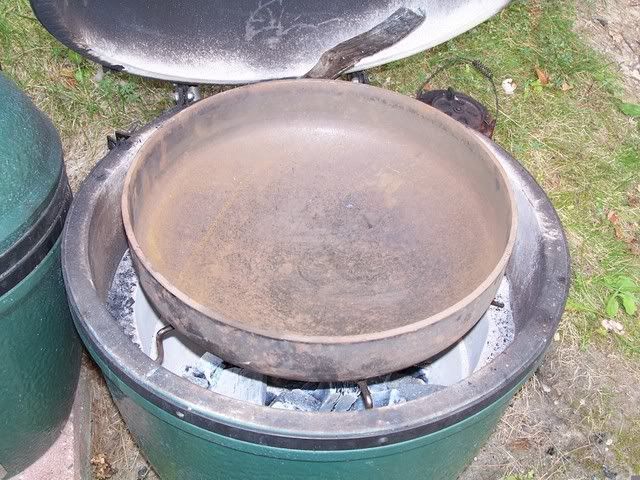
900 hundred is a good temp, ive gone as high as 1100 dome temp with this setup and the thin crust shown here was cooked in 53 seconds at that temp. you need to get something for under the stone to keep the stone cooler than the dome temps. my setup is a tank head filled with sand and the stone sitting in the sand. this forces the heat up and around the top and when cooking you can see a blue fireball hovering above the pizza. the big problem cooking at these temps is that the bands expand as the temp rises, thermal expansion, and there is a good chance that the dome could slip out. if your going to try higher temps i suggest you go over to the primo forum and ask charwoody to show you a picture of a dome clip. those are needed to hold the dome onto the bands if you do any extended high temp pizza cooks. ill be modifying my bands before i do another cook at those temps.
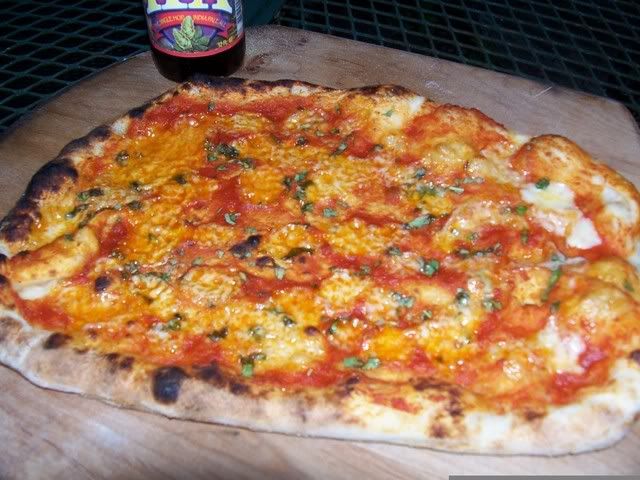
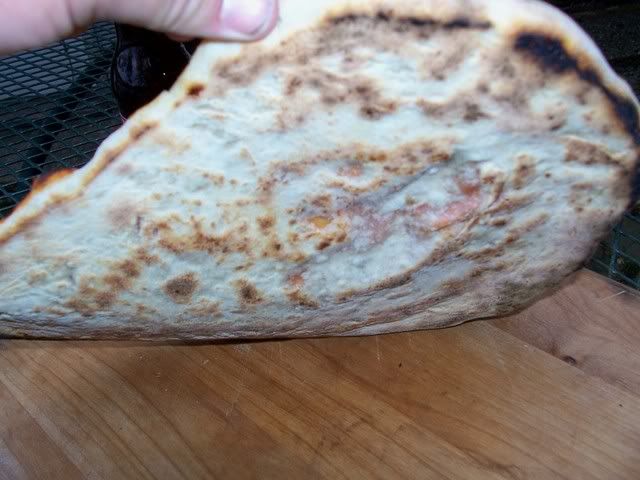
care to share the dough recipe, thats something i need to work on, im actually having good luck with storebought dough, but i know it could be even better.fukahwee maineyou can lead a fish to water but you can not make him drink it -
That's good information - thanks for posting. I'm in the midst of experimenting myself - I think you will find that % hydration is directly proportional to the baking temp required to get the toppings done at the same time as the crust browns. Jeff Verasano, which is the link I assume you're using, does use a very wet dough, thus the really high baking temps - he claims that it's the steam inside the dough that creates that NY style bubbly texture, rather than the CO2 from the fermentation process.
For my purposes, I'm trying to zero in on a hydration that gives me good results at a lower baking temp, say around 550 degrees, simply because it's a bit easier to bake at these temps, and it can be done in my oven (to which I am currently limited). Some links I have read suggest 63% hydration if you're baking in the 550 range. Also, I have found that cold fermentation gives a better tasting crust (let dough rise for 24 hours in fridge instead of a couple hours at room temp). I am not yet convinced that the autolyse period makes a noticeable difference, but need to experiment further.
This is also a good link where I've found a lot of info - basically, a lot of variations on the Tom Lehmann NY style dough recipe:
http://www.pizzamaking.com/forum/index.php/topic,1453.0.html
Hopefully I'll have some time for some more experimenting this week - will post results if I do. Keep us updated on your exeriments as well.
Thanks,
TRex -
I am using the info from Jeff Verasanos site http://slice.seriouseats.com/jvpizza/. Fishlessmans pictures look like the kind of char I’d like.
I figure a pizza a week with a progressive variation on each try. Last pizza was high hydration. My next will be with a cold rise.
Thanks WLL


Categories
- All Categories
- 184K EggHead Forum
- 16.1K Forum List
- 461 EGGtoberfest
- 1.9K Forum Feedback
- 10.5K Off Topic
- 2.4K EGG Table Forum
- 1 Rules & Disclaimer
- 9.2K Cookbook
- 15 Valentines Day
- 118 Holiday Recipes
- 348 Appetizers
- 521 Baking
- 2.5K Beef
- 90 Desserts
- 167 Lamb
- 2.4K Pork
- 1.5K Poultry
- 33 Salads and Dressings
- 322 Sauces, Rubs, Marinades
- 548 Seafood
- 175 Sides
- 122 Soups, Stews, Chilis
- 40 Vegetarian
- 103 Vegetables
- 315 Health
- 293 Weight Loss Forum