Share your photos by tagging us and using the hashtag #BigGreenEgg.
Want to see how the EGG is made? Click to Watch
sourdough starter, now what?

Comments
-
Great! I love my starter. Here is some of what I have learned.
You will I'll get a ton of advice. Most of it will work. Relax this is easy...
you will observe some bubbles in the next day or two, that is bacterial not yeast (fungus). Ignore them.
I like to feed red everyday for two to three weeks 1:1:1 filtered water:organic whole grain flour: starter. Not the only way, just my way.
Keep in trucking! -
Oops now that you mentioned filtered water I forgot about that and I used tap water for my feeding tonight. I think it's ok though because it has grown a fair bit larger over the last few hours.
Thanks for the advice.Large BGEBBQ Guru DigiQ IIMartensville, Saskatchewan Canada -
@gerhardk sent me my starter and included a recipe. I'm in the US for work but I can send that to you Friday. I think it was 1 cup of starter to 500 grams of flour to make a sponge and then use that but I don't recall for sure.
ive made a few loaves and they have been good but I have a lot to learn just on basic baking so I haven't posted here yet.Mt Elgin Ontario - just a Large. -
Thanks @gmac I'm just starting as well. Figured what the hell, I love sourdough pancakes, I might as well make some.Large BGEBBQ Guru DigiQ IIMartensville, Saskatchewan Canada
-
@SciAggie offered me some tremendous tips a while ago. Hopefully he will chime in.Here's a recipe I worked out with a buddy who has also been baking sourdough bread. Of course, there are many variations that work for different folks, so it's by no means the only way to do it. I'm kind of starting with the bread deal, and folks here have been very helpful.Mix water 75g + flour 75g + starter 100g . Cover and let rise for 8-12 hrs at room temp.Add flour 375g + water 230g + salt 2tsp. Knead for 7-10mins in a stand mixer or by hand. Let it rise for about 6hrs or until 2x volume. Fold the dough every 30mins x4 during the first 2hrs. Rises best in the oven with just the light turned on.After 6hrs , dust the top of the dough and tip it out onto a well floured surface. Check out Trevor J Wilson's videos for shaping the dough. Proof in the fridge overnight for 12-15 hrs.Set the oven to as close to 500F as you can get, and heat the Dutch oven for 1hr. Tip the dough into your preheated Dutch oven and slash the top. Bake for 20mins covered. Reduce heat to 450 and bake for another 10mins with the lid still on. Remove lid and bake for another 10-20mins depending on how dark you want the crust.#1 LBGE December 2012 • #2 SBGE February 2013 • #3 Mini May 2013A happy BGE family in Houston, TX.
-
Recipes refer to starter by various names: Culture, pre-ferment, leaven, chief, chef, head, mother or sponge etc. (in some circles some of these have specific technical meaning that distinguishes them, but in general use they are often used without distinction) Basic sourdough bread making has three steps - proofing the dough, shaping and proofing the loaf, then baking the loaf. You use some of your starter (culture proof) to make the dough. Amount used varies by recipe, so there is no standard amount. The recipe below illustrates the basic steps. There are endless variations on ratios of ingredients and timing, but the steps are pretty standard.
What to do with it:- 240 ml Culture Proof (starter), about 1 cup
- 1 teaspoons salt
- 240 grams water
- 480 grams all purpose flour
1.
Dough Proof: Pour the culture into a mixing bowl. Dissolve the salt in the water, add to the culture, and mix well. Add the flour a cup at a time and mix until too stiff to stir by hand. Turn out onto a floured board and knead in the remaining flour until the dough is smooth and satiny.
OR Mix and knead all of the ingredients for a maximum of 25 minutes in a bread machine or other mixer.
Proof for 8-12 hours. Room temperature (70ºF). Large bowl covered with plastic wrap. Dough should double in size.
After proof gently ease the dough out onto a floured board. Allow the dough to rest for 30 minutes. If marked flattening occurs during this time, knead in additional flour before shaping.
2.
Loaf Proof: Shape the dough. Flatten it slightly, then lift a portion from the periphery and pull it toward the center. Continue this around the dough mass to form a rough ball, then shape as a French loaf by gently patting the dough into a rough rectangle then folding over and pressing the edges together to make a seam.
Place the shaped dough, seam side down on a baking sheet. Proof for 2-4 hours, until it doubles in bulk. For a good combination of sourness and leavening, proof the loaf for the first hour at room temperature (70ºF) and tenth remaining time at 85-90ºF.
3.
Baking: Just before baking, make diagonal slashed in the crust with a razor blade. Place the baking sheet with its loaf in a cool oven, then turn the temperature to 375ºF and bake for 70 minutes. OR Transfer the loaf to a preheated baking stone in a 450ºF oven and bake for 40 minutes. OR bake at 375º for 50 minutes in an oven with steaming function cycle.
When the loaf is baked, remove it from the pan and let cool on a wire rack for at least 20 minutes before slicing.
Southeast Florida - LBGE
In cooking, often we implement steps for which we have no explanations other than ‘that’s what everybody else does’ or ‘that’s what I have been told.’ Dare to think for yourself. -
@jtcBoynton awesome, that's exactly what I was looking for, thank youLarge BGEBBQ Guru DigiQ IIMartensville, Saskatchewan Canada
-
I made learning about and doing my own sourdough my New Year's resolution this year. I started with the book Flour Water Salt Yeast which has been a tremendous resource. I really recommend it, but of course there are a TON of resources online. (Think egghead community and ratchet up the fanaticism!)
I am only a few months into learning but I would say the most important thing I have learned is not to overthink it. Yes, measuring out ingredients by weight is important for the actual baking but for the starter/levain/mother or whatever you want to call it all I do is mix roughly equal parts whole wheat and AP flour with enough water (I use filtered from my fridge) to make a sloppy wet mix, add a glob of the last batch, and repeat every 24 hours until you have a really active batch. I store it in the fridge if I am going to be going more than a few days.
Here is a loaf from this weekend, all natural (no commercial yeast) made in a 4 quart lodge cast iron dutch oven...I love doing it and having it around.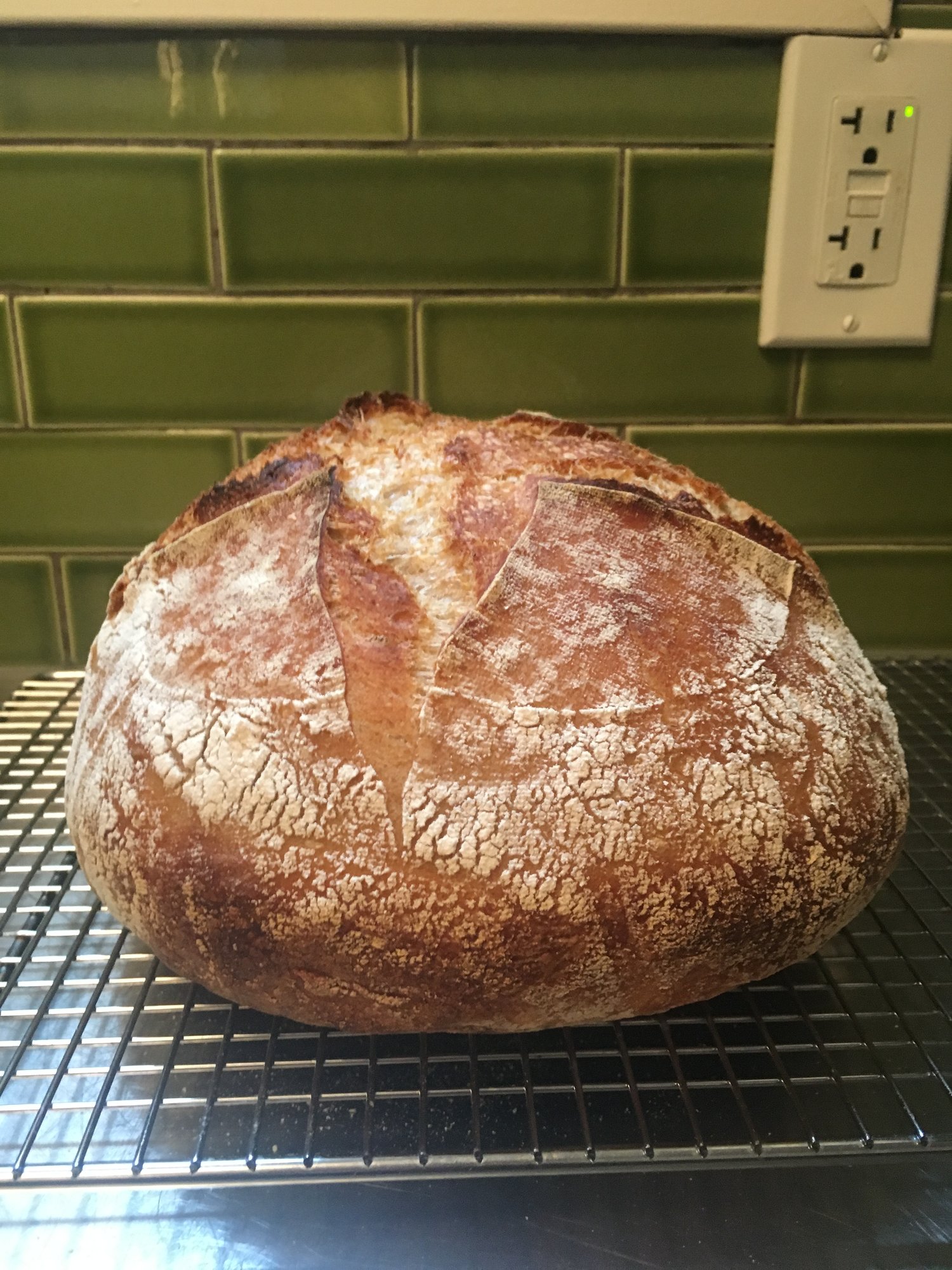 Toronto ON
 -
Nice looking loaf!!Southeast Florida - LBGE
In cooking, often we implement steps for which we have no explanations other than ‘that’s what everybody else does’ or ‘that’s what I have been told.’ Dare to think for yourself. -
That looks fantastic.Steve
XL, Mini Max, and a 22" Blackstone in Cincinnati, Ohio -
"Flour Water Salt Yeast" by Ken Forkish is a great resource. I also really like "Classic Sourdoughs - A Home Baker's Handbook" by Ed Wood.Southeast Florida - LBGE
In cooking, often we implement steps for which we have no explanations other than ‘that’s what everybody else does’ or ‘that’s what I have been told.’ Dare to think for yourself. -
Agreed on FWSY. Depending on your bread baking skills you should look at tartine bread or josey baker bread. Tartine has a very very detailed writeup for country loaf. Josey baker takes you from no knead loaf in a pan to SD hearth loaf over 9 loaves, adding skills/steps to each loaf.jtcBoynton said:"Flour Water Salt Yeast" by Ken Forkish is a great resource. I also really like "Classic Sourdoughs - A Home Baker's Handbook" by Ed Wood. -
Great thanks for all the info everyone! What size of a dutch oven is a good size? A 5 qt lodge is 42% off on amazon, would that size work well?Large BGEBBQ Guru DigiQ IIMartensville, Saskatchewan Canada
-
@bigalsworth 5 quart would be fine. I prefer the 4 quart for the amount of dough from FWSY (split into two loaves) as the smaller size gives a taller less spread out loaf.Toronto ON
-
@simcan that's a beauty! I'm having trouble getting good oven spring, but I think I may be kneading the dough too much in the mixer .#1 LBGE December 2012 • #2 SBGE February 2013 • #3 Mini May 2013A happy BGE family in Houston, TX.
-
@caliking thanks. I am certainly no sourdough expert but I don't use a mixer or do much true kneading with sourdough. I use a mixer and knead loafpan breads. For sourdough I just do a few "folds" of the slack dough 3 or 4 times in the hour or two after mixing, then let it rise, cut in half, fold each half just enough to form a ball to pop into a container to proof (which I do overnight in the fridge). But I think the key to oven spring is heating the dutch oven at 475 for a good 45 minutes before adding the loaf.Toronto ON
-
You've been given some great advice. One of the things I've learned is that you can bend your recipe to suit your daily schedule. @jtcBoynton @caliking and @Simcan gave great advice and sound recipes. I'll offer up basically what I do as an alternative; mainly it will give you timing alternatives.
Feeding the starter:
I use an electric balance and weigh my ingredients. I'll weigh out 150 grams of all purpose flower. I'm using Gold Medal brand because that's what's available locally. I measure into that 150 grams of purified, non-chlorinated bottled water. To that I add 150 grams of starter out of the refrigerator. I mix it up well and let it sit out in the kitchen for a few hours - I don't stress over how long. When I can see some activity I put the starter in the refrigerator.
Making bread:
It's currently about a three day (easy) process to make bread.
Day 1:
before I go to bed at night I pull the starter from the refrigerator. Mix 150 g water, 150 g flour, and 150 g of starter. I put it in a small bowl covered in plastic wrap and leave on the kitchen counter. Put the remaining starter back in the fridge (feed it separately when you feel like it). I use room temperature water.
Day 2:
Early AM before work (usually 5:30 for me) I repeat the feeding of the starter - I think it's normally called a leaven now that we're going to bake with it). Same 150, 150, 150 process. I throw out the excess from the first feeding.
Cover it and leave ot on the counter while at work.
After I get home from work (usually 5:30ish)
Before I describe my process let me talk about my loaf. I have found that using about 430 grams of flour makes a loaf that my wife and I will eat before it goes stale. I use a baker's percentage based on that amount of flour.
Back to mixing: I mix 100 grams of King Arthur 100% organic whole wheat flour with 330 grams of King Arthur bread flour for a total flour mass of 430 grams.
I use a 75% hydration; I'm not comfortable with more hydration at this point.
Ok - I calculate how much water is 5%. Based on 430 g flour that's 22 grams of water. That leaves 300 grams of water - with me?
I add 300 grams of water at about 90 degrees F to the 430 grams of flour. Mix this roughly and let it rest an hour. This is the autolyse.
After one hour I add 1 tsp of salt, 90 grams of leaven (that's a little over 20%) and the reserved 22 grams of room temp water. Work this all together well. Trevor J Wilson has a good YouTube for how to mix relatively wet dough - worth watching.
After the dough comes together I place it in a clean plastic tub for the bulk rise. I put the dough somewhere that I can keep about 80 degrees. Right now, I'm using a spare bathroom with a space heater, lol.
I turn the dough every thirty minutes for 4 turns. Then I let it rise undisturbed for 2-3 more hours. I just look for it to be active and "fluffy" - maybe doubled in volume.
At this point I turn the dough out (unfloured) onto my wood cutting board. I use a bench knife to preshape the dough. TJ Wilson has another good video for that. I then let the dough rest for thirty minutes.
After the bench rest I'll lightly flour and shape the dough - see further videos. After shaping I'll leave the dough on the board for a few (< 5) minutes for the bottom seal to close. Then I place the dough in a linen lined banneton dusted with 50/50 mix of rice flour and regular flour (very important) to keep it from sticking to the linen. I put the banneton full of dough in a 2 gallon Ziploc and put it in the refrigerator. If my math is right it's time for bed now...
Day3:
When I get home from work I turn the oven on to 475 degrees. My pizza stone and ceramic cloche are in the oven. I give it a full hour to heat thoroughly. When ready, turn the dough out onto the pizza stone, slash the dough and cover with your cloche or DO. Bake 20 minutes and remove the cover. I have been reducing the oven temp to 425 at this point. Bake another 20 minutes or so until nicely browned.
Remove to a cooling rack and let the bread cool completely before cutting.
I hope this helps,Coleman, Texas
Large BGE & Mini Max for the wok. A few old camp Dutch ovens and a wood fired oven. LSG 24” cabinet offset smoker. There are a few paella pans and a Patagonia cross in the barn. A curing chamber for bacterial transformation of meats...
"Bourbon slushies. Sure you can cook on the BGE without them, but why would you?"
YukonRon -
Lots of good advice from others. King Arthur Flour has a good web site with lots of sourdough recipes and videos - one good one is the video about bread shaping. Some of their sourdough recipes also use regular yeast, but I don't use it. Experiment and find what works best for you.
Large BGE
Barry, Lancaster, PA -
I am actually using the king arthur site to make my starter, lots of good info there.Shiff said:Lots of good advice from others. King Arthur Flour has a good web site with lots of sourdough recipes and videos - one good one is the video about bread shaping. Some of their sourdough recipes also use regular yeast, but I don't use it. Experiment and find what works best for you.Large BGEBBQ Guru DigiQ IIMartensville, Saskatchewan Canada -
Okay guys I think I'm blowing it. I think I ruined my first starter so I turfed it and started a new one. I changed containers that I am making it is which is a wide mouth Mason jar.
I am following the King Arthur website and the first couple days things seem to be going super good, I got bubbling after the first day and after the first feeding it doubles in size. After that I get tons of bubbling but no more doubling in size after a feeding, I also get some water separation but from what I understand that isn't a bad thing. The smell also smells salty like homemade playdough, you know the stuff that is just a mixture of flour and salt.
It has been 5 days now and I decided to try @jtcBoynton recipe with the starter I would discard. I followed his instructions but my dough didn't double overnight, it expanded some but not much. I baked it anyway and while it doesn't taste bad it just doesn't taste like what I would recognize as sour dough. It maybe had a slight tangy taste that seems like the start of what should be sourdough.
One question I have is the King Arthur website says to measure out 4oz of starter then add 4 oz flour and 4 oz water. Should I be removing all my starter from the jar, measuring it out, clean my jar and then start with a clean jar? I have not been doing that, I have just spooned out until I have what should be 4 oz of starter left and then adding the feed.
I also wonder if the flour I use maybe wrong? I use Robinhood bread flour, and day used Robinhood whole wheat for my day one starter.Large BGEBBQ Guru DigiQ IIMartensville, Saskatchewan Canada -
I would wait for atleast 2 weeks of life before using. After five days you would be better off using commercial yeast.
-
okay, just to clarify, two weeks on the counter with feedings everyday? or should I throw in the the fridge sooner than that?bigbadben said:I would wait for atleast 2 weeks of life before using. After five days you would be better off using commercial yeast.Large BGEBBQ Guru DigiQ IIMartensville, Saskatchewan Canada -
I would say two weeks in counter feeding everyday. Yours might be ready a few days before or after 14 days, but you will have to see how much rise you are getting 12,18, and 24 hrs after feeding.bigalsworth said:
okay, just to clarify, two weeks on the counter with feedings everyday? or should I throw in the the fridge sooner than that?bigbadben said:I would wait for atleast 2 weeks of life before using. After five days you would be better off using commercial yeast. -
I just activated a dormant culture i semt away from ed wood at sourdo.com. ischia island italian culture
Started it last friday and today it smells ready to go...in fact it expanded so much it spilled over the jar lid
Ive fed it no name ap or bread flour amd purified water every day and poured out half each day...so now i have four containers with live cultures
Am considering using this with pizza this week.... -
I use wide mouth mason jars as well. Bubbling is an indication of active culture. The doubling in size is a function of the air bubbles being trapped in the culture. The hydration levels of the culture go a long way in determining how much rise you get. With higher hydration, you will get less rise even though the culture is active (more air bubbles escape rather than being trapped). I keep my starter near 100% hydration so I don't get as much rise. You don't need to go to a clean jar every time you use your starter.bigalsworth said:Okay guys I think I'm blowing it. I think I ruined my first starter so I turfed it and started a new one. I changed containers that I am making it is which is a wide mouth Mason jar.
I am following the King Arthur website and the first couple days things seem to be going super good, I got bubbling after the first day and after the first feeding it doubles in size. After that I get tons of bubbling but no more doubling in size after a feeding, I also get some water separation but from what I understand that isn't a bad thing. The smell also smells salty like homemade playdough, you know the stuff that is just a mixture of flour and salt.
It has been 5 days now and I decided to try @jtcBoynton recipe with the starter I would discard. I followed his instructions but my dough didn't double overnight, it expanded some but not much. I baked it anyway and while it doesn't taste bad it just doesn't taste like what I would recognize as sour dough. It maybe had a slight tangy taste that seems like the start of what should be sourdough.
One question I have is the King Arthur website says to measure out 4oz of starter then add 4 oz flour and 4 oz water. Should I be removing all my starter from the jar, measuring it out, clean my jar and then start with a clean jar? I have not been doing that, I have just spooned out until I have what should be 4 oz of starter left and then adding the feed.
I also wonder if the flour I use maybe wrong? I use Robinhood bread flour, and day used Robinhood whole wheat for my day one starter.
Sourdough means using a natural starter as opposed to using commercial yeast. Natural starters are a culture of yeast and bacteria. The bacteria are what produce the tangy flavors. The balance between the bacteria and yeast and the specific bacteria influence the amount of sourness you get. How you proof the loaf will also influence the taste profile. Advice from Ed Wood (Classic Sourdoughs - A Home Baker's Handbook):- Proof at room temperature for good flavor and even leavening but mild sourness.
- Proof at higher temperature (85-90ºF) for more sour loaf with good flavor but decreased leavening.
- Proof at room temperature for first hour and then raise temperature to 90ºF for much more sour with only slightly lower leavening.
Most sourdoughs will not have the leavening capacity as commercial yeasts.
The taste profiles are influenced by the different bacteria and yeast in your starter. The mix in your starter is primarily determined by the strains of bacteria and yeast that came attached to the whole wheat flour you start with. This will vary based on the source of the wheat used to make the flour. You can override this randomness by using a starter from a commercial source or getting some from a friend who has a good culture. Also remember that "room temperature" is a term of art that means different thing to different people. Culturing your starter at 65º will get a different bacteria/yeast balance than culturing at 75º.
Southeast Florida - LBGE
In cooking, often we implement steps for which we have no explanations other than ‘that’s what everybody else does’ or ‘that’s what I have been told.’ Dare to think for yourself. -
@jtcBoynton thank you, that is very helpful.Large BGEBBQ Guru DigiQ IIMartensville, Saskatchewan Canada


Categories
- All Categories
- 184K EggHead Forum
- 16.1K Forum List
- 461 EGGtoberfest
- 1.9K Forum Feedback
- 10.5K Off Topic
- 2.4K EGG Table Forum
- 1 Rules & Disclaimer
- 9.2K Cookbook
- 15 Valentines Day
- 118 Holiday Recipes
- 348 Appetizers
- 521 Baking
- 2.5K Beef
- 90 Desserts
- 167 Lamb
- 2.4K Pork
- 1.5K Poultry
- 33 Salads and Dressings
- 322 Sauces, Rubs, Marinades
- 548 Seafood
- 175 Sides
- 122 Soups, Stews, Chilis
- 40 Vegetarian
- 103 Vegetables
- 315 Health
- 293 Weight Loss Forum