Share your photos by tagging us and using the hashtag #BigGreenEgg.
Want to see how the EGG is made? Click to Watch
Holding pulled pork in water bath for serving

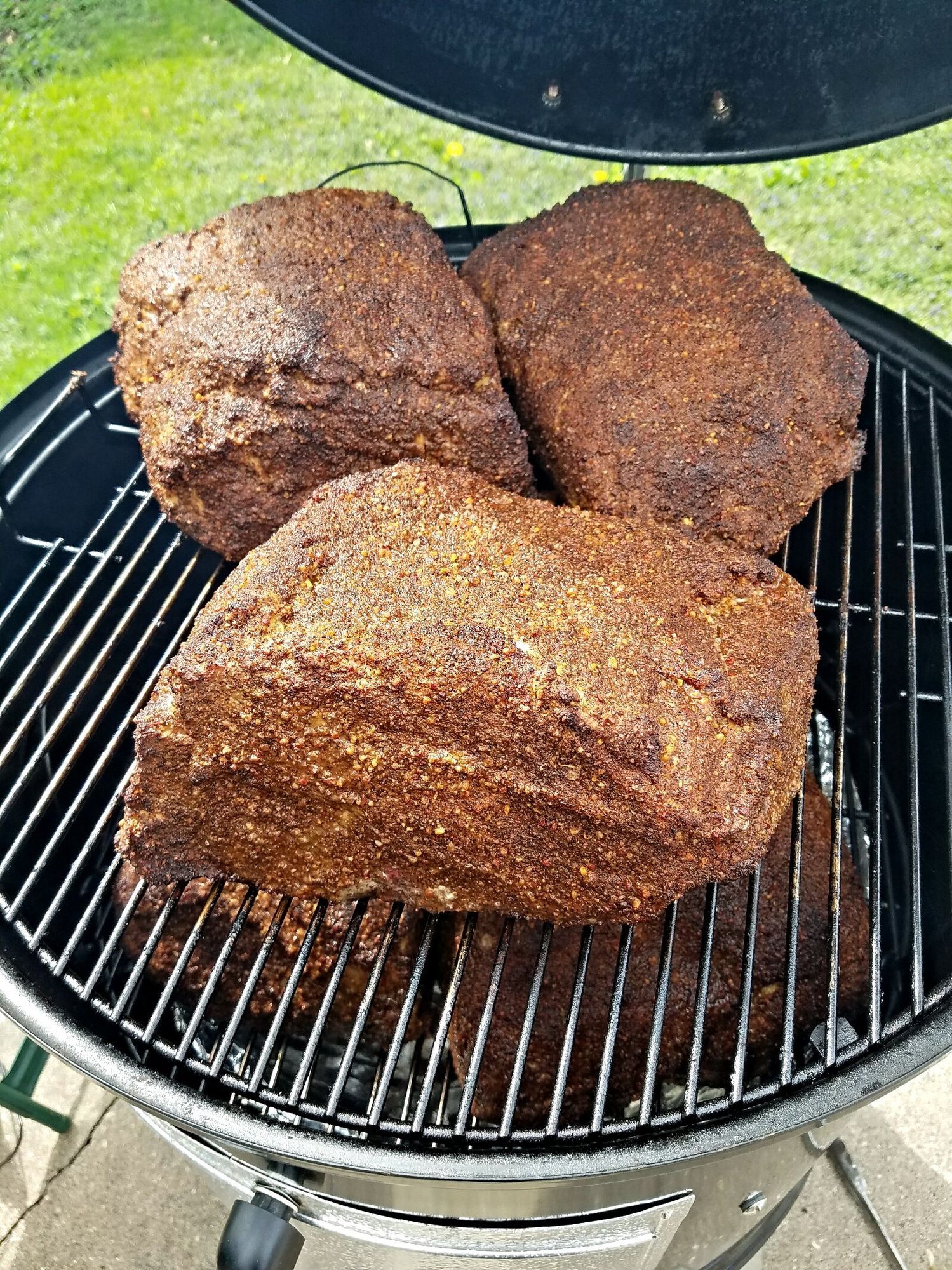
Contemplating using a water bath instead of a turkey fryer and king cooker pot to heat, hold, and serve. Figured SV with the Anova would be so much easier in a free 5 gal icing bucket from the grocer's bakery dept. Load up roasters for first rush, then have ready to serve water bathed PP on standby.
140 minimum I know, what do y'all sous viders think about filling the bags up a little more holding them longer, knowing the internal would get there?
Thanks
"If yer gonna denigrate, familiarity with the subject is helpful."
Comments
-
I think you'll be fine filling huge bags up. Rule is 4 hours max under 130F. Given you cooked the food and it's sterile, if it takes a while to get to "safe" temp, it's no big deal.
______________________________________________I love lamp.. -
Thanks for the reassurance nola.BrandonQuad Cities
"If yer gonna denigrate, familiarity with the subject is helpful." -
That sounds so completely, resoundingly right! ... but it isn't. If cooked food really were sterile, there would be no reason to refrigerate cooked food! We could just wrap it well and leave it out for months. People have studied real-world cases of food poisoning and found that chilling cooked food rapidly is necessary to prevent people from getting sick. From the USDA, for example:nolaegghead said:... Given you cooked the food and it's sterile, if it takes a while to get to "safe" temp, it's no big deal.Cool Food Rapidly
To prevent bacterial growth, it's important to cool food rapidly so it reaches as fast as possible the safe refrigerator-storage temperature of 40° F or below. To do this, divide large amounts of food into shallow containers. A big pot of soup, for example, will take a long time to cool, inviting bacteria to multiply and increasing the danger of foodborne illness. Instead, divide the pot of soup into smaller containers so it will cool quickly.
Cut large items of food into smaller portions to cool. For whole roasts or hams, slice or cut them into smaller parts. Cut turkey into smaller pieces and refrigerate. Slice breast meat; legs and wings may be left whole.
Hot food can be placed directly in the refrigerator or be rapidly chilled in an ice or cold water bath before refrigerating.
@nolaegghead, I completely agree with you that it just seems obvious that the big pot of soup they're talking about, like a thoroughly cooked chunk of BBQ, "ought to be" sterile! So you "shouldn't" have to worry about chilling it. But... in real-world cases, people have gotten desperately, miserably sick when cooked food wasn't chilled fast enough (or reheated fast enough, for that matter).
And from the standard manual for food safety used all across the country in the food service industry, the Servsafe Coursebook,
Cool food from 135°F to 70°F within two hours.Then cool it from 70°F to 41°F or lower in the next four hours.If food has not reached 70°F within two hours, it must be reheated and then cooled again.
The reason for these "commandments" isn't because somebody likes to make up non-essential rules to make people's lives miserable. It's because real people in the real world have GOTTEN SICK when cooked food wasn't chilled fast enough, and these guidelines are what have been shown in real-world situations to keep people from getting sick.
Large quantities of hot BBQ should either be kept above 140° or rapidly chilled and then rapidly reheated.
I know, I know... we've all done it other ways and "nobody's ever gotten sick..." so we think we know it's OK. But the reason for that is that you can do it wrong and get away with it most of the time. I've read many case reports of people who'd been doing BBQ, for example, for DECADES and no one ever got sick. ... until they did, and dozens of people were hospitalized, and some of them died.
There's a reason that guidelines for commercial food service are tougher than for home cooks: the dangers of cooking ONE big chunk of meat for one family, having the family eat a fair bit of it, and chilling the reduced portion of leftovers, are VERY different than the dangers of cooking, say, SIX chunks of meat and keeping all or nearly all of it to serve to others many hours or days later. The much larger quantities take MUCH longer to chill and reheat, and that's where the danger is.
It's a little like driving a pickup to haul your own stuff, or driving an 18-wheel rig to haul a whole bunch of people's stuff. There's a LOT to learn before driving a big rig. Well, cooking for a whole bunch of people involves different dangers than cooking for your own family, and most of us don't have the equipment to keep massive amounts of BBQ at the proper temperatures.
For anyone who's cooking large amounts of food for a large group of people, the Servsafe Coursbook is your friend.
-
This is good info as always @Theophan, but i have a clarifying question:
the rule itself makes no reference to this, but doesn't it assume that the food is leftover, or at least handled and had human contact or a source of re-infection?
as with you soup example, i'm thinking of beer making. The reason people drank weak beer (in the period before clean available municipal water), and (one of the) the reason(s) we can make beer at home legally, is that boiling the wort sterilizes the beer.
The vast majority is fermented at room temp, and the alcohol doesn't kick in quickly enough to be the antiseptic to keep it safe.
Is the assumption that we are talking about food which has been out on a tray and served, coughed over, etc? Or undercooked and maybe harboring bacteria because it was incorrectly cooked?
i can think of other exMples of food which are sterilized by cooking and then left out at room temp for extended periods and are perfectly safe. Home canned fruits and vegetables for example. I don't mean pickling or cured foods either. Pears in syrup, for example. Granted, we're talking about environments with no air. But would anaerobic bacteria thrive atroom temp if they were there after boiling?
So the only difference appears to be an opportunity for reinfection
this also doesn't square with foods left out all the time at room temp and which might even be expected to be 'compromised '. Butter, cake, breads, olive oil,etc
i'm asking fir my own education on this, and none of this is a debate or questioning your knowledge.
But my interpretation is that the 'rule' is one constructed to convey the simples information to the simplest user covering themajority of conditions. And that it is based on assuming multiple levels of failure (as opposed to reauiring only one for things to go wrong). Kind of like requiring foods to be cooked to 160 when pasteurization is achieved at temps not nearly so high. It's 160 that's recommended not because that's the real temp, but because they assume you will take it in the wrong part of the meat, or your thermo is miscalibrated, or any of a few other possible errors in reading it
to pose a more applicable scenario for BGE-ers:
you have a pork butt whose internal is 160, in an environment that is 225. The fire goes out and five hours later (hey, you got drunk and slept in) the internal temp is down to 120 or something. Maybe it's cold out.
Untouched and previously pasteurized, in a pasteurized cooker. More than four hours lossibly at 40-140. Internal temp and even longer externally
this is a legit question, not antagonism: what event took place to the meat in that time which would cause there to be a (bacterial) safety issue?
atthe end of it all, it's my belief that the science is of course solid. But that the rule makers cannot parse every condition and circumstance. So they, as a benefit to the most people covering most scenarios, develop a general rule which they apply to all situations so that people do not have to 'know' anything so much as simply remember the rule and apply it
safer for everyone, but in the details, not always iron clad
again. I am posing this so i can learn. Not to question the science (i tend to be a science-leaning guy myself). And i am not asking this as an undoing of the logic behind the rule. Just asking "but why?"
[social media disclaimer: irony and sarcasm may be used in some or all of user's posts; emoticon usage is intended to indicate moderately jocular social interaction; the comments toward users, their usernames, and the real people (living or dead) that they refer to are not intended to be adversarial in nature; those replying to this user are entering into a tacit agreement that they are real-life or social-media acquaintances and/or have agreed to or tacitly agreed to perpetrate occasional good-natured ribbing between and among themselves and others] -
when I reheat PP sous vide, I go to 160ish. I figure finish cooking temp is ~200 so why not heat up more than 140? Ps. I've done a bunch of large bags (1+ gallon) all at once and worked great. I advise your bags be an inch or two thick max once sealed, that way it will reheat reliably. I use a cooler and set it up (anova) near my serving area. I can take a bag out at a time to refill my serving tray..
Small & Large BGE
Nashville, TN
-
@Darby_CrenshawDarby_Crenshaw said:This is good info as always @Theophan, but i have a clarifying question:
the rule itself makes no reference to this, but doesn't it assume that the food is leftover, or at least handled and had human contact or a source of re-infection?
as with you soup example, i'm thinking of beer making. The reason people drank weak beer (in the period before clean available municipal water), and (one of the) the reason(s) we can make beer at home legally, is that boiling the wort sterilizes the beer.
The vast majority is fermented at room temp, and the alcohol doesn't kick in quickly enough to be the antiseptic to keep it safe.
Is the assumption that we are talking about food which has been out on a tray and served, coughed over, etc? Or undercooked and maybe harboring bacteria because it was incorrectly cooked?
i can think of other exMples of food which are sterilized by cooking and then left out at room temp for extended periods and are perfectly safe. Home canned fruits and vegetables for example. I don't mean pickling or cured foods either. Pears in syrup, for example. Granted, we're talking about environments with no air. But would anaerobic bacteria thrive atroom temp if they were there after boiling?
So the only difference appears to be an opportunity for reinfection
this also doesn't square with foods left out all the time at room temp and which might even be expected to be 'compromised '. Butter, cake, breads, olive oil,etc
i'm asking fir my own education on this, and none of this is a debate or questioning your knowledge.
But my interpretation is that the 'rule' is one constructed to convey the simples information to the simplest user covering themajority of conditions. And that it is based on assuming multiple levels of failure (as opposed to reauiring only one for things to go wrong). Kind of like requiring foods to be cooked to 160 when pasteurization is achieved at temps not nearly so high. It's 160 that's recommended not because that's the real temp, but because they assume you will take it in the wrong part of the meat, or your thermo is miscalibrated, or any of a few other possible errors in reading it
to pose a more applicable scenario for BGE-ers:
you have a pork butt whose internal is 160, in an environment that is 225. The fire goes out and five hours later (hey, you got drunk and slept in) the internal temp is down to 120 or something. Maybe it's cold out.
Untouched and previously pasteurized, in a pasteurized cooker. More than four hours lossibly at 40-140. Internal temp and even longer externally
this is a legit question, not antagonism: what event took place to the meat in that time which would cause there to be a (bacterial) safety issue?
atthe end of it all, it's my belief that the science is of course solid. But that the rule makers cannot parse every condition and circumstance. So they, as a benefit to the most people covering most scenarios, develop a general rule which they apply to all situations so that people do not have to 'know' anything so much as simply remember the rule and apply it
safer for everyone, but in the details, not always iron clad
again. I am posing this so i can learn. Not to question the science (i tend to be a science-leaning guy myself). And i am not asking this as an undoing of the logic behind the rule. Just asking "but why?"
I am going to call you next time I get into an argument with my wife to be my proxy....you can clearly articulate better than me...Have:
XLBGE / Stumps Baby XL / Couple of Stokers (Gen 1 and Gen 3) / Blackstone 36 / Maxey 3x5 water pan hog cooker
Had:
LBGE / Lang 60D / Cookshack SM150 / Stumps Stretch / Stumps Baby
Fat Willies BBQ
Ola, Ga -
Thanks for the help, 160 it is.Raymont said:when I reheat PP sous vide, I go to 160ish. I figure finish cooking temp is ~200 so why not heat up more than 140? Ps. I've done a bunch of large bags (1+ gallon) all at once and worked great. I advise your bags be an inch or two thick max once sealed, that way it will reheat reliably. I use a cooler and set it up (anova) near my serving area. I can take a bag out at a time to refill my serving tray..
BrandonQuad Cities
"If yer gonna denigrate, familiarity with the subject is helpful." -
From a "common sense" standpoint, again it just seems obvious, inescapable, that cooked food "must be" sterile, so your question is completely reasonable -- if there was a problem in "sterile" food, it must have been re-infected.Darby_Crenshaw said:... i have a clarifying question: the rule itself makes no reference to this, but doesn't it assume that the food is leftover, or at least handled and had human contact or a source of re-infection? ... Is the assumption that we are talking about food which has been out on a tray and served, coughed over, etc? Or undercooked and maybe harboring bacteria because it was incorrectly cooked?
But no, the Servsafe book I mentioned and quoted from isn't for home cooks, but the food service industry, so what they're dealing with is large quantities of food prepared for many people, and not just food that's out and coughed over by the public.
The basic concept, it seems to me, is that it's almost never 100% deadly or 100% safe. We can do it wrong and no one will get sick most of the time! It's just it's not a small risk of catching a cold, but a small risk of making some people really desperately sick. If you remember the first Jurassic Park movie, Jeff Goldblum's character kept saying, "Nature will find a way." In this context, it means that our cooked food can NEVER truly be considered 100% sterile. One easy example is bacterial spores. Clostridium perfringens is just one of many bacteria that produce spores under "adverse conditions" that are likely to kill the bacteria. Bacterial spores are dormant, but normal cooking temperatures will NOT kill them. Then, once the conditions are no longer adverse (like the food is cooling, the spores can germinate and now you have active, growing bacteria.
Another issue is the amount of time a massive amount of food can take to chill or heat up. Procedures that really are safe for a family's amount of food might be very UN-safe if the quantity is very much larger. For example, cooking to a certain temperature to a certain amount of time might reduce the number of bacteria so drastically that the likelihood any that remain might multiply to a dangerous level under normal family conditions might be nearly zero. BUT a family's leftovers put in the fridge might take an hour or a few to chill all the way to the center, but a large gathering's worth of food put in the same fridge might take SEVERAL DAYS to finally reach a temperature that slows bacterial growth nearly to zero. So a really tiny amount of bacteria (again, think "nature will find a way") might never reach a dangerous level in a family's leftovers, but when cooking for a large number of people, while using the same procedures that were safe for a family quantity of food, that same tiny amount of bacteria might now have so much time to exponentially multiply that they can reach dangerous proportions.
I completely agree! But before we suppose that we can ignore the guidelines provided by studying real-world events of foodborne illness, we need to have a reason to suppose our circumstance makes it safer. Restaurants that are preparing large quantities of pulled pork, for example, are required either to keep the pork above a certain temperature until it's served, or to chill it rapidly, and then reheat it rapidly, and they have commercial equipment and trained staff to do all of that. If we at home are taking on the task of cooking a restaurant quantity of food for a large number of people, the safest assumption is that the commercial rules DO apply to us if we want to be safe, because we're cooking a restaurant quantity of food! To suppose that we don't have to follow procedures that have been demonstrated to be safe in this context, we need to have a reason to believe our circumstances somehow make our food safer. I can't think of such a reason. If a really large quantity of pulled pork need to be kept above a certain temperature, or chilled below a certain temperature within a certain amount of time, I'm not sure it matters whether it's a restaurant or me at home. I fought with people at my church, for example, about doing a fund-raiser by selling BBQ. We don't have a commercial kitchen, and we aren't trained to safely prepare and serve large quantities of food.... at the end of it all, it's my belief that the science is of course solid. But that the rule makers cannot parse every condition and circumstance. So they, as a benefit to the most people covering most scenarios, develop a general rule which they apply to all situations so that people do not have to 'know' anything so much as simply remember the rule and apply it
safer for everyone, but in the details, not always iron clad...
I feel crummy about these posts of mine -- I don't want to be a buzz-kill! Realistically, again, most of the time everything will be fine. But I've talked to people who had food poisoning who said if they'd had a gun they would have put themselves out of their own misery. And elderly people and young children sometimes die from it! The idea that "I've been doing this for years and nobody's ever gotten sick" is simply a demonstration that the risks are relatively low, even when doing it wrong. All of these guidelines came about by studying real-life cases in the real world of people getting sick, and sorting out what will lower the risk of that happening THIS time. -
Good info (per usual). I think the difficulty (for me) is that as you explained, this is a rule based on assumptions about large amounts of production and industrial or commercial settings.Theophan said:
I feel crummy about these posts of mine -- I don't want to be a buzz-kill!
...
The idea that "I've been doing this for years and nobody's ever gotten sick" is simply a demonstration that the risks are relatively low, even when doing it wrong. All of these guidelines came about by studying real-life cases in the real world of people getting sick, and sorting out what will lower the risk of that happening THIS time.
And so in a very literal sense, there is no gray area allowed, no risk assessment, but rather that it must be all or none, black or white.
I tend to be somewhere in between
I can appreciate the logic behind it. Thanks
[social media disclaimer: irony and sarcasm may be used in some or all of user's posts; emoticon usage is intended to indicate moderately jocular social interaction; the comments toward users, their usernames, and the real people (living or dead) that they refer to are not intended to be adversarial in nature; those replying to this user are entering into a tacit agreement that they are real-life or social-media acquaintances and/or have agreed to or tacitly agreed to perpetrate occasional good-natured ribbing between and among themselves and others] -
Cross contamination of cooked food (including handling) and uncooked (raw) or under-cooked foods (that are contaminated) are the main causes of food poisoning.
Cooking some pork butt to 200F and throwing it into bags (without cross contaminating it when cool), letting it cool in the fridge (with good air flow) and reheating is an unlikely scenario for food poisoning.
That lovely looking bulk-prepared salad is exponentially more likely in the real world to make you sick. Cook all your salad to 160F.
______________________________________________I love lamp.. -
______________________________________________I love lamp..


Categories
- All Categories
- 184K EggHead Forum
- 16.1K Forum List
- 461 EGGtoberfest
- 1.9K Forum Feedback
- 10.5K Off Topic
- 2.4K EGG Table Forum
- 1 Rules & Disclaimer
- 9.2K Cookbook
- 15 Valentines Day
- 118 Holiday Recipes
- 348 Appetizers
- 521 Baking
- 2.5K Beef
- 90 Desserts
- 167 Lamb
- 2.4K Pork
- 1.5K Poultry
- 33 Salads and Dressings
- 322 Sauces, Rubs, Marinades
- 548 Seafood
- 175 Sides
- 122 Soups, Stews, Chilis
- 40 Vegetarian
- 103 Vegetables
- 315 Health
- 293 Weight Loss Forum