Welcome to the EGGhead Forum - a great place to visit and packed with tips and EGGspert advice! You can also join the conversation and get more information and amazing kamado recipes by following Big Green Egg to Experience our World of Flavor™ at:
Want to see how the EGG is made? Click to Watch
Facebook | Twitter | Instagram | Pinterest | Youtube | Vimeo
Share your photos by tagging us and using the hashtag #BigGreenEgg.
Share your photos by tagging us and using the hashtag #BigGreenEgg.
Want to see how the EGG is made? Click to Watch
Installing Blower and Controller Right Away

chadpsualum
Posts: 409
I made some wings last night and decided to do a little test with the Stoker controller and I wanted to see if the group had any thoughts.
When I typically use the Stoker, I light (with a looftlighter) and leave the bottom vent wide open and the daisy wheel off (as most people do). When I get to 50F above temp I open, install Platesetter/grates, install fan and probes and away I go.
Last night, I lit the fire, installed the Platesetter/grates and installed the fan right away. I let the fan guide the fire up to setpoint, waited until the smoke was clear and then I started cooking. Seemed to work great.
Anyone have reason(s) not to do it this way?
When I typically use the Stoker, I light (with a looftlighter) and leave the bottom vent wide open and the daisy wheel off (as most people do). When I get to 50F above temp I open, install Platesetter/grates, install fan and probes and away I go.
Last night, I lit the fire, installed the Platesetter/grates and installed the fan right away. I let the fan guide the fire up to setpoint, waited until the smoke was clear and then I started cooking. Seemed to work great.
Anyone have reason(s) not to do it this way?
North Pittsburgh, PA
1 LGE
1 LGE
Comments
-
Yes, but only if you are inexperienced with the start-up mannerism of the BGE.
If you have your pit set for 250F and the ambient temp is 50F, the ceramic is 50F. You fire it up and the ceramic acts as a HUGE heat sink sucking up the heat. The fan is blowing @ 100% because it's 100F+ below the set point. So you're creating this HUGE fireball that you do not need (because that heat sink is going away soon). Once the ceramic comes up 200-250F, the fan will start backing off and then turn off at 250F. But the Egg is so efficient, it doesn't need force fed air--it can draw it's own past the fan or through a leaky gasket, draft door, etc. This is when people blow past their set point by 50-75-100F+. That huge fireball wants to keep going and now you're trying to snuff it out.
Two ways to combat this:
1 - Just bring it up to temp like a normal, then put the fan on once things stabilized.
2 - Or strap the fan on, but set it for 150 or 175F. The fire will exceed these temps easily, so it shuts the fan off while the ceramic is still absorbing heat. Once it passes 200F and stabilizes, bump it a little, let it stabilize, then repeat until you hit your temp.
Sometimes it just works and you don't have to worry (especially if it's cold outside). But anyone here who has ever had the temp get a away from them knows what a bear it is to cool back down. So, I'm cautious and step it up little by little. No reason to be in a hurry at that point--you're going L&S anyway.
-
I used #2 yesterday on my maiden voyage with my FB 200, but I left my DW holes fully open. When it got to 190 I went back outside and closed the daisy wheel to my cook setting and set it for 210* and the FB nailed with only 2* of overshoot.
Cooking on an XL and Medium in Bethesda, MD. -
That's the way I always do it. It seems to take a bit longer to get to temp, but I don't have to pay attention as I would if I were letting the temp get close before installing the controller. No chance of overshooting.
Not sure I follow the "huge fireball" thing. I only use my DigiQ for lo n slo cooks. I want a stable 250° fire that will last as long as needed (could be 18-20 hours) and that's what I get. Always.I hate it when I go to the kitchen for food and all I find are ingredients!
MichaelCentral Connecticut -
I agree with STC...I tend to manually stabilize the Egg and then hook up my Stoker to let it "Babysit" the cook from that point. I feel there is a risk over "overshooting" your target temp if you apply blower earlier in the process.
-SMITTY
from SANTA CLARA, CA
-
I do a two stage method. First I light the egg with the Looflighter and hook up the fan and CyberQ within 5 minutes with the grate on. Once the temp reaches the target I add my wood chunks and stone or platesetter. By the time it reaches the target temp I add the food and the temp is stable within 30 minutes at my target temp.
-
When I started with my DigiQ I used Jonathan's #2 approach of aiming for 50* low on start-up. When the temp overshot, I bumped the target to 25* low. Then I'd up the target to the final tempature value. Lots of mistakes on the first three or four start-ups ... a number of folks pitched in with advice to help me get through the learning curve. Mostly I had too much natural air leakage ... both top and bottom vents.
Now that I know the correct vent settings necessary for the egg to happily operate, I've stopped using the step approach to getting to target temp. I fully understand and even agree with Jonathan's description of how the fan will stir up too much fire, but my recent experience with the Flameboss doesn't seem to adhere to that theory. Here is a typical start up ... pull the electric starter, install the smoke wood, PSWoo3 w/ all accessories, install the Flameboss, and close the lid.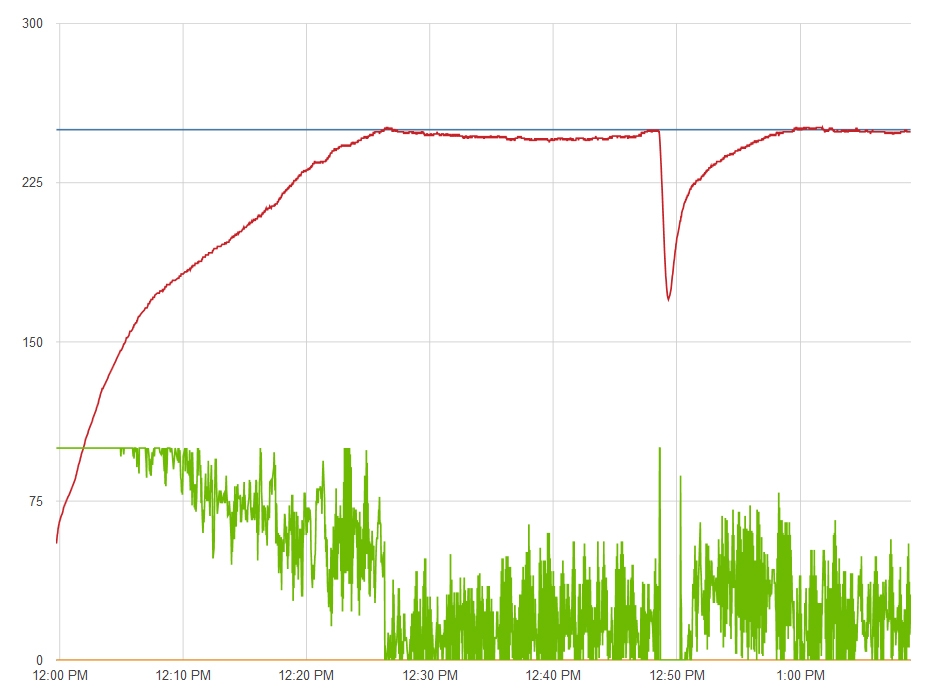
Until you know exactly what your egg requires to peculate along happily at target temp, I'd urge you to start with Jonathan's #2 process.
Washington, IL > Queen Creek, AZ ... Two large eggs and an adopted Mini Max
-
Okay @stlcharcoal correct me if I'm wrong. I seem to remember that you set your controllers up so that the fan runs minimally ... yes/no? I've found the temperatures easier to control if the exhaust vent is restricted enough to cause the fan to run around 20 to 30% of the time. Note, in the above graph, that the mean run time after 12:30 is nominally in that range.
The change in vent settings would seem to be why our experiences on start-up with/without temperature overshooting are different.
One other point that none of us have mentioned: Just like running an egg in manual mode, the exhaust vent needs to allow more airflow for a higher target temperature. For 225*, on one of my eggs, the Smokeware cap needs to be completely closed; for 250* the cap is slightly closed; and for 350* it needs to be open around 3/8". Those settings force the fan to run around 20 to 30% of the time and keep the pit temp at or slightly below target. If we wanted the fan on that egg to only run a little bit, then the vent settings would have to be increased even more for each target temp.
Washington, IL > Queen Creek, AZ ... Two large eggs and an adopted Mini Max
-
Different smokes for different folks......but I do it the right way!!!Jeepster47 said:Okay @stlcharcoal correct me if I'm wrong. I seem to remember that you set your controllers up so that the fan runs minimally ... yes/no? I've found the temperatures easier to control if the exhaust vent is restricted enough to cause the fan to run around 20 to 30% of the time. Note, in the above graph, that the mean run time after 12:30 is nominally in that range.
The change in vent settings would seem to be why our experiences on start-up with/without temperature overshooting are different.
I set mine up like that because I know if the power goes out, the probe fails, etc it keeps on going. Rather than a constant snuffing of the fire and the fan force feeding it, I just run normally and let the fan kick on if it needs too.
Now, last night I closed it up tight and ran like you because it was 35mph winds and 20F. The fan ran constantly and still is. Wind screws with BGE's more than anything else, so I couldn't risk running it like I normally do.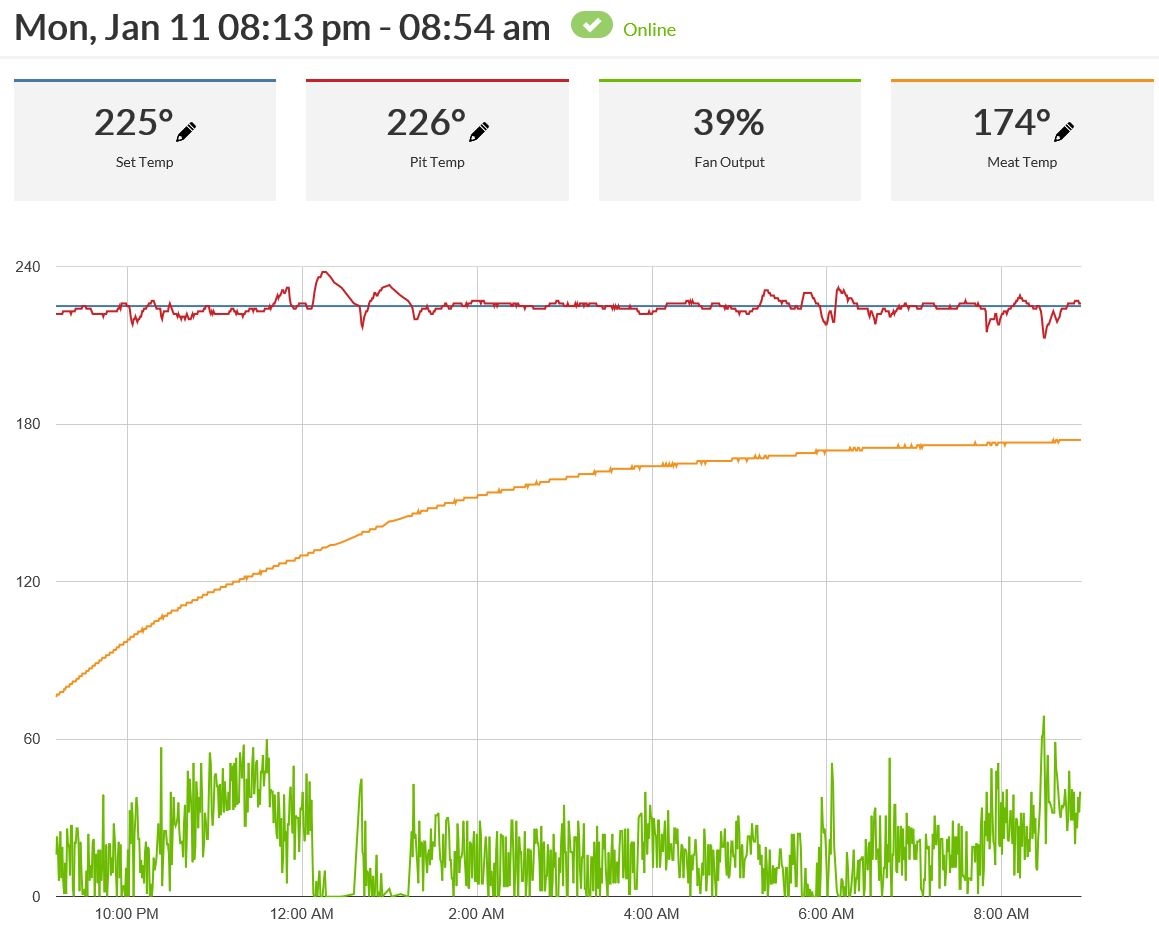
-
Hmmm ... let me see if I've got this correct! When the going is easy, you run the egg kind of manually with the FB as sort of an insurance policy against the fire going out. And, when it's tough egging and you really need the capability of the FB, then you use my method.
Damn where did I put that password for your unit that you shared with us to play around with ... it's around here someplace.
Thanks for the input mate.
Washington, IL > Queen Creek, AZ ... Two large eggs and an adopted Mini Max
-
When it's 'nice' outside I have no issues with starting the Egg the 'manual' way and installing the blower after I get to where I want to be.
However, when it's cold, snowing and icy out, I think that I will follow the method of installing blower and everything immediately and them bumping up the setpoint as I go to avoid constant fan and possible overshoot.
Side question...I know my Stoker can't do this, but any of these controllers allow you to tune them (the Proportional, Integral and Derivative)?North Pittsburgh, PA
1 LGE -
The main advantage of an early installation (either in steps or one jump to target) is that you can turn your back on the egg for 30 to 45 minutes to prep the protein.
Washington, IL > Queen Creek, AZ ... Two large eggs and an adopted Mini Max
-
And to avoid going out in the rain, sleet and snow for an unnecessary trip to install blower and BGE internals. That's my biggest gain.Jeepster47 said:The main advantage of an early installation (either in steps or one jump to target) is that you can turn your back on the egg for 30 to 45 minutes to prep the protein.North Pittsburgh, PA
1 LGE -
Jeepster47 said:Hmmm ... let me see if I've got this correct! When the going is easy, you run the egg kind of manually with the FB as sort of an insurance policy against the fire going out. And, when it's tough egging and you really need the capability of the FB, then you use my method.
Damn where did I put that password for your unit that you shared with us to play around with ... it's around here someplace.
Thanks for the input mate.
YEP! But it's not your way, it was my alternate way / plan B because I had mine first. Serial number 21 here, yours is a three digit. Hahahahaha.
Oh and the password is really tough--think of the name of a charcoal and have fun. They're past 180 internal, not going to hurt them.
-
@stlcharcoal ... you mean bigger isn't better?
Washington, IL > Queen Creek, AZ ... Two large eggs and an adopted Mini Max


Categories
- All Categories
- 184K EggHead Forum
- 15.8K Forum List
- 459 EGGtoberfest
- 1.9K Forum Feedback
- 10.4K Off Topic
- 2.2K EGG Table Forum
- 1 Rules & Disclaimer
- 9K Cookbook
- 13 Valentines Day
- 93 Holiday Recipes
- 224 Appetizers
- 520 Baking
- 2.5K Beef
- 88 Desserts
- 167 Lamb
- 2.4K Pork
- 1.5K Poultry
- 33 Salads and Dressings
- 324 Sauces, Rubs, Marinades
- 548 Seafood
- 175 Sides
- 122 Soups, Stews, Chilis
- 44 Vegetarian
- 102 Vegetables
- 313 Health
- 292 Weight Loss Forum