Share your photos by tagging us and using the hashtag #BigGreenEgg.
Want to see how the EGG is made? Click to Watch
brisket question

Hi all, I have a question on my first brisket cook on an XL. Here were some of the details of the cook.
· Lump with oak chunks
· 235 pit temp
· Drip pan, little bit of water
· Rub: 50/50 cowlick and turbinado sugar
· 12 pound whole brisket
· Fat cap ¼ inch and placed down entire cook
At about 14 hours in to the cook the internal temp of the meat was at 176. During the next hour I realized my fire/charcoal ran out. it probably took me a good 30+ minutes to lift, get new charcoal in, get the fire going, etc. by the time I got the brisket back in and the pit actually reached temp again it was probably another 20 minutes. The internal temp of the meat dropped to about 160 before rising again.
I got nervous about it being ready too late and soon thereafter wrapped it in foil. I took the flat off at internal temp of 197. The few probe tests I did, did not have that smooth as butter push and pull but I pulled it anyway, wrapped in foil and towels and put in cooler for 3 hours. I cubed the point and put back on for burnt ends.
The burnt ends were pretty good but the flat was dryer than I would have liked. It wasn’t completely dried out but it wasn’t too moist either.
I know what I did wrong with my fire, I unfortunately only had small and medium lump left, I need some bigger chunks for the long cook but ultimately my question is whether I didn’t get the moisture I was seeking because of the internal temp drop?
If people think so then I will try my cook again the same way but not mess the fire up this time. if not interested to hear other thoughts.
Thanks very much
Comments
-
I think the first issue is with the amount of lump. Don't be shy, fill her up. As long as the plate setter fits, you're still good to go. I've gone 18 hours on the XL with lump to spare.
2nd, don't be afraid to cook closer to 275, that'll help with time constraints.
Finally, brisket is not a very forgiving cut of meat. While not ideal, you could probably finish in the oven and end up with a better result than an hour long break in cooking.XL & MM BGE, 36" Blackstone - Newport News, VA -
Make sure to fill it up to the top of the fire ring for a long L&S cook I'm not a brisket xpreet by any stretch, but what you listed sounds good. You should get some comments for the real birsket cooks here. The flats are always going to be drier.
We're not sure though that this really happened, No Pics.LBGE - I like the hot stuff. The big dry San Joaquin Valley, Clovis, CA -
First up-welcome aboard and enjoy the journey.
And as above, within reason you cannot load too much lump for a cook. The air-flow dictates the quantity of lump burning and thus the cook temperature.
With the flat-it was undercooked based on the resistance you got when probing. That was a major contributor to the dryness. The timing on a brisket cook can be quite narrow.
No need for water in the drip pan-it acts as a heat sink and once evaporated you will get a temperature rise. Just use an air-gapped drip pan.
I would get back on that horse and give it another go.
Here's some good reference material when you are so inclined:
Aaron Franklin video series-first one is here: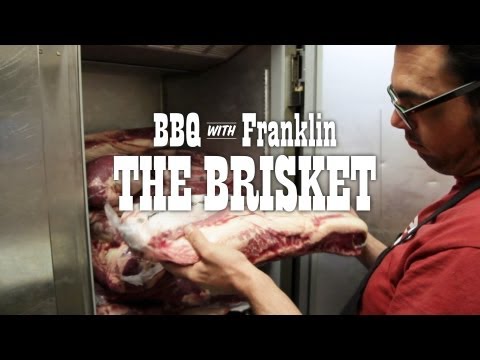 https://www.youtube.com/watch?v=VmTzdMHu5KU Then some good reading: http://amazingribs.com/recipes/beef/texas_brisket.html;
http://playingwithfireandsmoke.blogspot.com/1996/03/brisket.html
https://www.youtube.com/watch?v=VmTzdMHu5KU Then some good reading: http://amazingribs.com/recipes/beef/texas_brisket.html;
http://playingwithfireandsmoke.blogspot.com/1996/03/brisket.html
FWIW-Louisville; Rolling smoke in the neighbourhood. Life is too short for light/lite beer! Seems I'm livin in a transitional period. CHEETO (aka Agent Orange) makes Nixon look like a saint. -
+1 on what @lousubcap said and welcome aboard.
I am doing a brisket tomorrow night into Saturday morning for lunch the next day. I am shooting for 250 to 275 so it is done in the morning so I can then cook ribs. At 259 to 275 on my last cook my prime brisket cook was right at 1 pound an hour. Good luck on the next one. Don't give up.XL, WSM, Coleman Road Trip Gas GrillKansas City, Mo. -
The size of the lump was not the fire mistake, that wont matter in only 14 hours on an XL, you just needed more of it. I load it in up to the plate setter and I still have probably a third or more leftover after an 18 hour smoke.
-
all, thanks very much for your feedback and comments, will definitely give it another go taking these points into account.
in a quick glance on lousubcap's link it does seem my pull at internal of 197 was probably premature, i will be more patient next time! -
Fwiw, on these big BBQ cuts of meat, IT is only a point of reference. Each cut of meat is a little different. On one brisket, it will be ready at 197, on another maybe not until 203+. Start probing around 190 and give it the TLC it needs.slb78 said:in a quick glance on lousubcap's link it does seem my pull at internal of 197 was probably premature, i will be more patient next time!
XL & MM BGE, 36" Blackstone - Newport News, VA -
Lots of good advice so far. You have to remember every brisket is different so start probing at 193f until it probes like butter.
-
As above-the temperature of the thickest part of the flat (ignore the point as it has enough fat to never be in the equation) gives you an idea of when to start checking for doneness (if even a word). The only finish-line indicator worth paying any attention to is "how does it probe.." When you get the "no resistance/probes like buttah feel" you are there. And sometimes there are pockets of the flat that "won't release". Go with the thickest part and the great majority and "declare victory".
BTW- the more marbling the chances are that the release point will be lower, but not a given. Bottom-line " the cow always wins." Just manage the cow and you will be in for some great eats.
BTW- I find the cook much more fun than the eats.Louisville; Rolling smoke in the neighbourhood. Life is too short for light/lite beer! Seems I'm livin in a transitional period. CHEETO (aka Agent Orange) makes Nixon look like a saint. -
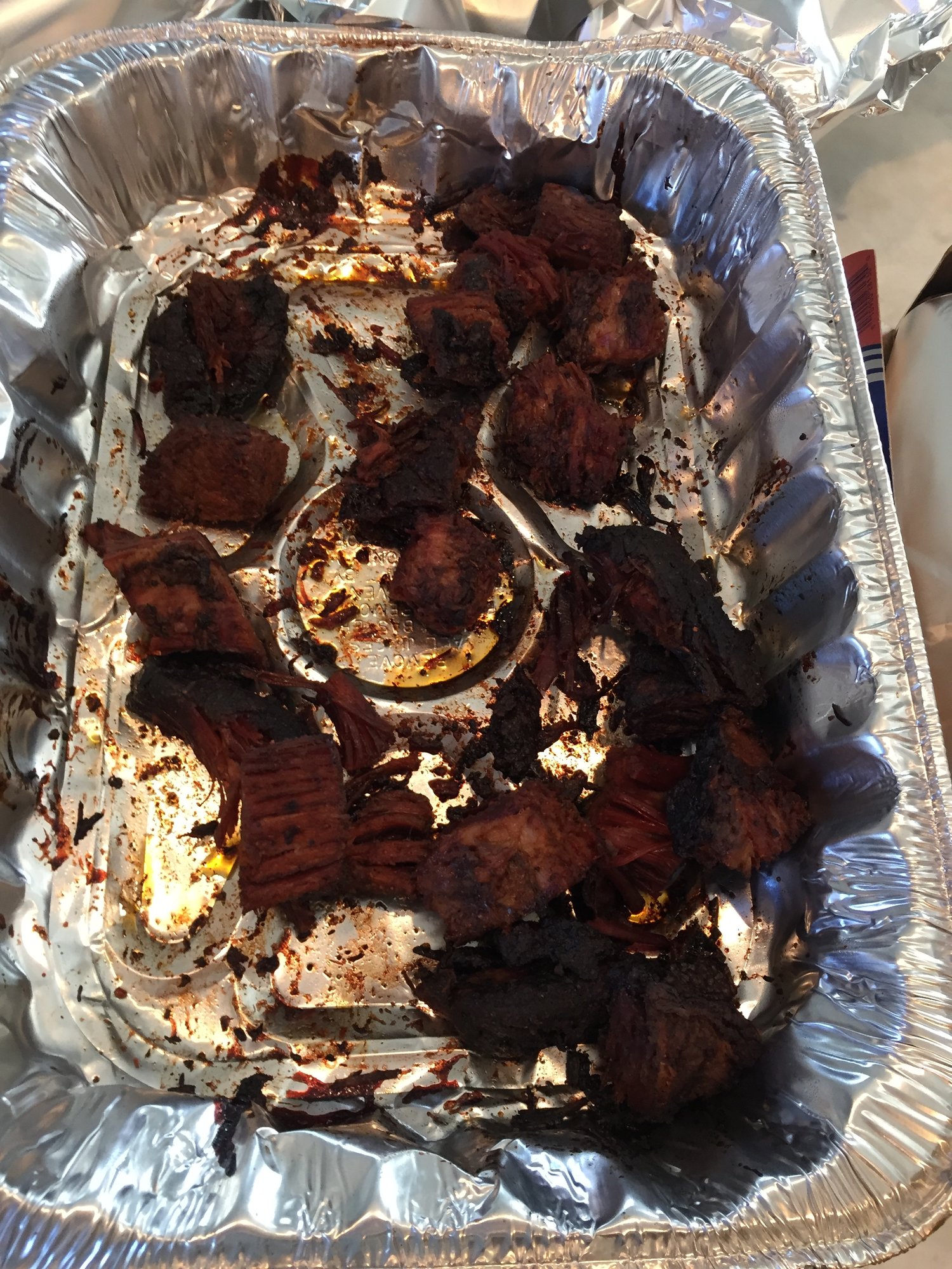
hi all, happy new year. it took awhile but finally took another stab at a brisket. made a few changes/tweaks based on all of your comments and some of the commentary in the links provided above. all in all pretty happy, i give the 2nd try a B+. the burnt ends were awesome and the flat was definitely moister and tasty. certain parts of it were moister than others so i guess it depends what piece you got served. i feel confident having a bigger crowd over and serving it now.
cook notes and changes from first:- skipped the sugar in the rub this time, just did a basic salt, pepper, paprika, gran garlic
- skipped water in the drip pan but feel like i need more lift in the tray off the platesetter, drippings were boiling at one point i think creating higher than set temp for about an hour up to 300 deg. this was hour 2 of the cook
- filled charcoal all the way up where it the platesetter barely fit. maybe the closeness of the fire early in the cook contributed to above issue. that said cook was from 530pm to 1045am. burnt ends went back on for 2 more hours and had plenty of coal so good to know
- read about scaling up the temps in one of those links, started first 2 hours at 200, scaled up to 235 before bed and raised to 265 when i woke up. i was open to trying this because i didn't want to finish too early, preferred to finish late if anything. next time might just set one temp now that i have a better feel, 250/265ish.
- otherwise things were the same as first try, fat cap trimmed to 1/4 inch and down entire cook. whole brisket, though a little bigger than first, 14 lbs, no wrap, oak chunks
- i did several probes, definitely got what it feels like to be like buttah. that said certain parts were, certain weren't. i ended up pulling at 203 degrees
thanks to everyone for their original comments, they all helped out making this a good 2nd try!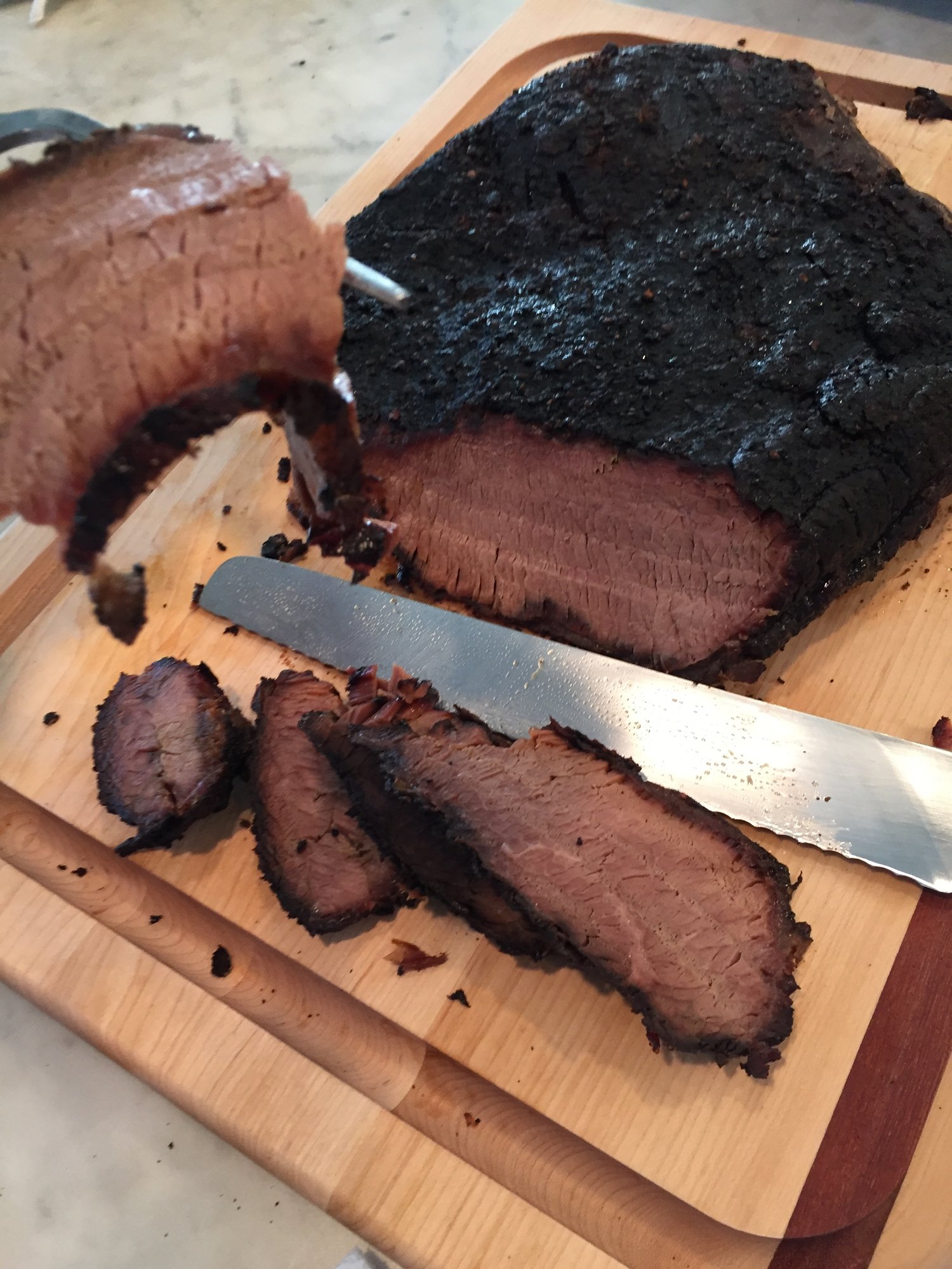

-
I generally don't comment on more mature threads but I'm glad I opened this one (brisket does that for me). Great adaptation and cook-congrats. Just need to put that hunk of beef into the rotation on a more frequent basis. Brisket cooks are the most fun you can have with the BGE. Well-done.Louisville; Rolling smoke in the neighbourhood. Life is too short for light/lite beer! Seems I'm livin in a transitional period. CHEETO (aka Agent Orange) makes Nixon look like a saint.


Categories
- All Categories
- 184K EggHead Forum
- 16.1K Forum List
- 461 EGGtoberfest
- 1.9K Forum Feedback
- 10.5K Off Topic
- 2.4K EGG Table Forum
- 1 Rules & Disclaimer
- 9.2K Cookbook
- 15 Valentines Day
- 118 Holiday Recipes
- 348 Appetizers
- 521 Baking
- 2.5K Beef
- 90 Desserts
- 167 Lamb
- 2.4K Pork
- 1.5K Poultry
- 33 Salads and Dressings
- 322 Sauces, Rubs, Marinades
- 548 Seafood
- 175 Sides
- 122 Soups, Stews, Chilis
- 40 Vegetarian
- 103 Vegetables
- 315 Health
- 293 Weight Loss Forum