Welcome to the EGGhead Forum - a great place to visit and packed with tips and EGGspert advice! You can also join the conversation and get more information and amazing kamado recipes by following Big Green Egg to Experience our World of Flavor™ at:
Want to see how the EGG is made? Click to Watch
Facebook | Twitter | Instagram | Pinterest | Youtube | Vimeo
Share your photos by tagging us and using the hashtag #BigGreenEgg.
Share your photos by tagging us and using the hashtag #BigGreenEgg.
Want to see how the EGG is made? Click to Watch
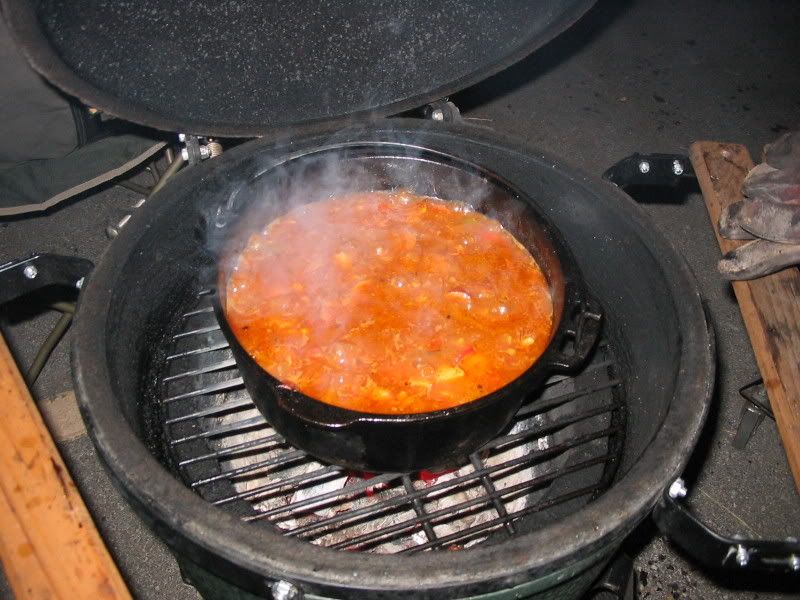
puzzled about simmering chili?? can't wait for the theories!

eggdog
Posts: 38
i'm a relative newbie and made my first chili last night on the egg. perfect night for it, as the temps in central louisiana were dropping into the thirties. it was superb. (and lawn ranger, before you ask, yes you add red kidney beans to chili and serve it over rice. what do texans know?) i have a large, and used a plate setter. the chili was in a lodge dutch oven, no top on. i use copper tees to keep the dutch oven from directly contacting the place setter. here's what puzzles me. the chili never really simmered or bubbled as it would on a stove. i know my thermometer is close enough to true cuz i have checked it against my maverick. i kept increasing the temp up to about 350 but it still wouldn't "bubble" as in a typical stove simmer. i knew it was done, took the dutch oven off the egg, and placed it on the stove. i turned on the gas to a very low temperature, and almost immediately it began to rolling boil. is there something about the egg that raises the boiling temp of liquid? i didn't notice any ufos in the area while i was cooking. best, john
Comments
-
eggdog,
I cook right over the coals with my dutch oven. 300 usually does it nice.[p]The egg might look a little like a UFO, but I kinda doubt it raises the boiling point of liquid! LOL.[p]Cheers
Chris
-
chris, does the chili bubble over the coals, as it does on a stove? john
-
eggdog,
The reason is basically that air can't hold very much heat. It takes a tremendous amount of heat to bring an iron pot full of liquid to the boiling point. A stove burner can generate a tremendous amount of heat and most of it gets conducted directly to the pot and its contents. Hot air, on the other hand contains comparatively little heat, so it takes a much much longer time to heat the pot and contents up to the boiling point of your chili.[p]TNW
The Naked Whiz -
eggdog,
Here is a theory for you to disregard... completely.[p]I am going with simple physics here. The bubbles that you see when boiling water are actually steam. Given that water switches to a gas from a fluid at 212F, and given that steam can be heated beyond 212F, the gas is trying to escape fluid. On a burner the main heat source is at the bottom of the heating vessel, the flame or heating coil is hotter than 212 and you are trying to heat a liquid inside the vessel. So I propose that two things are going on here. First, the vessel holding the liquid is transferring heat from the flame to the liquid inside. Second, the steam itself could be heated past 212 and is also transferring heat to the cooler liquid. All of this brings about the fact that the majority of the bubbles created are on the bottom of the pot (and some on the sides), you simply see the effects of the bubbles rising to the top.[p]Now to continue the theory, when you place a Dutch oven on a platesetter to make chili, or in my case Red Beans and Rice, you are heating the cooking vessel at the same rate that you are heating the liquid inside and from all directions, not just the bottom of the vessel. If you had no raised the Dutch oven off of the platesetter, I think that you would have seen bubbles. I use kiln post to do much the same thing and I rarely get bubbles. So here is the thing, you are cooking above 212F so you know that water is changing from a liquid to a gas because you can see that the amount of liquid in the pot has reduced. It is just happening from the top of the liquid and not near the bottom [p]Whoa … What just happened there? I blacked out for a minute.[p]Cook’s Illustrated actually talked about this some with its article on beef stew and how it should be baked and simmered on the top of the stove.[p]Waddayatink?
RhumAndJerk
-
RhumAndJerk, thanks. after eliminating ufos as the cause, i got to thinking and arrived at the same answer you just gave. as a history major at LSU i feel qualified to opine on thermodynamics. as you cook on a stove, the heat is at the bottom, causing the lower liquid to rise and "bubble". in my set up in the egg, within reason, the heat is the same everywhere. so no rising effect. it's boiling, you just don't notice it. i had plenty of heat, cuz when i would stir the chili and it hit the dutch oven above the liquid level, it would sizzle and evaporate. so now we know. i will sleep better tonight. peace and order, john.
-
eggdog,[p]I think TNW's comments are more accurate than my thoughts. Since I just finished proof reading my reply, I thought I'd post it ayway.[p]The plate setter prevents infrared radiation from the burning coals from directly hitting your Dutch oven. So, it will not get as hot as it would if it was. For example, put your hand in a 400 oven. You can keep it in there for quite a while. Since, like Whiz says, air does't hold heat very well. However, if you try to hold your hand in front of a radiant space heater, you will see you can’t keep it there for very long even if it’s on low.[p]So, if you want to see bubbling chili for sure, go direct with a raised grid like mentioned in another post here. The added radiation will get more heat transferred to your oven than convection currents of hot air alone will.[p]Just my 2 cents worth…
-
eggdog,
were you taking a dome reading, or a grid reading near the bottom of the pot. im betting its much cooler at the grid than the dome. 325-350 is a good place for a long slow simmer, 400 wiil get things really going. with all that cooler mass, look at the fire and you will see its pretty hot in there just to maintain the 350 dome temps
fukahwee maineyou can lead a fish to water but you can not make him drink it -
<p />eggdog,

Like a stove, but better with a little smoke. Just adjust your temp to acheive a rolling boil, or a bubblng simmer.
Happy cookin!
Chris
-
fishlessman, you are correct. it was a dome reading not a grid reading. and i did notice it was taking a healthy dose of burning lump to maintain the 350 range.
-
<p />eggdog,[p]The egg is very easy to adjust for stovetop temps... if it's too hot, simply close the bottom vent a bit. If it's not bubbling enough, open up a bit. Be patient though, the temp won't change immediately...but in a minute or two.[p]John
-
Nice Whiz. Makes absolute total sense.
Plus, a dutch oven is normally used over a fire or coals. That is what they are designed for. Dontchyaknow.[p]Friday beverages to you Mr. Whiz.
Chris





Categories
- All Categories
- 184K EggHead Forum
- 16.1K Forum List
- 461 EGGtoberfest
- 1.9K Forum Feedback
- 10.5K Off Topic
- 2.4K EGG Table Forum
- 1 Rules & Disclaimer
- 9.2K Cookbook
- 15 Valentines Day
- 118 Holiday Recipes
- 348 Appetizers
- 521 Baking
- 2.5K Beef
- 90 Desserts
- 167 Lamb
- 2.4K Pork
- 1.5K Poultry
- 33 Salads and Dressings
- 322 Sauces, Rubs, Marinades
- 548 Seafood
- 175 Sides
- 122 Soups, Stews, Chilis
- 40 Vegetarian
- 103 Vegetables
- 315 Health
- 293 Weight Loss Forum